Haunted Places on Oahu: 21 Haunted Spots and 8 to Leave Alone
A royal palace where a queen was held prisoner, a cliff where an army was driven over the edge, a freeway built through sacred valleys and four Waikiki hotels with ghosts of their own. These are Oahu’s ghost stories, checked, with the places you can actually visit.
Storytelling is part of daily life on Oahu, and many of its ghost stories are much older than the tourist trade. Honolulu’s are close together: Iolani Palace, Aliiolani Hale, the State Capitol and Kawaiahao Church are a short walk apart downtown, and Waikiki’s haunted hotels line the same beach. The Pali Lookout and the H-3 are a short drive over the mountains, Pearl Harbor is near the airport, and the North Shore has Waimea Valley and Puu o Mahuka Heiau. Several of these places are sacred to Native Hawaiians: we explain how to visit them respectfully, and we never send readers onto private land, military bases or highway shoulders.
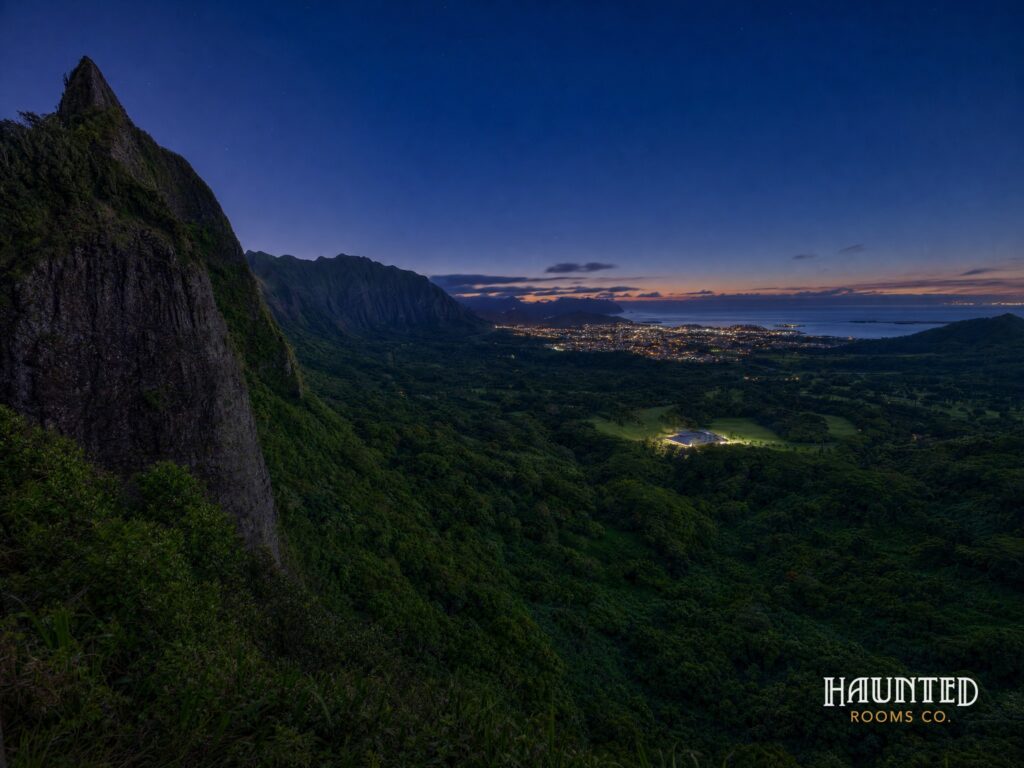
Address Nuuanu Pali State Wayside, Pali Highway, Honolulu, HI
Where to look The lookout wall at the cliff edge, the Old Pali Road below, and Nuuanu Pali Drive
Reported ghosts Warriors driven over the cliff in 1795; a voice that calls names; the pork legend of Pele and Kamapuaa
Visiting State wayside open daily 6am to 6pm; parking fee for non-residents
Hours and season 6am to 6pm daily
Tickets $7 parking per vehicle for non-residents; free for residents
Ghost hunting Local ghost tours visit the area; the wayside closes at 6pm, so do not stay after hours
In May 1795 Kamehameha’s army drove the forces of the Oahu chief Kalanikupule up Nuuanu Valley to these cliffs, where hundreds of warriors either jumped or were pushed over the edge of the pali, a drop of about 1,000 feet. When the Pali road was built in 1898, workers are said to have found some 800 skulls. Today the state wayside overlooks windward Oahu from about 1,200 feet, in winds strong enough to lean on.
Storytellers say the warriors are still heard at night, and Lopaka Kapanui tells of a girl who leapt from the lookout and a voice that calls a man’s name from below. The best-known legend is that you must never carry pork over the Pali: the windward side belongs to the pig god Kamapuaa, the leeward side to Pele, and cars carrying pork are said to stall until it is thrown out.
What investigators report
Local legend holds that a vehicle carrying pork over the Pali will stall until the pork is thrown out, and storyteller Lopaka Kapanui has described a tour bus sputtering in the tunnel until the last bit of roast pork was removed.
Haunted Rooms tip: Go in the late afternoon before the 6pm closing, hold onto your hat, and walk a short way down the Old Pali Road for the view back up at the cliffs.
Where to look The upstairs Imprisonment Room, the Blue Room, the palace gates and the banyan grove
Reported ghosts Queen Liliuokalani on the grounds at dawn; royal guards; a piano that plays itself
Visiting Museum open for guided and self-led audio tours; the grounds are open to walk
Tours Docent-led and self-led audio tours of both floors; reservations highly recommended
Hours and season Tours Tuesday to Saturday; ticket office 8:30am to 4pm
Ghost hunting Ghost walks run by local storytellers pass the palace at night; the palace itself does not host ghost hunts
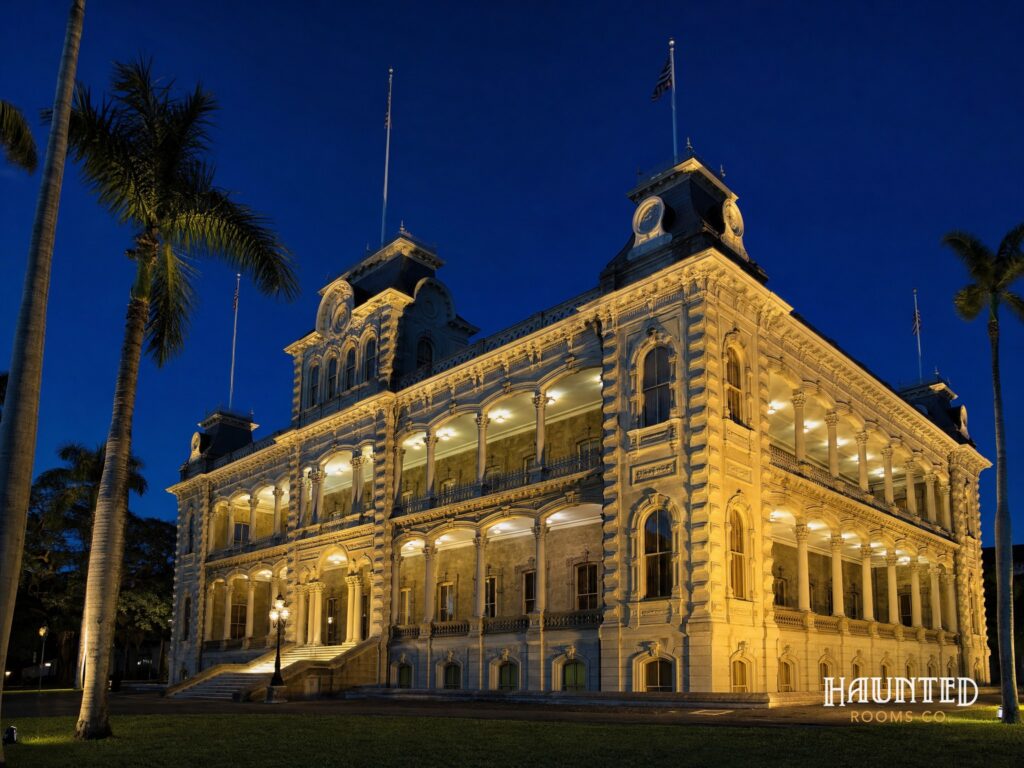
King Kalakaua laid the cornerstone of Iolani Palace on December 31, 1879, and the palace was finished in 1882, the official residence of Hawaii’s last two monarchs. After the overthrow of 1893 it became the seat of government, and in 1895 Queen Liliuokalani was held prisoner in an upstairs room for months. It served as the capitol until 1969 and opened as a museum in 1978.
Palace security guards have told storyteller Lopaka Kapanui they see the queen’s figure on the grounds around 5:30 in the morning and hear the piano in the Blue Room. Older stories, collected by the late historian Glen Grant, tell of royal guards still rattling their keys and a gate on the King Street side that swung open by itself. Palace staff have never confirmed the stories, and one historian has called them hearsay.
Haunted Rooms tip: Book the docent-led tour, then walk around to the King Street gate and the fenced Pohukaina burial mound, which is kapu: look from outside the fence.
Where to look The graveyard behind the church, Likelike Hall and the preschool grounds
Reported ghosts A weeping woman in white; Hawaiian voices; night marchers
Visiting Active church; grounds and graveyard can be visited respectfully by day
Tours Self-guided historic walking tour
Ghost hunting An active church and burial ground: no ghost hunting
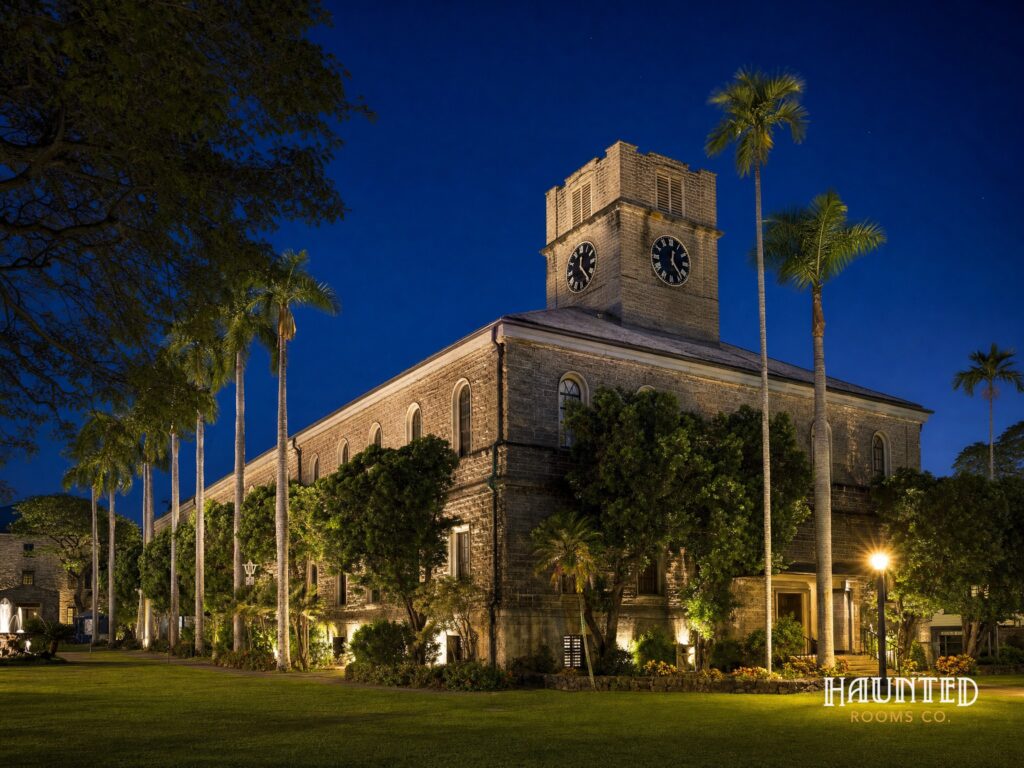
Kawaiahao Church was built between 1836 and 1842 from about 14,000 coral slabs cut from the reef, to a design by the missionary Hiram Bingham. King Lunalilo is buried in a tomb in the churchyard, and the graveyard behind the church is one of the oldest Western-style burial grounds in the islands. It is a National Historic Landmark.
Storyteller Lopaka Kapanui, who once taught at a preschool on the church grounds, writes of a pale woman in white seen weeping on a tomb outside the kitchen door of Likelike Hall, and of Hawaiian voices heard in the classrooms at night. Retired police major Gary Dias described similar calls in the 1970s and 1980s, and older ghost walks said night marchers pass through the graveyard.
What investigators report
A security firm reportedly recorded furniture moving and voices speaking Hawaiian on the church grounds at night, and voices and music have been reported inside the empty church late at night.
Address 1 Arizona Memorial Place, Honolulu, HI 96818
Where to look The memorial over the sunken battleship, and the oil that still rises from the wreck
Reported ghosts A sailor seen on the wreck at low tide; footsteps and voices; a face some saw in the oil
Visiting National memorial; visitor center open daily, memorial by timed program
Tours USS Arizona Memorial program by boat, first at 8am and last at 3:30pm
Hours and season Visitor center 7am to 5pm daily, closed Thanksgiving, Christmas and New Year’s Day
Tickets Free; $1 Recreation.gov reservation fee for the memorial program
Ghost hunting A war grave and memorial: no ghost hunting
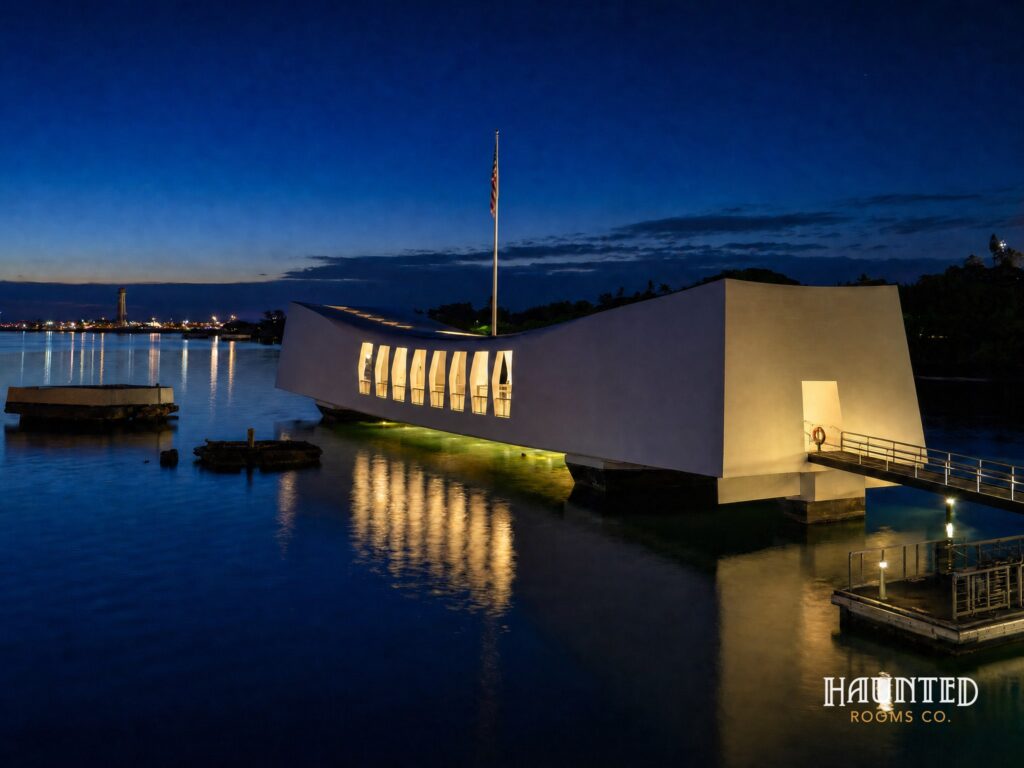
On December 7, 1941, 1,177 sailors and Marines were killed aboard the USS Arizona, and the remains of 1,102 of them still lie inside the sunken battleship. The white memorial that spans the wreck was dedicated in 1962, and oil still seeps to the surface, drops some call the ship’s black tears. The visitor center, museums and memorial program are run by the National Park Service.
This is a war grave, and its stories are told quietly. Visitors and staff describe footsteps and hushed voices when nobody is near, and a legend says a sailor who left his post walks the wreck at low tide. In 2011 an Australian family said they saw a sad young face in the oil above the ship. None of this is recorded, and the park presents only the history.
Haunted Rooms tip: Reserve the free USS Arizona Memorial program online (a $1 booking fee applies) and leave bags at home: none are allowed inside.
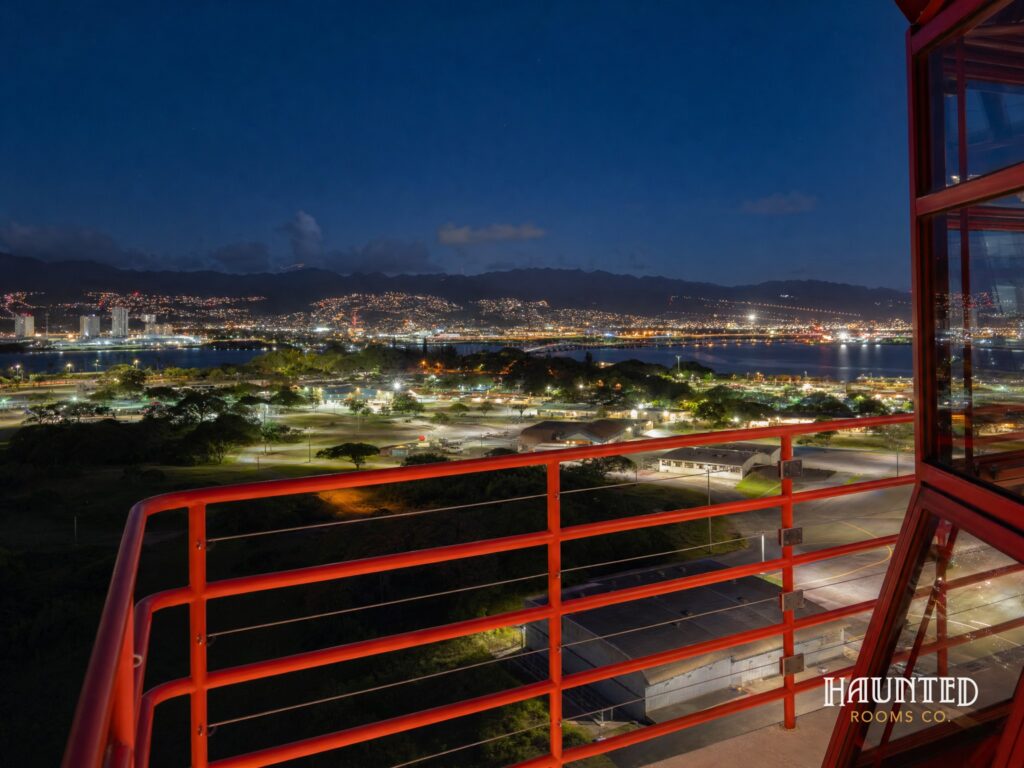
Where to look Hangar 79 and its bullet scars, Hangar 37 and the old control tower
Reported ghosts Voices, footsteps and music after closing; a mannequin that seems to move
Visiting Museum on an active base, reached by shuttle bus from the Pearl Harbor visitor center
Tours Self-guided, with guided hangar tours
The museum, formerly the Pacific Aviation Museum, fills Hangars 37 and 79 on Ford Island, which stood on the morning of the attack. The hangars still carry bullet scars from December 7, 1941, and the museum is restoring the 158-foot Ford Island control tower, where the first radio alert of the attack was sent. Non-military visitors buy tickets at the Pearl Harbor visitor center and ride a bus onto Ford Island.
Staff have described men’s voices, footsteps and music at night, and a mannequin whose arm is found in a different position in the morning. In 2011 the TV show Ghost Hunters investigated both hangars, reporting footsteps and banging upstairs in Hangar 79, though the team also suggested tremors and fluorescent lights as explanations.
What investigators report
On Ghost Hunters, investigators ran a flashlight session in Hangar 37 and reported the flashlight switching on and off before rolling across a bench. In Hangar 79 they reported footsteps, banging and running sounds from the second floor.
Where to look The 1901 Banyan Wing and its corridors
Reported ghosts Jane Stanford in Victorian dress; a tall man in a feathered cape
Visiting A working hotel; the lobby, verandas and banyan courtyard bar are open to visitors
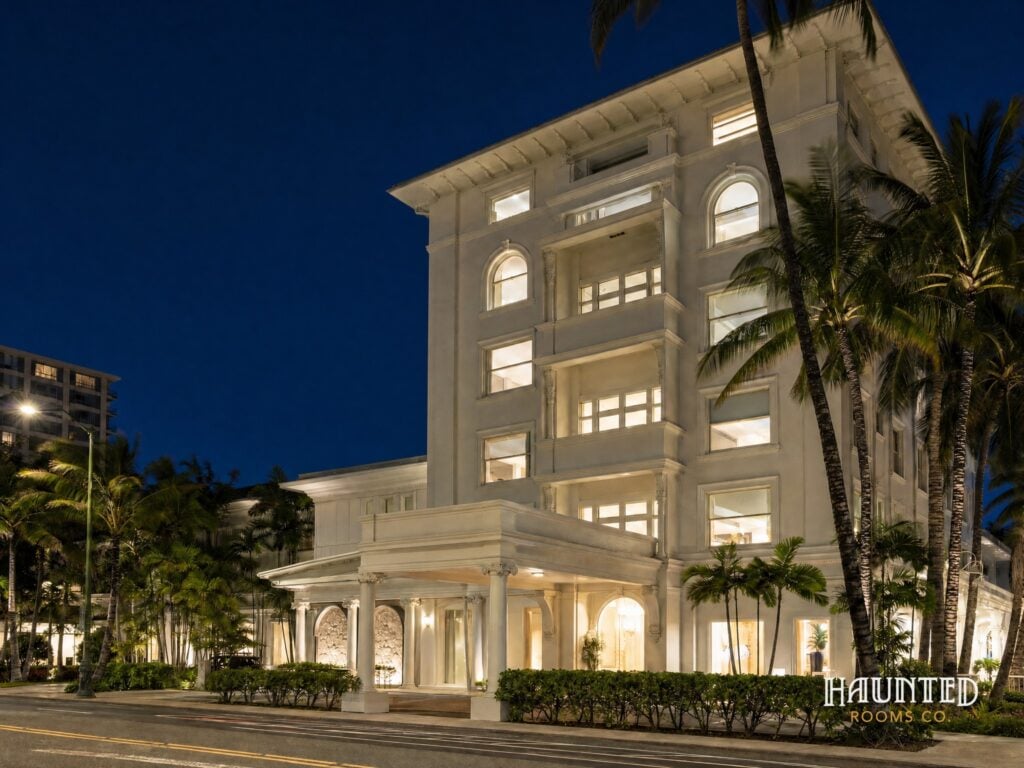
The Moana opened on March 11, 1901, as the first hotel in Waikiki, a white Colonial-style building by architect Oliver G. Traphagen with deep verandas facing the surf. Its courtyard banyan, planted in 1904, now spreads about 150 feet across, and the original wing is on the National Register of Historic Places.
In February 1905 Jane Stanford, co-founder of Stanford University, died of strychnine poisoning in a room at the Moana; the source of the poison was never found. Honolulu storytellers say guests and staff have seen a woman in Victorian dress they believe is Stanford, and a tall man in a feathered cape linked to a temple that once stood near the site.
Haunted Rooms tip: Have a drink under the banyan at sunset, then walk the historic lobby.
Where to look Guest towers and hallways, the beachfront and the lagoon
Reported ghosts A glowing woman in a red muumuu, often linked to the goddess Pele
Visiting A working resort; the shops, restaurants, lagoon and beach are open to visitors
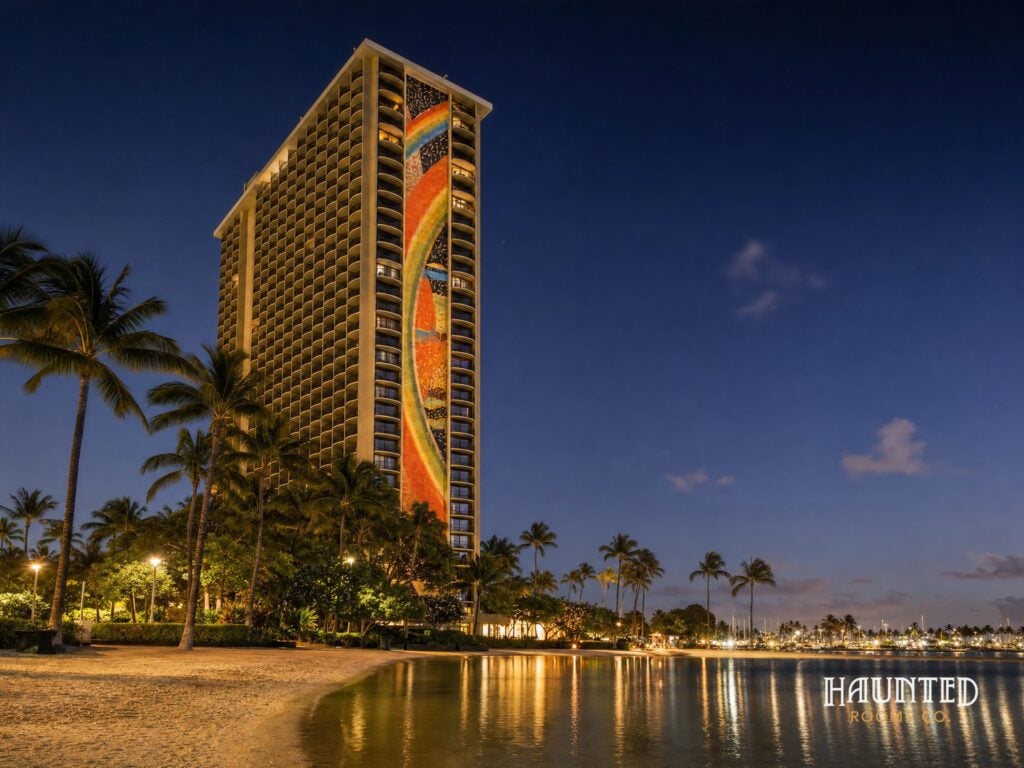
Hilton Hawaiian Village began in 1955 as Henry J. Kaiser’s Hawaiian Village Hotel, 70 thatched-roof rooms on the old Kalia estate at the western end of Waikiki. Hilton bought into it in 1961, the year Elvis stayed while filming Blue Hawaii, and it has grown into a 22-acre resort of more than 3,300 rooms with the famous rainbow mosaic on the Rainbow Tower.
Its ghost story was in the newspaper as early as 1959, when a housekeeper described a tall, glowing woman with long reddish-black hair in a red muumuu who vanished as she was led to a room. Many believe she was Pele, the volcano goddess, who is said to appear as a beautiful woman in red. Guests and staff still describe a barefoot woman in red in the towers and on the beach.
Haunted Rooms tip: Walk the beach by the lagoon after the Friday fireworks, when the crowds thin out.
Where to look The restored 1913 courtroom, the foyer and the banyan trees outside
Reported ghosts Crowd voices in empty offices; a figure in the banyans
Visiting Working courthouse; the Judiciary History Center is open to visitors
Hours and season Judiciary History Center Monday to Friday, 8am to 4pm
Tickets Free
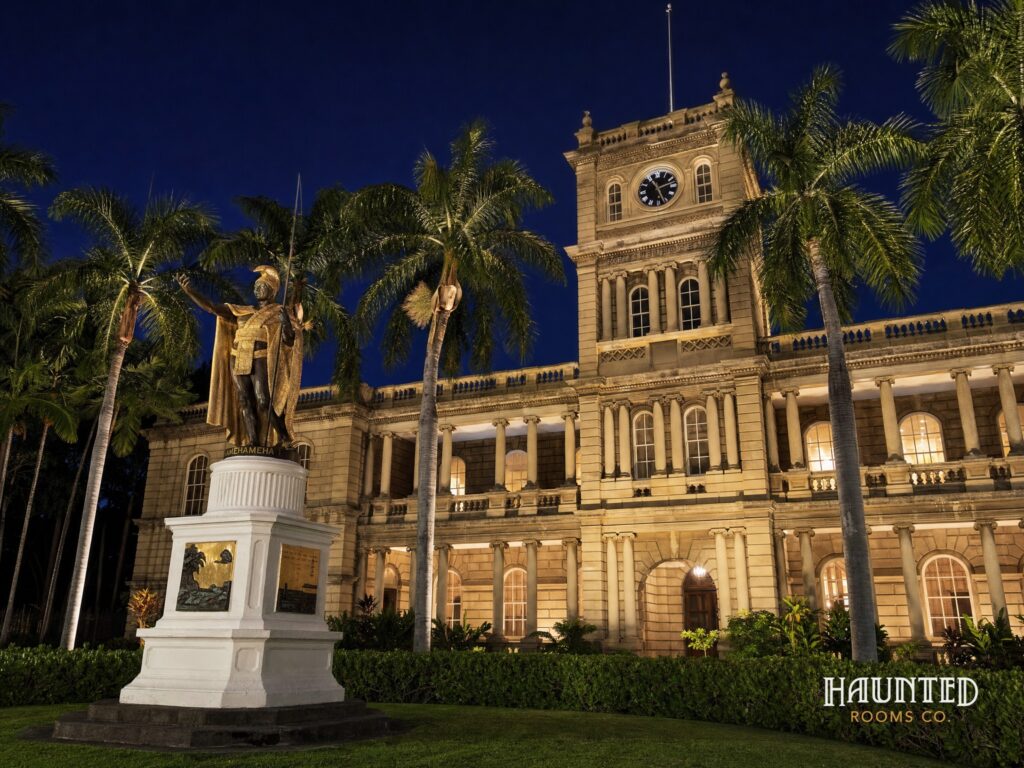
King Kamehameha V began Aliiolani Hale in 1872, and it was finished in 1874 to house the legislature, the courts and the kingdom’s first national museum. King Kalakaua named it the house of heavenly kings. It saw the overthrow of 1893 and the Massie trials of the 1930s, and today it is home to the Hawaii Supreme Court and the free Judiciary History Center, with the gold-leaf statue of Kamehameha the Great out front.
Storytellers Lopaka and Tanya Kapanui describe a phone call from inside the building that picked up a crowd talking over one another while the offices were empty, and a recording in the foyer that they say captured a man’s voice. In the banyans beside the building, planted in the 1880s, a sheriff told them he felt hands at his belt and saw a thin black figure in the branches.
What investigators report
During a group session in the courtroom museum and foyer, participants recorded audio while questions were asked aloud, and one woman said the playback captured a male voice saying the nickname her late father used for her.
Address Interstate H-3 (John A. Burns Freeway), Halawa Valley to Kaneohe, Oahu
Where to look The Tetsuo Harano Tunnels through the Koolau Range and the North Halawa Valley viaducts
Reported ghosts Warrior spirits said to have frightened workers; a curse laid over destroyed heiau
Visiting A working interstate; see it only by driving through. No stopping, walking or parking
Ghost hunting No ghost hunting: it is an active freeway, and the valley sites below are cared for by Hawaiian groups
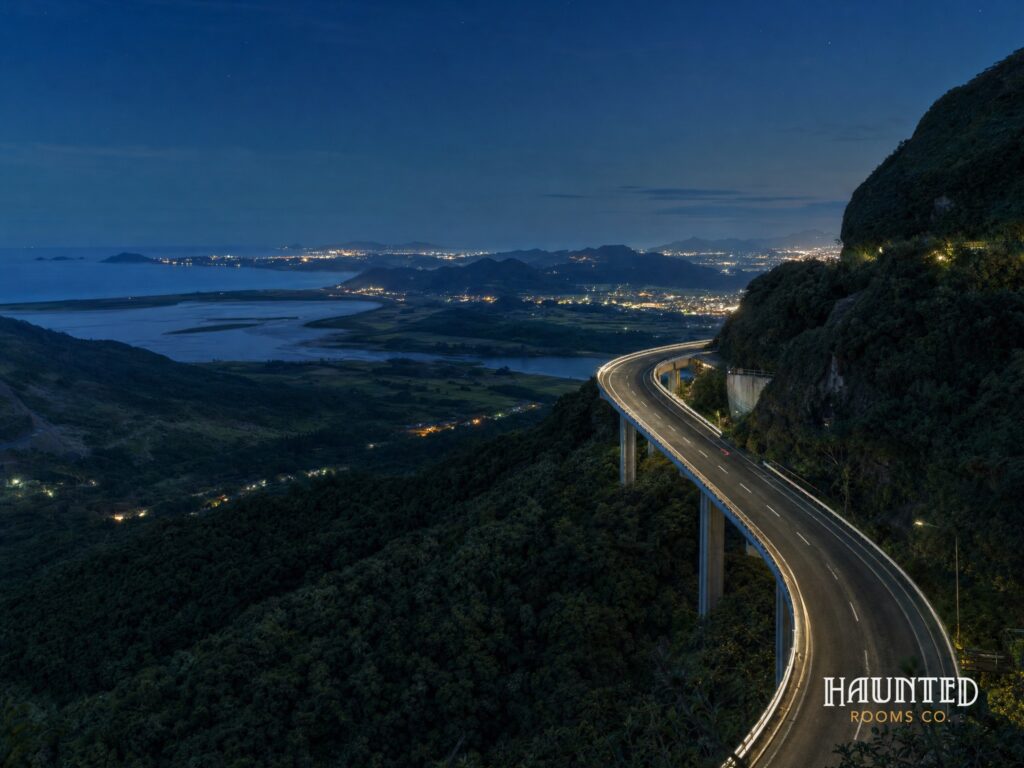
Our older guide called this road Highway 1, but the story it told belongs to Interstate H-3, the freeway that tunnels through the Koolau Mountains between Halawa and Kaneohe. Planned from 1960, it was held up for decades by lawsuits and protests over sacred sites, including a women’s heiau, Hale o Papa, in North Halawa Valley. It finally opened on December 12, 1997, at a cost of about $1.3 billion.
In 1996 a University of Hawaii professor of Hawaiian studies said she had placed a curse on the project after construction violated a heiau, and workers died in accidents during the build. Ghost sites add warriors’ voices in the tunnels and crews who quit after seeing spirits; those details have no record behind them. The freeway is a working road: there is nowhere to stop.
Haunted Rooms tip: Drive it in daylight toward Kaneohe for the view as you leave the tunnels, and never stop on the shoulder.
Where to look A third-floor guest room and the old coconut grove grounds
Reported ghosts A tall shadow by the bed; a cold spot; a phantom rooster in old legend
Visiting A working hotel; the lobby, gardens, beach bar and restaurants are open to visitors
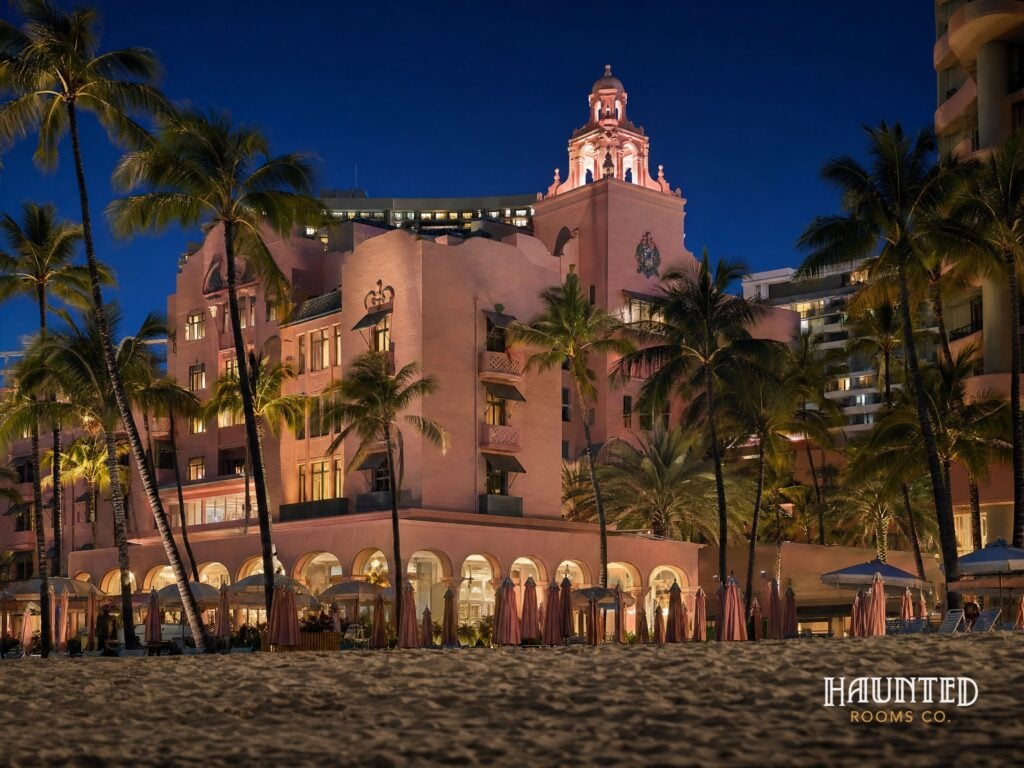
The Pink Palace of the Pacific opened on February 1, 1927. Built by the Matson Line and designed by New York architects Warren and Wetmore, it was taken over by the US military as a rest center during World War II and is now part of Marriott’s Luxury Collection.
Honolulu storytellers say guests in one third-floor room find themselves locked out until maintenance opens the door, and describe a cold spot and a tall shadow standing beside the bed. An older legend tells of a supernatural rooster that led people to the coconut grove where workers later dug up human bones.
Haunted Rooms tip: Even if you do not stay, have a mai tai at the beach bar and walk the historic wing’s arcades.
Reported ghosts A worker said to have died after sacred heiau stones were used in an exhibit; Princess Pauahi
Visiting Museum open daily
Hours and season 9am to 5pm daily; closed Thanksgiving, Christmas Eve, Christmas Day and New Year’s
Tickets Admission charged; see the museum’s tickets page
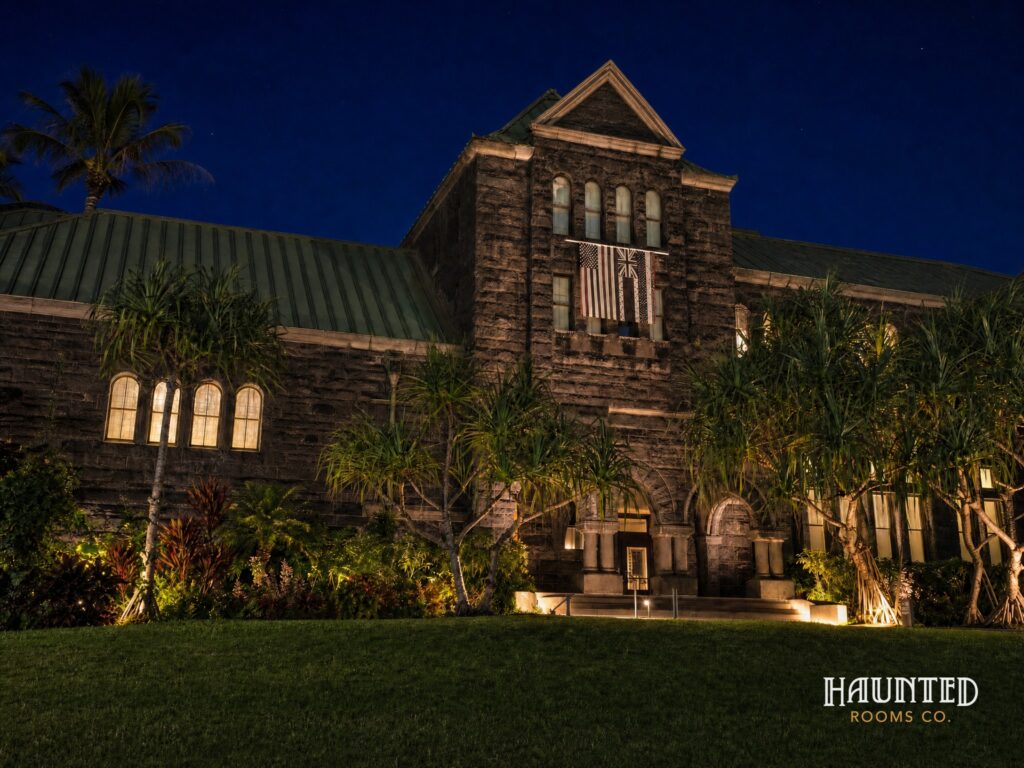
Charles Reed Bishop founded the museum in 1889 in memory of his wife, Princess Bernice Pauahi Bishop, and it opened to the public in 1891. Hawaiian Hall and Polynesian Hall, built of dark lava stone in 1898, are on the National Register, and the museum holds the world’s largest collection of Polynesian cultural artifacts.
Its best-known story is a cautionary tale: an exhibit designer is said to have taken lava stones from a real heiau, and the next day a worker fell through the roof onto them and died after his mother dreamed of blood. We found no record of any such death, and the story reads as a warning about respecting sacred stones. Some also tell of Princess Pauahi seen near opening and closing times.
Haunted Rooms tip: Give Hawaiian Hall at least an hour; its three floors move from the gods to the land to the people.
Address 415 South Beretania Street, Honolulu, HI 96813
Where to look The courtyard and pond, the chamber-level restrooms and the statue of Queen Liliuokalani
Reported ghosts Governor John Burns and his cigar smoke; the queen, said to walk near her statue
Visiting Public building; the courtyard and grounds are open to walk
Ghost hunting Downtown ghost walks pass the capitol and statue at night
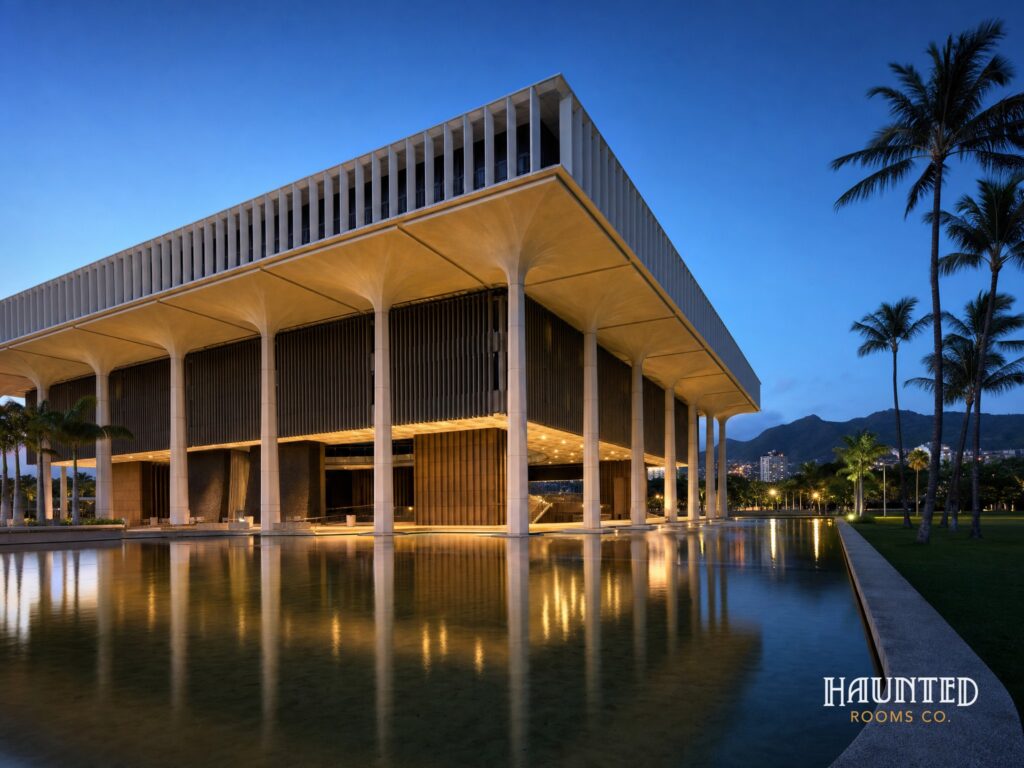
Hawaii’s open-air capitol was completed in 1969, with a reflecting pool for the Pacific, cone-shaped chambers for the volcanoes and an open courtyard to the sky. It stands where the royal guard’s barracks once stood; the coral-block barracks was taken apart, numbered and rebuilt on the palace grounds. Between the capitol and Iolani Palace stands the bronze statue of Queen Liliuokalani, installed in 1982.
Staff still smell cigar smoke in a building that has been smoke-free since 2006, and many blame Governor John Burns, who smoked cigars in his fifth-floor office. Storyteller Lopaka Kapanui tells of a former senator’s young daughter who played with a kind Hawaiian woman in the empty building at night, then pointed to the queen’s statue and said that was the lady.
What investigators report
Ghost tour guides have told groups that people sometimes smell cigar smoke on the Capitol steps facing the Queen Liliuokalani statue when no one is smoking, a smell linked to Governor John Burns.
Where to look The ravine section of the gulch and its bridges
Reported ghosts The Green Lady, a scaly figure draped in seaweed said to search for a lost child
Visiting City botanical garden, free entry
Hours and season 9am to 4pm daily, closed Christmas and New Year’s Day
Tickets Free
Sugar planters started this 27-acre garden in the 1930s as an experimental arboretum on Oahu’s central plateau, testing trees to reforest the watersheds. The city took it over in 1950 and opened it to the public in 1957. Its paths drop into a cool rainforest gulch full of giant trees, palms and ferns, and admission is free.
It is also home ground for the Green Lady, the most famous urban legend in central Oahu. Children near Wahiawa Elementary described her in 1957: a foul-smelling figure draped in seaweed, some say with green scales and jagged teeth, searching the gulch for a child who drowned. Folklorists note she worked as a warning to keep children out of the dangerous ravine.
Haunted Rooms tip: Go on a weekday morning, stay on the paths in the gulch, and leave before the 4pm closing.
Address 59-864 Kamehameha Highway, Haleiwa, HI 96712
Where to look The pool below Waimea Falls and the valley's heiau
Reported ghosts A drowning spirit said to claim swimmers; a moo (lizard spirit) in the deep pool; night marchers
Visiting Paid admission to the valley, gardens and falls
Hours and season Tuesday to Sunday 9am to 4pm (daily in summer); closed Thanksgiving and Christmas
Tickets Adults $26; kamaaina $10
Waimea Valley on the North Shore was once a thriving village with heiau and burial sites, home to generations of kahuna. Today it is a botanical garden and cultural site run by the nonprofit Hiipaka, and a paved path leads up the valley to Waimea Falls, where you can swim with lifeguards on duty. Divers died here for decades after striking hidden rocks, and cliff diving is no longer allowed.
Older ghost guides say a spirit in the pool claims a swimmer every so often and that the bodies surface days later; that story is folklore, though a fire captain once told the Star-Bulletin the current can hold a body underwater. Storyteller Lopaka Kapanui led evening ghost walks here from 2009, telling of a moo lizard spirit in the 30-foot-deep pool and spirit children in the trees.
Haunted Rooms tip: Swim only when the lifeguards say it is safe, and treat the heiau along the path as sacred: look, do not climb.
Address Kamehameha Highway bridge over Kipapa Gulch, Mililani, HI
Where to look The highway bridge over the gulch
Reported ghosts Night marchers' torches coming down the ridge; voices and crying below the bridge
Visiting A highway bridge; see it only by driving across. Do not stop or walk on the bridge
Ghost hunting No ghost hunting: a busy highway with no shoulder
Tradition says invaders from Hawaii and Maui were defeated here by the Oahu chief Mailikukahi, and that the ground was so covered with their bodies it was called kipapa, placed prone. A World War II airfield once stood at the edge of the gulch, and today Kamehameha Highway crosses it on a bridge near Mililani.
Residents and workers have long reported torchlights moving down the mountainside into the gulch, the path of the night marchers, and crying from under the bridge. Storyteller Lopaka Kapanui told KHON2 that cars stall on the bridge and people changing tires hear their names called from below. Legend says you must never meet a night marcher’s eyes.
Haunted Rooms tip: Drive across in daylight and keep going: there is no safe place to stop on the bridge.
Where to look The Leahi ridge above Kapiolani Park and the slopes where Papaenaena Heiau stood
Reported ghosts Night marchers' torches on the ridge; Pele as an old woman on Diamond Head Road
Visiting State monument; reservations required for non-residents
Hours and season 6am to 6pm daily (last entry 4:30pm); closed Christmas and New Year’s
Tickets Entry and parking fees for non-residents, card only
Leahi, the brow of the tuna, is the tuff cone that rises behind Waikiki, formed in a single eruption about 300,000 years ago. Its summit trail was built in 1908 for the island’s coastal defenses. On the slopes facing Waikiki stood Papaenaena Heiau, a temple to the war god where human sacrifices were made; it was destroyed after the old religion fell in 1819.
Storytellers say night marchers come down the ridge toward the old heiau site. A 1937 book tells of a man who once interpreted for King Kalakaua hiding behind a boulder as a ghostly procession passed with drums, and in 2019 the Kapanuis’ tour group saw a line of torchlike lights descending the ridge near La Pietra. Drivers on Diamond Head Road have also told the Kapanuis of an old woman in white with a walking stick who vanished from a wall, and many locals say that was Pele.
What investigators report
One ghost tour group gathered near the Kapiolani Park bandstand reported seeing a line of torch lights descending the Diamond Head ridge at night, which they took to be night marchers.
Address Pupukea, on the bluff above Waimea Bay, Haleiwa
Where to look View the walls from the path outside; do not enter
Reported ghosts Night marchers; visitors who lost time at dusk
Visiting State historic site; view from outside the walls only
Hours and season 9am to 5:30pm daily
Tickets Free
Ghost hunting A sacred site: no ghost hunting, rituals or offerings by visitors
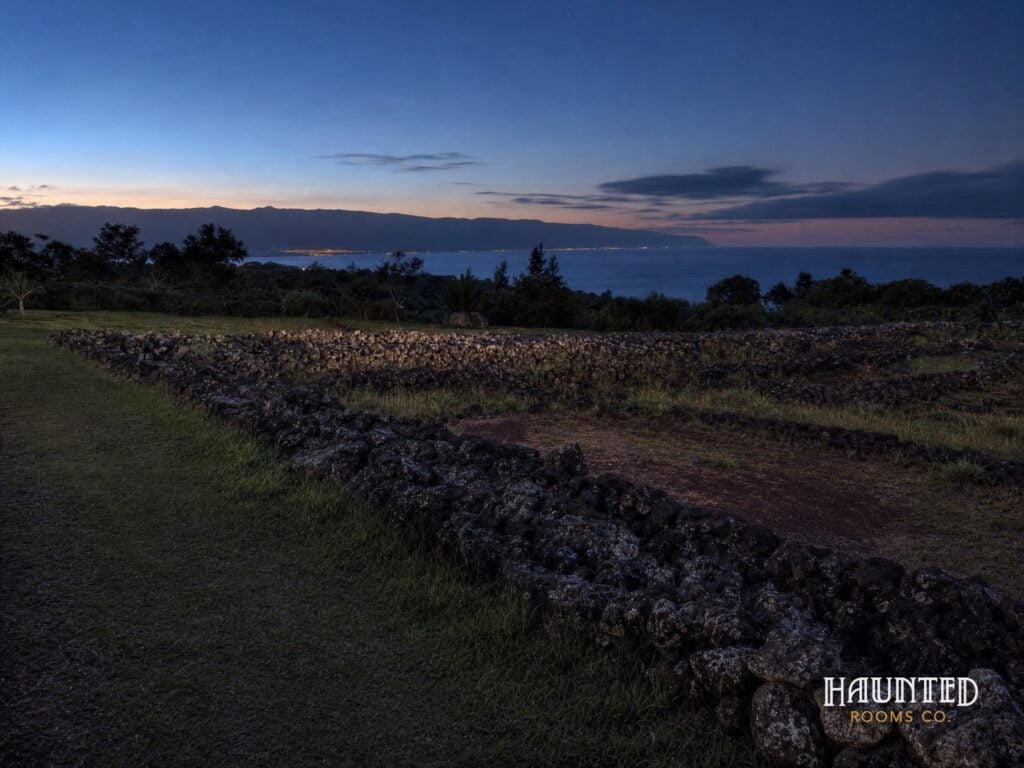
Puu o Mahuka, on the bluff above Waimea Bay, is the largest heiau on Oahu, nearly two acres of stone-walled enclosures probably begun in the 1600s. It was likely used as a luakini, a sacrificial temple, in the 1770s, and Kamehameha’s high priest Hewahewa held ceremonies here in 1795. It is a National Historic Landmark and a place of worship that is still respected today.
Oral accounts say three men from the British ship Daedalus were sacrificed here in 1792. Visitors told storytellers Lopaka and Tanya Kapanui of a car radio switching itself on in the parking area and of a man who lost two hours at dusk on the path. Some say the night marchers pass this way. Whatever you believe, the state asks visitors to stay outside the walls.
Haunted Rooms tip: Visit quietly in daylight, stay on the path outside the walls, and never move, stack or take stones or leave things on the heiau.
Address Joint Base Pearl Harbor-Hickam, Honolulu, HI 96853
Where to look The bullet-scarred Pacific Air Forces headquarters, once the 'Big Barracks'
Reported ghosts Slamming doors and voices in the old barracks; airmen killed on December 7, 1941
Visiting Active military installation; no public access without base authorization
Ghost hunting Not open to the public; do not attempt to enter
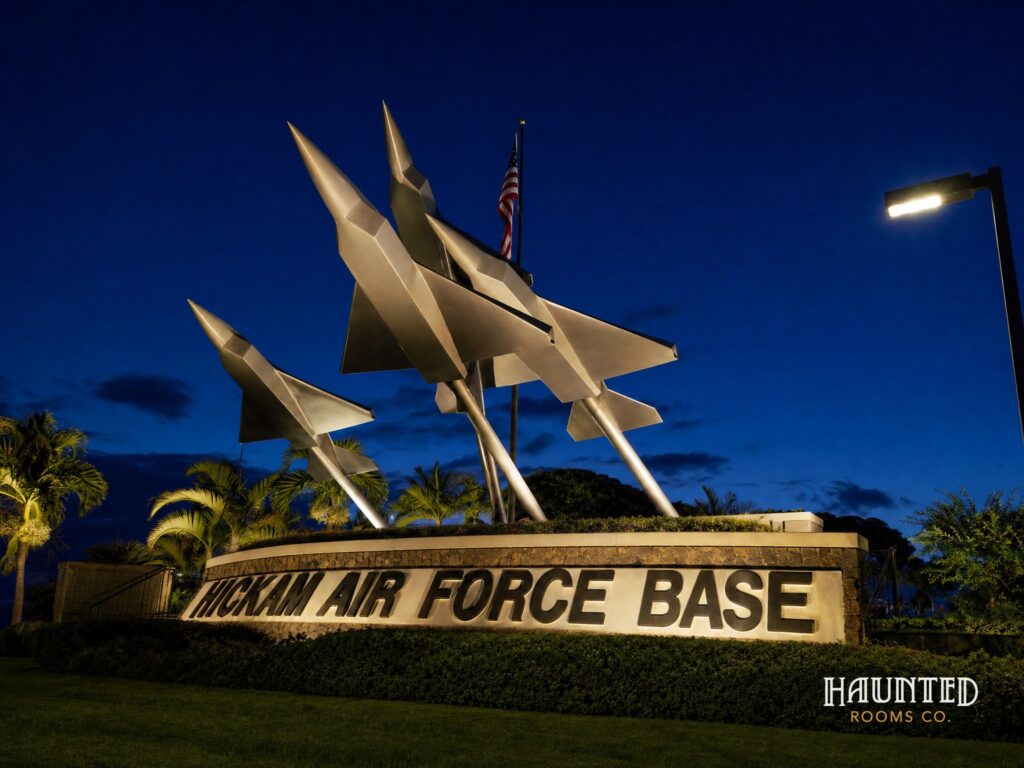
Hickam Field was dedicated in 1935 and activated on September 15, 1938, named for aviation pioneer Lt. Col. Horace Hickam. On December 7, 1941, Japanese aircraft bombed and strafed it with Pearl Harbor: 189 people were killed and 303 wounded. A bomb hit the mess hall of the huge consolidated barracks at breakfast time. That building is now Pacific Air Forces headquarters, and its bullet holes were deliberately left in the walls.
Staff working late in the old barracks have told of doors slamming, voices calling out and other mischief, and some believe the men who died there remain. Older ghost lists add a prankster called Charley and a haunted guard shack; other sources place Charley on Ford Island, and we found no record for the guard shack. Hickam has been closed to tourists since 2001.
Haunted Rooms tip: You cannot visit the base, but the Pearl Harbor Aviation Museum on Ford Island tells the story of the attack on the airfields.
Where to look Terminal windows facing the runways, restrooms and the Wiki Wiki shuttle
Reported ghosts The Lady in Waiting, a blonde woman in white; a choking ghost
Visiting Public airport; most areas past security are for ticketed passengers only
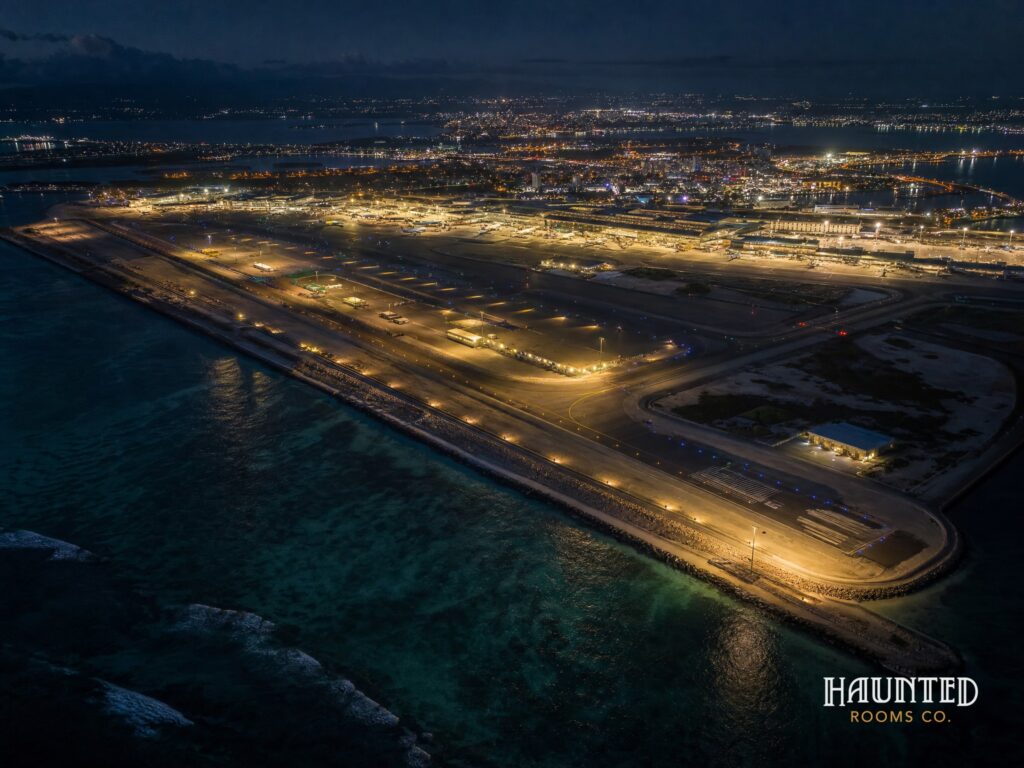
Honolulu’s airport opened on March 21, 1927, as John Rodgers Airport and was renamed for Senator Daniel K. Inouye in 2017. It shares its runways with Hickam Field next door, and the free Wiki Wiki shuttle links its terminals.
Its ghost is the Lady in Waiting, a blonde woman in a long white dress who stands at the terminal windows looking out at the runway and vanishes when approached. The story says she waits for a fiance who flew away and never came back. A retired police officer who answered calls in the early 1990s told Honolulu Magazine people only ever saw her from behind. Staff also speak of a choking ghost that presses on the chest.
Haunted Rooms tip: If you have time before a flight, look for the Hawaiian and Japanese cultural gardens in Terminal 2.
Address University of Hawaii at Manoa campus, Honolulu
Where to look The first floor of the mauka (mountain-side) wing, the aisles and restrooms
Reported ghosts A young woman in a pink muumuu
Visiting University library open to the public during posted hours
Hamilton Library is the main research library of the University of Hawaii at Manoa, in the green valley behind Waikiki, and it is open to the public.
Custodians and students working late have long told of strange noises, footsteps and figures in the aisles and restrooms. The most repeated sighting comes from a janitor who saw a young woman in a pink muumuu walking the first floor of the mauka wing. Nobody knows who she is, and she seems harmless.
Haunted Rooms tip: Check the library’s public hours before you go, and keep it quiet: people are studying.
Where to look The basement corridors and lower floors
Reported ghosts An elderly man in a hospital gown; whispers and moving lights
Visiting A working hotel; the lobby and restaurants are open to visitors
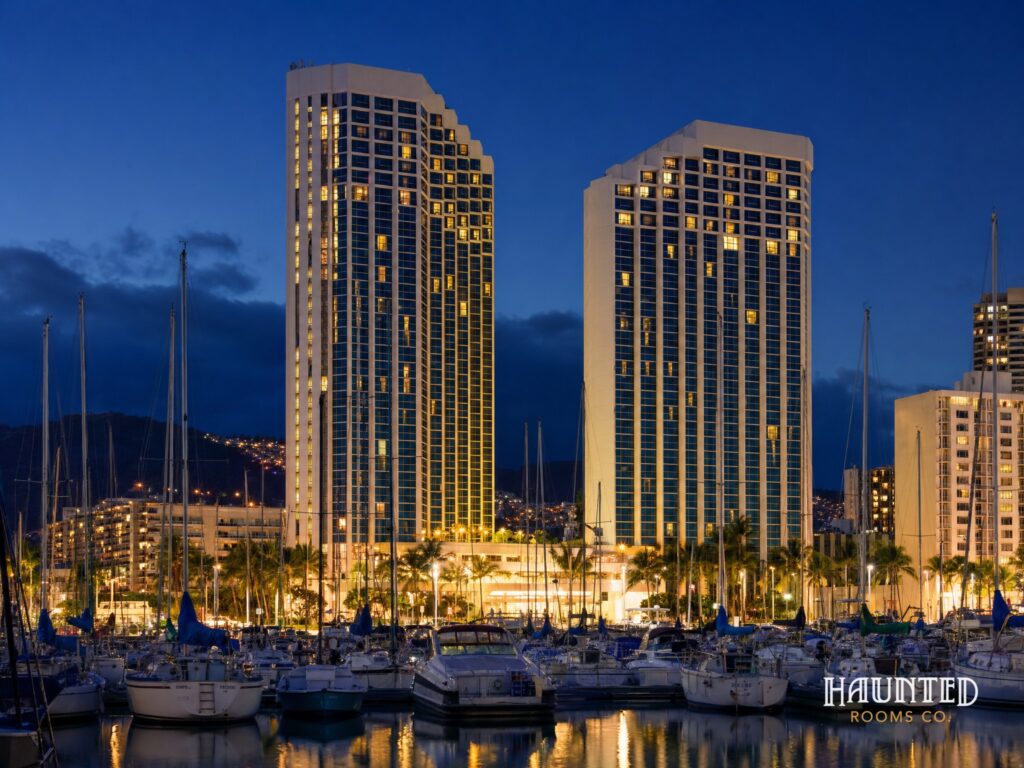
The twin towers of the Prince Waikiki rise over the Ala Wai Yacht Harbor at the western edge of Waikiki. The hotel opened in 1990 as the Hawaii Prince Hotel Waikiki and was renamed after a renovation in 2016. It stands on the site of Kaiser Hospital, which treated patients here from 1958 until the building was imploded in 1986.
Its stories come from that past. Storyteller Lopaka Kapanui says he saw an old barefoot man in a hospital gown walking a basement corridor in 1994, and guests describe whispers, odd lights and luggage that seems to move.
Haunted Rooms tip: Ask for a harbor-view room; the sunset over the yacht harbor is one of the best in Waikiki.
These places appear in older lists of Oahu’s haunted spots, including our own earlier guide. We keep them here so you know the facts, but they are private homes, working institutions, gone, or stories with no record behind them.
Oahu Community Correctional Center, Kalihi
Hawaii’s largest jail stands on the site of the old Oahu Prison, where 47 men were hanged between 1909 and 1944. Guards and inmates tell of rattling cell doors and of a squad room beside the old execution chamber where nobody sleeps well. It is a working jail: there is nothing to visit.
The Kaimuki House
Our older guide told of a 1942 night when police watched three children thrown about and killed by an unseen force. We found no police record, newspaper report or address for this story, and it is repeated only by ghost websites. Kaimuki is a residential neighborhood: please do not go looking for the house.
Chaminade University, Lokelani dorm
Students tell of children’s voices and doors that open by themselves, and of a Room 208 linked to a suicide and an exorcism. The rumor that the dorm was a wartime children’s hospital has no record we could find. It is a student residence, not open to visitors.
The old Waialae Drive-In
The drive-in theater, said to have a faceless (and sometimes footless) woman in its restroom, closed in the 1980s and the site has since been redeveloped as homes. There is nothing left to see.
The 16th Avenue bridge, Kaimuki
The story of a little girl killed in a hit-and-run who asks walkers to take her home is told with different dates in every version, and we found no record of the accident. It is a bridge in a residential street: do not stop or loiter.
The North Shore house
Ghost sites describe a North Shore house where a baby’s crying is heard at dawn. No address, names or records are given, so there is nothing to visit, and the homes on the North Shore are private.
Dole Cannery theaters, Iwilei
The story that the movie theaters stand on a heiau where a school bus full of children crashed appears only on ghost websites; we found no record of the crash. Whatever its current use, it is a commercial building, not a place to ghost hunt.
Morgan's Corner, Nuuanu Pali Drive
The hairpin bend named for Dr. James Morgan is where two escaped prisoners killed Therese Wilder in her home in 1948, the real crime behind Oahu’s most famous urban legend. The tale of a hanged boyfriend tapping on a car roof is invented, according to Honolulu Magazine’s research. Her house is gone and the address is a gated community; the road is narrow with no parking. Please do not stop or trespass.
Changed from our older guide: we moved the Oahu Community Correctional Center, the Kaimuki House, Chaminade’s Lokelani dorm, the old Waialae Drive-In, the 16th Avenue bridge, the North Shore house and the Dole Cannery theaters to the off-limits list, and added Morgan’s Corner there with its real history. We explain that the ‘Highway 1’ story belongs to the H-3 freeway, and we added Iolani Palace, the Pali Lookout, Pearl Harbor, the aviation museum, Bishop Museum, the State Capitol, Aliiolani Hale, Kawaiahao Church, Diamond Head, Waimea Valley, Puu o Mahuka Heiau and four Waikiki hotels.
Visited one of these places? Tell us what happened
We collect first-hand accounts from visitors and add the best ones to our guides, with your first name and the date of your visit. We read every story before it’s published.
Frequently asked questions
What is the most haunted place on Oahu?
Iolani Palace is the best known. Security guards have told storytellers they see Queen Liliuokalani’s figure on the grounds at dawn and hear the piano in the Blue Room, though palace staff have never confirmed the stories. The Nuuanu Pali Lookout, where warriors were driven over the cliff in 1795, comes close.
Why can't you take pork over the Pali?
Legend says the windward side belongs to the pig god Kamapuaa and the leeward side to Pele, his former lover. Carrying pork across breaks their agreement, and drivers say their cars stall until the pork is thrown out.
Can you visit Hickam Air Force Base?
No. Hickam is part of Joint Base Pearl Harbor-Hickam, an active military base that has been closed to tourists since 2001. The Pearl Harbor Aviation Museum on Ford Island tells the story of the attack on the airfields and is open to visitors.
Is Morgan's Corner real?
Yes. It is a bend on Nuuanu Pali Drive where Therese Wilder was killed in her home in 1948. The famous tale of a hanged boyfriend tapping on a car roof is an invented urban legend. The site is private homes with no parking, so please do not visit.
Are there ghost tours on Oahu?
Yes. Local storytellers such as Lopaka Kapanui’s Mysteries of Hawaii run evening ghost walks through downtown Honolulu and other sites, telling stories of Iolani Palace, Kawaiahao Church and the Pali.
How do I visit Hawaii's sacred sites respectfully?
Stay outside heiau walls and fences, keep your voice low, and never move, stack or take stones or leave offerings of your own. Do not go to sacred sites after dark or when they are closed.
Sources and how we research
Every place in this guide is checked against its official website, historic register listings and news coverage, and we confirm whether it is open, closed, private or gone before we list it. Ghost stories are reported as staff, visitors and local historians tell them; we say so where records contradict a story. Each place shows how many independent sources we checked it against; our own Haunted Rooms pages are not counted.
New guides and haunted places to visit. No spam, unsubscribe any time.
About the authors
The Haunted Rooms Team are paranormal researchers who write about historic haunted places across the United States. We research every place in our guides using official sites, historic registers, local archives and news coverage, and we report ghost stories as the stories they are. We review each guide regularly so you are not sent to a place that has closed, changed hands or banned visitors. Spotted something out of date? Let us know.