Haunted Places in Oklahoma: 22 of the Most Haunted to Visit
A frontier fort with a headless woman, a dance hall where Bob Wills is said to linger, an oil-boom hotel with a maid called Effie and a bridge named for a real 1905 murder. These are Oklahoma’s best-known haunted places, with what is history, what is legend and how you can visit.
Oklahoma packs a lot of history into a short time: the forced removal of the Five Tribes in the 1830s, frontier forts, land runs, an oil boom that built mansions and grand hotels almost overnight, and Prohibition roadhouses. Its ghost stories follow that history. We have checked every place below against current sources, say who tells each story, and point out where records contradict a legend. You will find places that run their own ghost tours, two famous haunted places to stay, and a few you can only see from the road. For more detail, see our guides to Oklahoma City and Tulsa.
Visit on a tourGhost toursParanormal investigations allowed
Address 7107 W Cheyenne St, El Reno, OK 73036
Where to look The visitor center upstairs, the Cavalry Museum, the Victorian house, the barracks and the post cemetery
Reported ghosts A cavalry soldier on watch; a girl called Emily Ann in a window; a voice that imitates staff
Visiting Visitor center and museum open weekdays; ghost tours on set evenings
Tours Historic Spirit Tours with lanterns and a paranormal team, by reservation (405-262-3987)
Hours and season Monday to Friday, 10 AM to 4 PM
Tickets Museum: adults $6, seniors and military $5, ages 5 to 17 $4
Ghost hunting The spirit tours include a short live investigation in the chapel
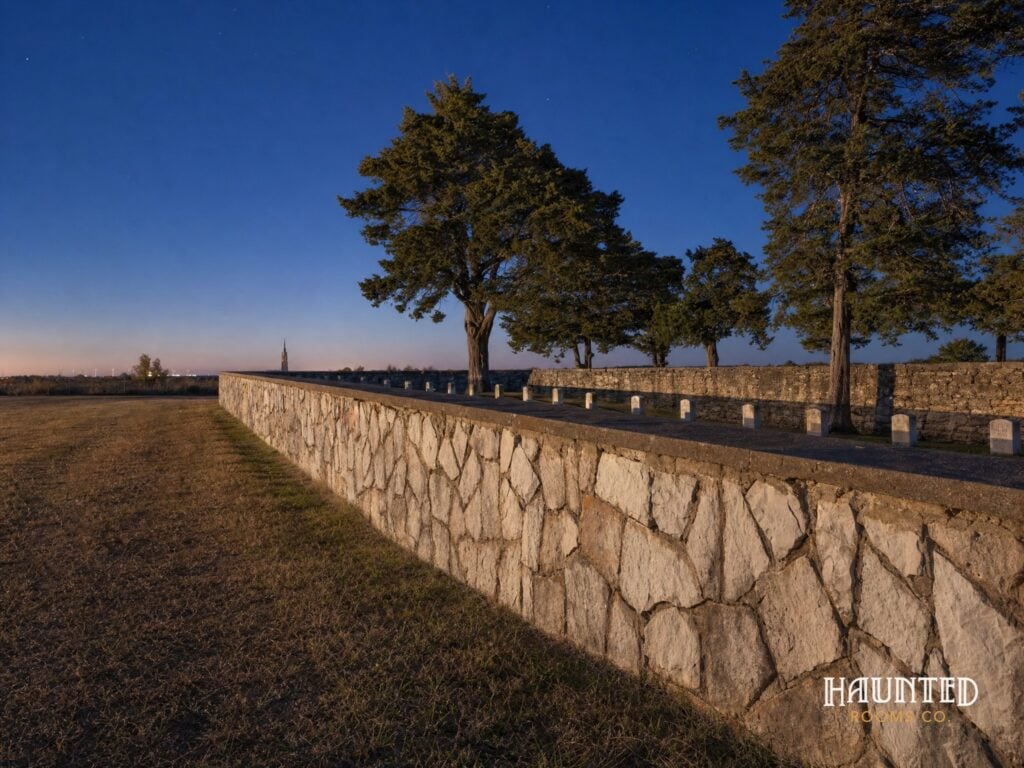
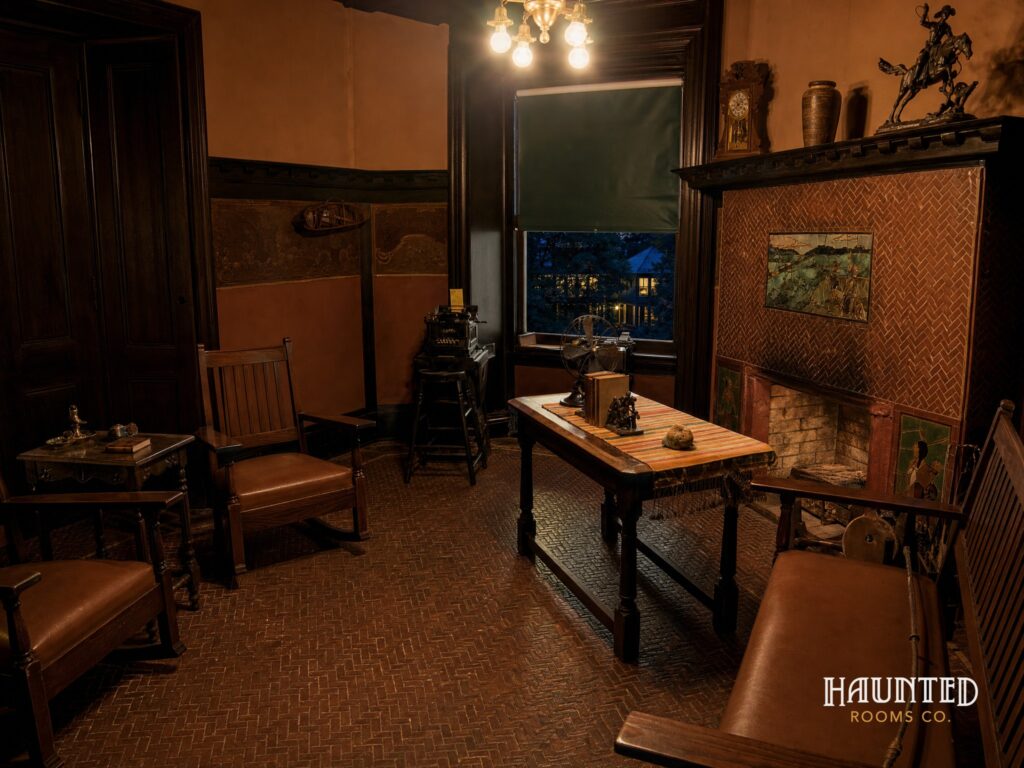
Fort Reno began as an Army camp in July 1874 to protect the Darlington Agency during the unrest that led to the Red River War. After the Army left in 1908 it was a cavalry remount depot, and in World War II it held German and Italian prisoners of war, who built the chapel; some are buried in the post cemetery. The USDA has run it as a research station since 1949, and a nonprofit runs the visitor center and museum on Route 66.
The fort’s director of operations told the Oklahoma Gazette that furniture moves upstairs in the visitor center and that something imitates her voice. Workers hear coughing in the Cavalry Museum, and visitors describe a girl called Emily Ann in a window of the Victorian house; stories that she was murdered have never been confirmed. Curator Wendy Ogden told 405 Magazine that two children who died at the fort in 1900 have been seen together, and ghost hunters tell of a soldier near the commissary.
What investigators report
Guides on the fort’s spirit tours carry EMF meters, and staff point to the second floor of the U.S. Cavalry Museum near the front desk, where workers report hearing coughing with no one there.
Where to look The barracks ruins, the Bohanan cabin, the officers' quarters and the cemetery
Reported ghosts Aunt Jane, a headless woman with a lantern; soldiers on horseback; an officer on the porch
Visiting An open historic site run by the Chickasaw Nation
Tours Seasonal candlelight ghost tours in October; reenactments and the fur trade rendezvous
Hours and season Tuesday to Saturday, 9 AM to 4:30 PM
Ghost hunting Ghost tours only; no public investigations
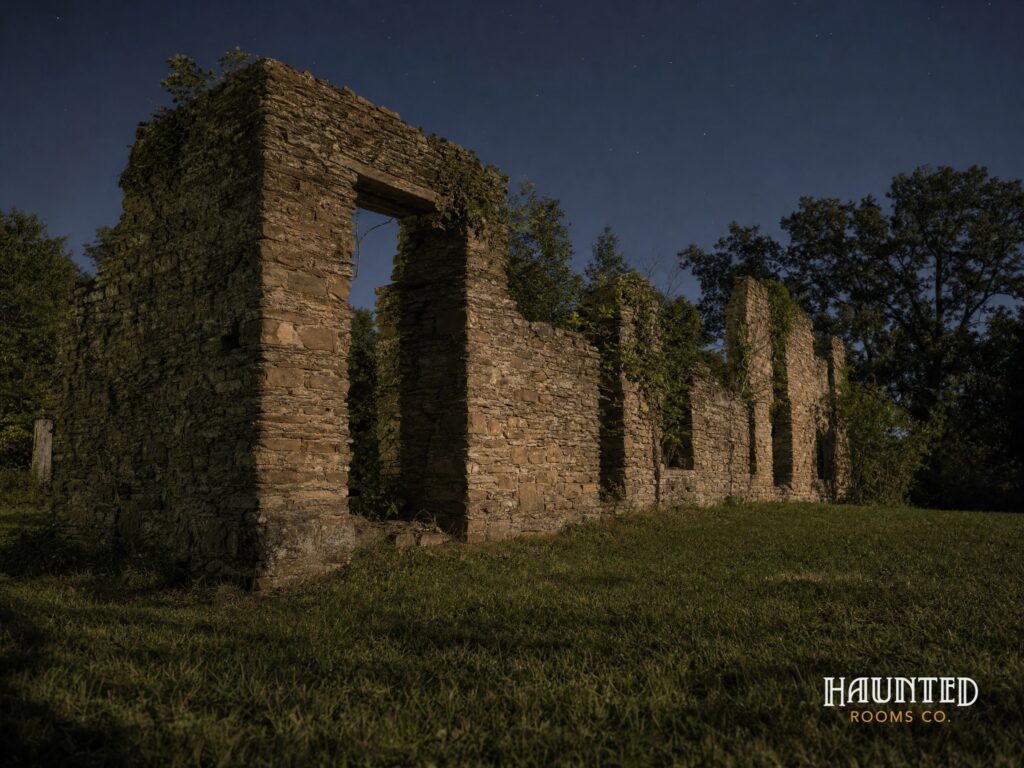
General Zachary Taylor chose this site in 1842 for the southwesternmost US Army post, set up to keep the peace for the Chickasaw and Choctaw nations. Federal troops left in 1861, Confederates held it and burned much of it at the end of the war, and the Colbert family later lived in the old barracks, which burned in 1917. It is a National Historic Landmark, owned and run by the Chickasaw Nation since 2017.
Its best-known ghost is Aunt Jane, said to have been murdered for her gold and buried on the grounds; stories disagree on who she was. Site manager Jim Argo told News 9 that reenactors saw a woman with a lantern and no head, a guard watched riders pass through a fence, and the Bohanan cabin is the most active, with doors slamming and recorders catching babies crying.
Haunted Rooms tip: Ask about the October candlelight ghost tours early; News 9 reported tickets sell out within a day or two of going on sale.
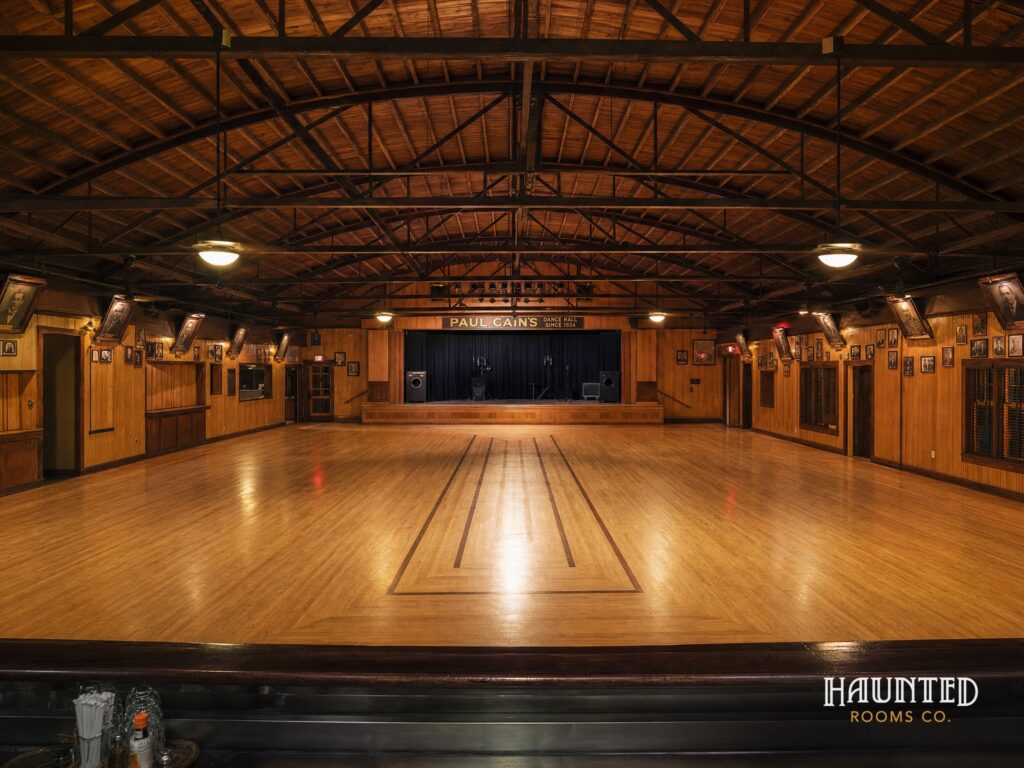
Where to look The maple dance floor, the bar, the restroom behind the stage and the upstairs bar in the old attic
Reported ghosts Bob Wills, a 'lady in red', a cowboy asking for ten-cent popcorn, a child's voice
Visiting A working concert venue; you get in with a show ticket
Tours No regular public tours; it is open for concerts
Hours and season Box office Monday to Friday, 10 AM to 4 PM (closed noon to 1 PM)
Ghost hunting No public ghost hunts; paranormal teams have investigated by arrangement
Tate Brady built this downtown Tulsa building as a garage in 1924. In 1930 Madison “Daddy” Cain turned it into a dance academy, and from New Year’s Night 1935 Bob Wills and His Texas Playboys made it their home, broadcasting on KVOO and turning Western swing into a national sound. The banner over the stage still reads “Home of Bob Wills.” It was listed on the National Register in 2003.
TravelOK says the hall is rumored to be haunted by Wills himself, and staff and fans describe a “lady in red”. A bartender told paranormal investigator Teri French about a see-through woman in a ballgown, and another worker was asked for ten-cent popcorn by a man in old cowboy clothes. Staff also say a paranormal team recorded a child’s voice saying “I wanna help.”
What investigators report
Tulsa Spirit Tours owner Teri French reports capturing an EVP she believes says “I want to help” in a young girl’s voice, and says she heard a woman sobbing in the restroom behind the stage when no one else was there.
Where to look The tenth floor (Room 1015 in most retellings), guest corridors, the lobby
Reported ghosts Effie, a maid in a legend about founder W.B. Skirvin; a crying baby
Visiting A working hotel; book a room to stay
Ghost hunting No public investigations
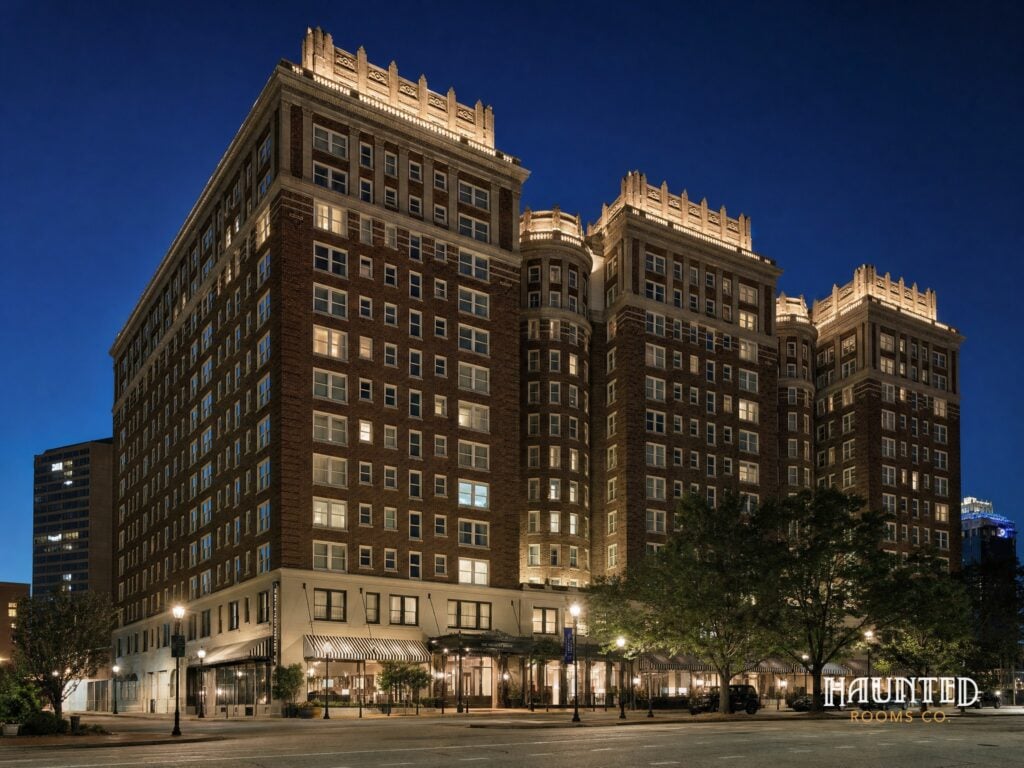
The Skirvin opened on September 26, 1911, as Oklahoma City’s grand oil-boom hotel, built by oilman William Balser Skirvin on Broadway and Park Avenue. It grew through the 1920s, hosted presidents and stars, closed in 1988 and stood empty for 19 years before a roughly $51 million restoration brought it back in 2007 as the Skirvin Hilton. A further renovation was completed in 2025.
Its ghost is Effie. The legend says she was a maid who became pregnant by Skirvin, was locked away on the tenth floor and fell or jumped from a window with her baby. Guests report a woman’s voice, a crying baby and doors that slam, and in 2010 New York Knicks players told reporters they believed the hotel was haunted. Local historians have found no record that Effie existed.
Haunted Rooms tip: Ask for a tenth-floor room when you book. It is a request, not a guarantee, and the hotel does not sell a ghost package.
Address 1016 West Warner Avenue, Guthrie, OK 73044
Where to look The third floor, the back staircase, the Cora Diehl and Kentucky Daisy suites, the basement that once held a funeral home
Reported ghosts A playful little girl who tucks guests in; a pipe-smoking man said to be F.E. Houghton; a man in the basement
Visiting A bed and breakfast; stay overnight or book a murder mystery dinner
Tours Murder mystery dinner weekends
Ghost hunting Paranormal teams have investigated by arrangement
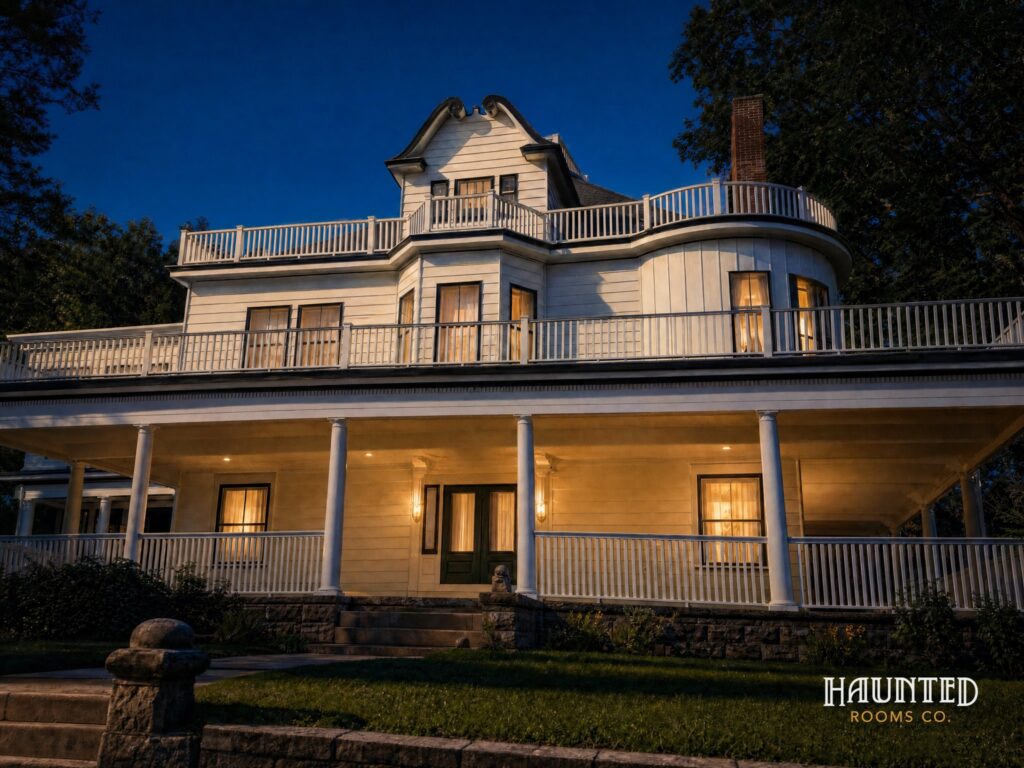
The Stone Lion Inn is an 8,000-square-foot Victorian mansion built in 1907 for Fred E. Houghton and his large family in Oklahoma’s first capital, Guthrie. In the 1920s the house was leased to an undertaker and became Smith’s Funeral Home. Becky Luker bought it in 1986 and turned it into a six-room bed and breakfast, famous across the state for its weekend murder mystery dinners.
Guests describe a child who tucks them into bed or pats their cheek, toys scattered overnight, footsteps on the back stairs and the smell of pipe tobacco. Ghost Hunters investigated in 2006 and Ghost Adventures in 2017. The popular story that a daughter named Augusta died here of a medicine overdose does not match census records, which show Augusta growing up and marrying.
What investigators report
Ghost Hunters ran EMF sweeps, thermal imaging and EVP recorders in the Daisy, Parlor and Wedding Suites, hallways and basement, reporting high EMF readings, heat imprints on a pillow and an EVP that sounded like a child’s voice.
Open to the publicParanormal investigations allowed
Address 121 N Chickasaw Ave (4th and Chickasaw), Claremore, OK 74017
Where to look The second floor, the basement stairs and the third-floor ballroom
Reported ghosts John Bayless; children playing; a 1940s tenant (unconfirmed)
Visiting A house museum with a tearoom and gift shop, run by the Rogers County Historical Society
Tours Self-guided tours during opening hours
Ghost hunting Occasional paranormal fundraiser nights hosted by local teams
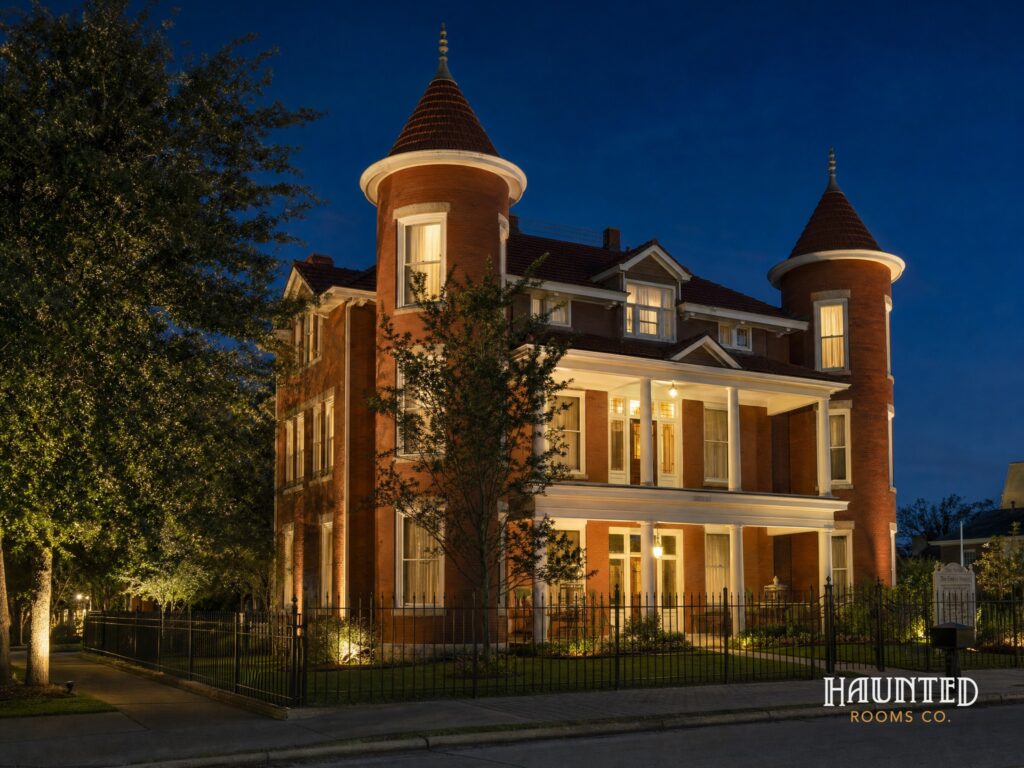
Railroad builder and banker John M. Bayless broke ground on this red brick mansion with four towers in March 1907 and died that June after an appendicitis operation, before it was finished. His widow Mary and their children moved in that December and stayed until 1919. It was then a hospital, then apartments, and was nearly condemned before the Rogers County Historical Society bought and restored it in 1991.
Paranormal groups say most activity is on the second floor: footsteps, whispers, hazy figures, cold spots and toilets that flush on their own. Psychics have described a distressed John Bayless and children at play, and a tenant who is said to have taken her life in the 1940s. The historical society says it has found no record of any death like that in the house.
What investigators report
Organizers of paranormal explorations at the mansion point investigators to the basement, where the group’s founder reports hearing footsteps come down the stairs and finding nothing when he turned on his flashlight.
Visiting a haunted place by day is one thing. Investigating one after dark is another. On a Haunted Rooms ghost hunt our team takes you through a historic building with professional ghost hunting equipment, runs EVP sessions and vigils, and gives you time to explore on your own. These are the nearest ones we run.
Address 1400 N Gilcrease Museum Rd, Tulsa, OK 74127
Where to look The Gilcrease House, its staircase and south bedroom, and the gardens
Reported ghosts Thomas Gilcrease; children seen in the house and gardens
Visiting The museum is closed while a new building goes up; it says it reopens in March 2027
Hours and season Closed until the planned March 2027 reopening
Ghost hunting No public investigations
Tulsa lawyer Flower Nelson built the sandstone house in 1913, and oilman Thomas Gilcrease, who grew up in the Muscogee (Creek) Nation, made it his home. He opened a gallery on the estate in 1949, gave the museum to the city, and died in 1962. The old museum building was pulled down from 2022 for a new one, and the museum says it reopens in March 2027.
Teri French of Tulsa Spirit Tours calls the house one of the most haunted places in Tulsa. Former curators are said to have seen Gilcrease tip his hat on the stairs, and French tells of police dogs that refused to climb to a bedroom where cameras kept triggering. Others describe Native American children in the house and gardens. These are staff and investigator accounts, not records.
Haunted Rooms tip: Check the museum’s site before you go: it plans to reopen in March 2027, and the house is part of the new campus.
Where to look The stage, the rafters and catwalks, and the basement
Reported ghosts Tenor Enrico Caruso; a stagehand said to have died in a fall
Visiting A working concert hall; you get in with a show ticket
Tours Tulsa Spirit Tours starts most of its tours outside the building
Ghost hunting No public investigations
The city built this hall as Convention Hall and opened it on October 22, 1914. It hosted vaudeville, Will Rogers, Mae West and Buddy Holly, and was called the Brady Theater from 1979 until 2019, when it dropped the name of Tate Brady because of his Ku Klux Klan ties. During the 1921 Tulsa Race Massacre the building was used to detain Black men rounded up by the National Guard.
Its best-known legend is the great tenor Enrico Caruso, who sang here in 1920. The story says he caught a chill on a rainy car trip to see the oil fields and blamed Tulsa for the illness that ended in his death in Naples in 1921. Paranormal investigators say they recorded a loud boom from the rafters, and other stories tell of a stagehand who died in a fall. These are legends, not records.
Haunted Rooms tip: See a concert here and think about the building’s 1921 history as well as its ghosts; the Greenwood Rising history center is a short walk away.
Address Deer Creek bridge, northeast of Weatherford (I-40 exit 84), Custer County, OK
Where to look Under the bridge and along the Deer Creek banks
Reported ghosts Katie DeWitt James calling for her baby; phantom wagon wheels; a crying baby
Visiting A public county road bridge; see it from the road
Ghost hunting No organized access; rural road at night, take care
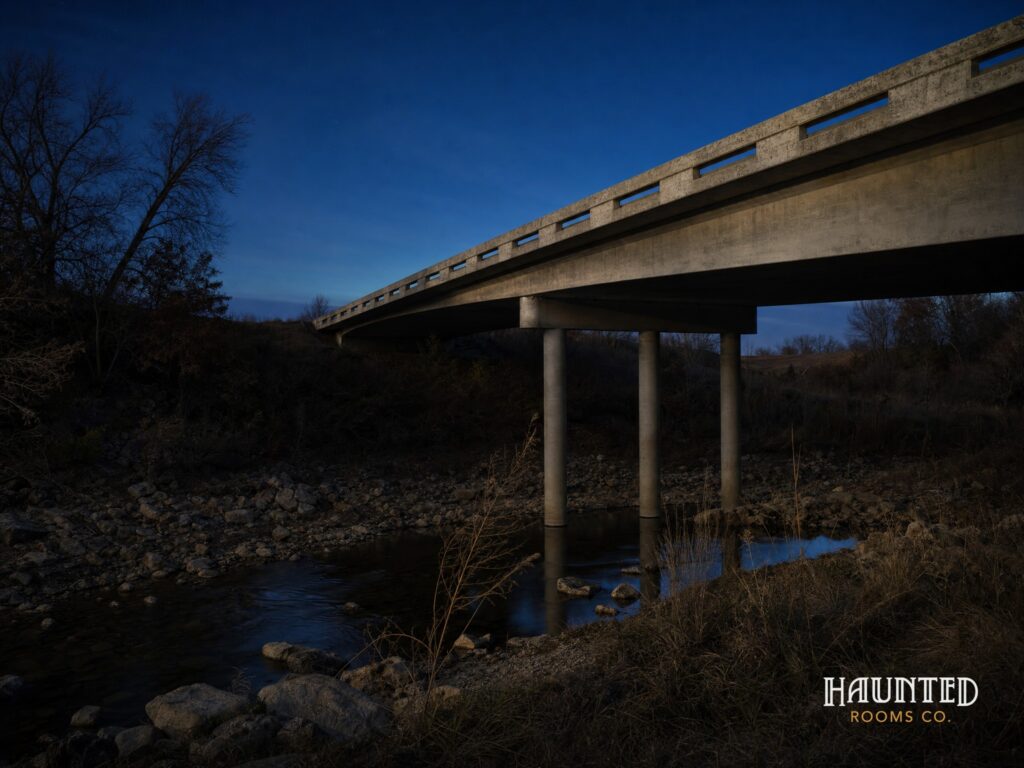
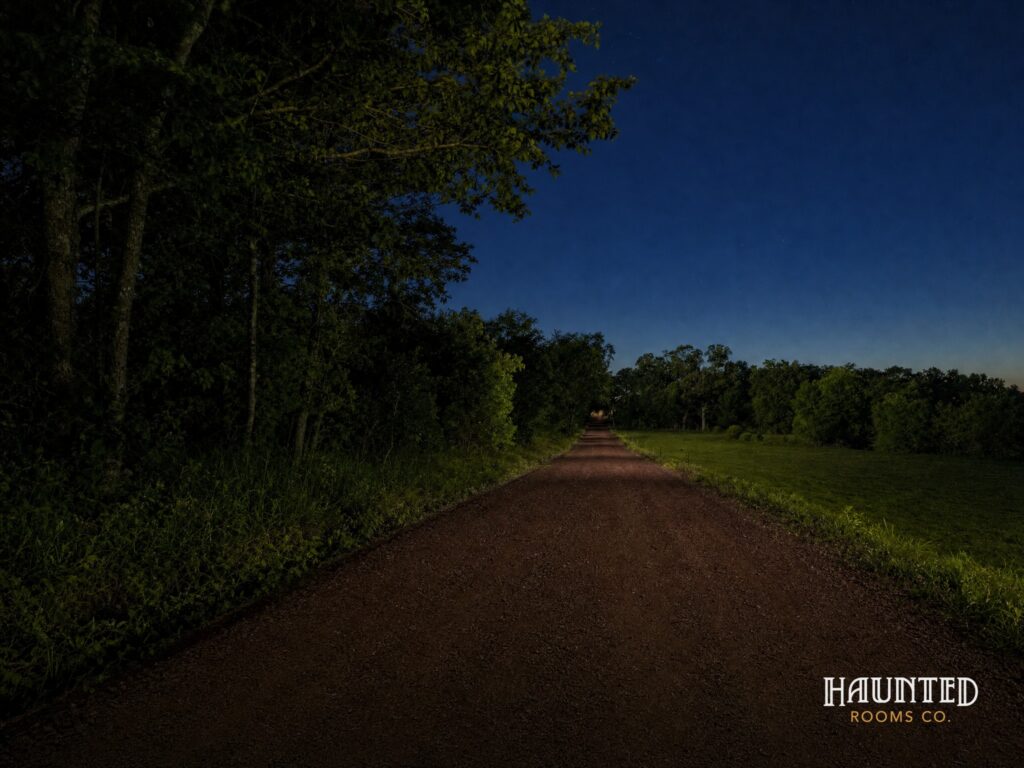
The murder is real. On July 7, 1905, schoolteacher Katie DeWitt James, who had just filed for divorce, boarded a train in Custer City with her 14-month-old daughter Lulu Belle. She left with Fannie Norton, known as Mrs. Ham, and was seen riding in a buggy near Deer Creek. Norton handed the baby to a farm boy, and when a detective caught up with her in Shawnee she took poison. Katie’s remains were found by the creek on August 31.
A coroner’s jury named Norton as the killer, though questions remain. The place took the name Dead Woman’s Crossing, and the legend says Katie walks the creek calling for her baby. Some people say that if you stand under the bridge you hear wagon wheels overhead; others tell of a baby crying. The old wagon crossing has washed out over the years and a concrete bridge stands nearby.
Haunted Rooms tip: Go in daylight, park safely off the road and stay out of the creek; Oklahoma Today gives directions from I-40 exit 84.
Where to look The third floor, the turret windows, the music room and library
Reported ghosts Anna Overholser in a white gown; Henry Overholser's tobacco; young Henry Ione
Visiting Guided house museum; closed for tours and events during a preservation project
Tours Guided tours at 10 AM, 12 PM and 2 PM, Wednesday to Saturday, when open; book ahead
Tickets Adults $10, seniors and military $7, students $5, under 6 free
Ghost hunting The mansion has held seasonal history and haunts evenings; no public ghost hunts
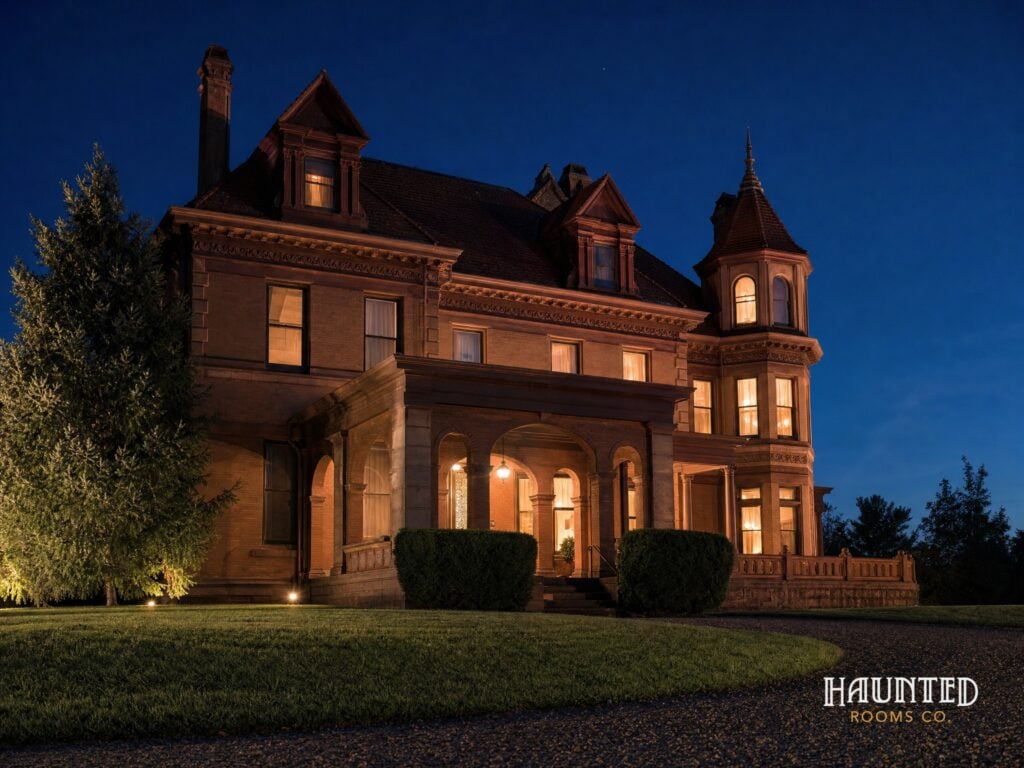
Henry Overholser, often called the father of Oklahoma City, built the city’s first mansion in Heritage Hills in 1903 for himself, his wife Anna and their daughter Henry Ione. All three lived and died here. After Henry Ione died in 1959 her husband passed the house to preservation groups with its furniture, clothes and books still in place, and Preservation Oklahoma has run it as a museum since 2003.
Museum coordinator Lisa Escalon told KFOR that sightings began soon after Henry Ione died: a woman in a long white gown with a Gibson Girl hairdo, taken to be Anna, seen at the turret windows, and the smell of roses, her favorite flower. A former state historical society curator described hearing muffled voices in the music room on a Tuesday afternoon, when Anna once held her bridge parties.
Haunted Rooms tip: The mansion is closed for a preservation project; check its website before you go. When open, guided tours run at 10 AM, noon and 2 PM, Wednesday to Saturday.
Where to look The parlor, the sealed tunnel behind the fireplace and the hill out back
Reported ghosts The 'key lady' who hides visitors' keys; a former owner in the parlor; Ella the rag woman
Visiting A private home shown on guided tours by appointment
Tours Guided tours by appointment (918-378-1952)
Tickets TravelOK lists adults $10, children 12 and under $5; confirm when you book
Ghost hunting Not offered publicly
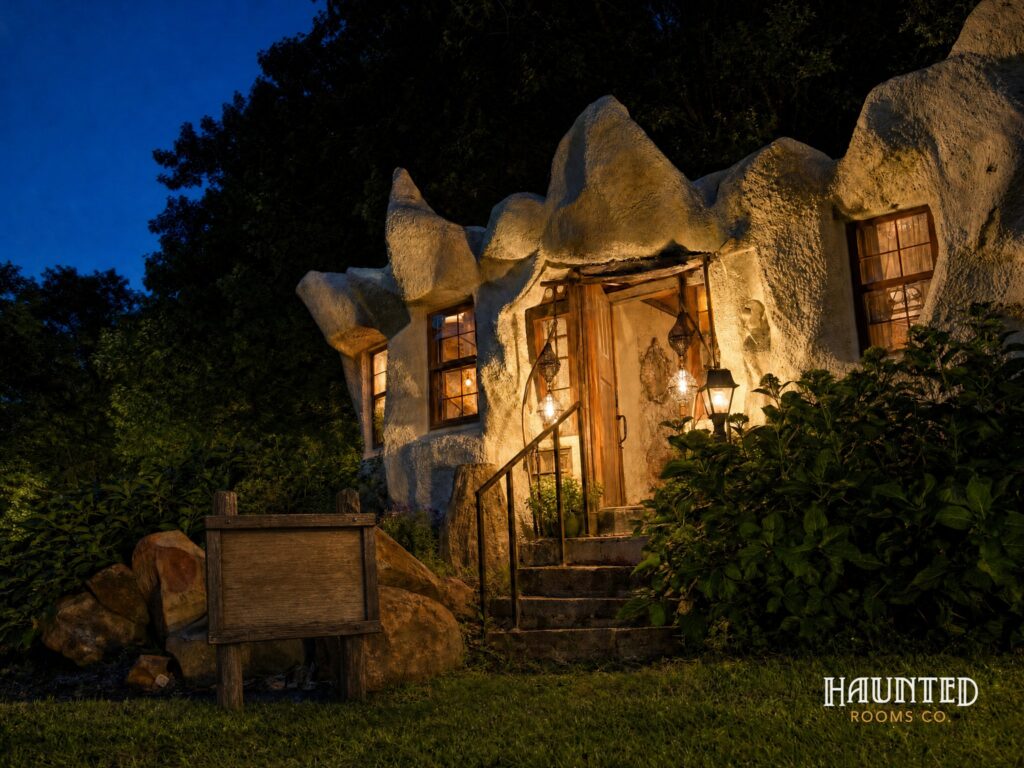
This hand-built house, covered in rockwork and nicknamed the Flintstone House, opened in the 1920s as the Cave Garden Restaurant, serving chicken at outdoor tables by day. TravelOK says it ran as a speakeasy at night, with a tunnel behind the fireplace leading to a room under the hill; the tunnel is now sealed with concrete. Local lore says Pretty Boy Floyd drank here, but there is no record of it.
Owner Linda Collier shows visitors around by appointment. The best-known ghost is the “key lady”: visitors say their keys vanish and turn up by the hill, so people leave spare keys, and thousands hang inside and out. Others tell of Ella, a woman who hung rags in the windows, and of a former owner seen in the parlor.
What investigators report
Visitors traditionally leave a key for the house’s ever-growing key collection, said to keep the mischievous “Key Lady” content, since she is blamed for hiding guests’ keys or leaving them near a hill on the property.
Reported ghosts Sappho Constantine Brown, the owner's daughter
Visiting A community theater open for shows and events
Ghost hunting Not offered
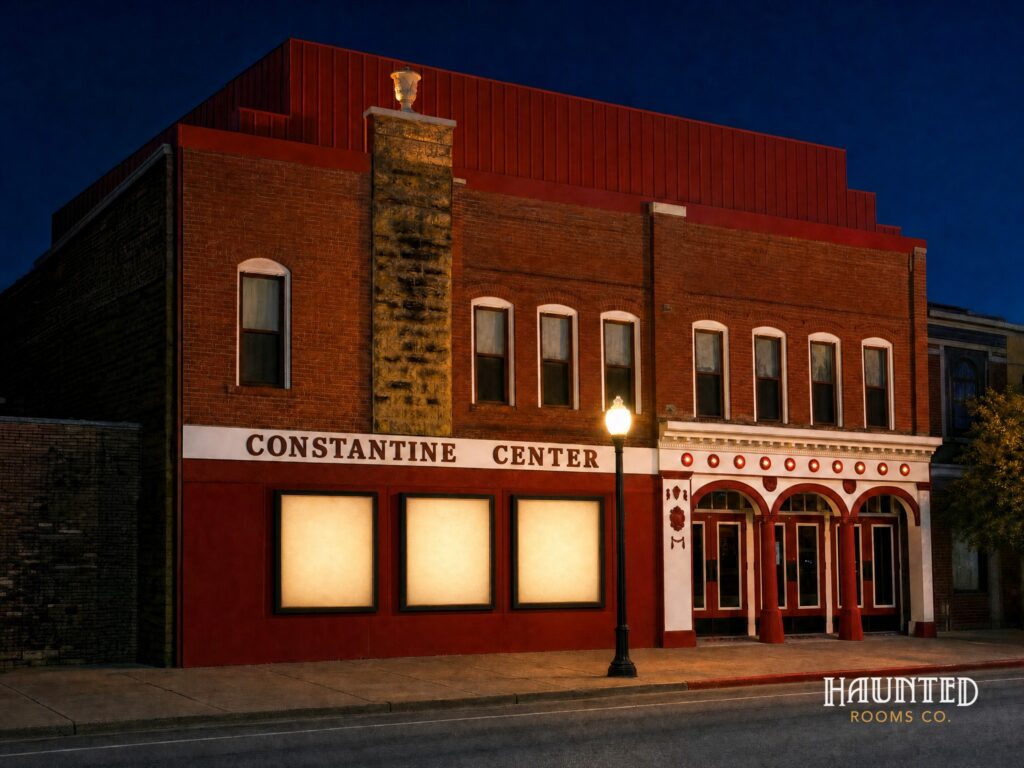
The Constantine opened as a theater in Pawhuska, the capital of the Osage Nation, with a grand opening on December 22, 1914. By the 1980s it was badly run down, and local volunteers, high school students among them, restored it from 1984; it qualified for the National Register in 1986 and is run by a volunteer board for shows, films and community events.
Local legend says the theater is haunted by Sappho Constantine Brown, daughter of the original owner. A 1987 Tulsa World article reported sightings of her backstage, and TravelOK says patrons describe a young woman in a button-down dress in the balconies. OnlyInYourState adds footsteps with a limp and a story that a wall volunteers tore down in the office was found standing again two days later.
What investigators report
One investigation team aimed most of its gear at the stage but reports its activity came in the boardroom above the lobby, including footsteps, knocking and a whispered EVP naming “Peter,” which they later matched to a 1920s Constantine employee.
Where to look The staircase, the south room where Mary Hull lay in state, the ballroom and the elevator
Reported ghosts Mary Hull, the wife of the second owner
Visiting The mansion is open on weekdays; the park around it is a public city park
Hours and season Mansion Tuesday to Friday, 9 AM to 4 PM
Ghost hunting No public investigations
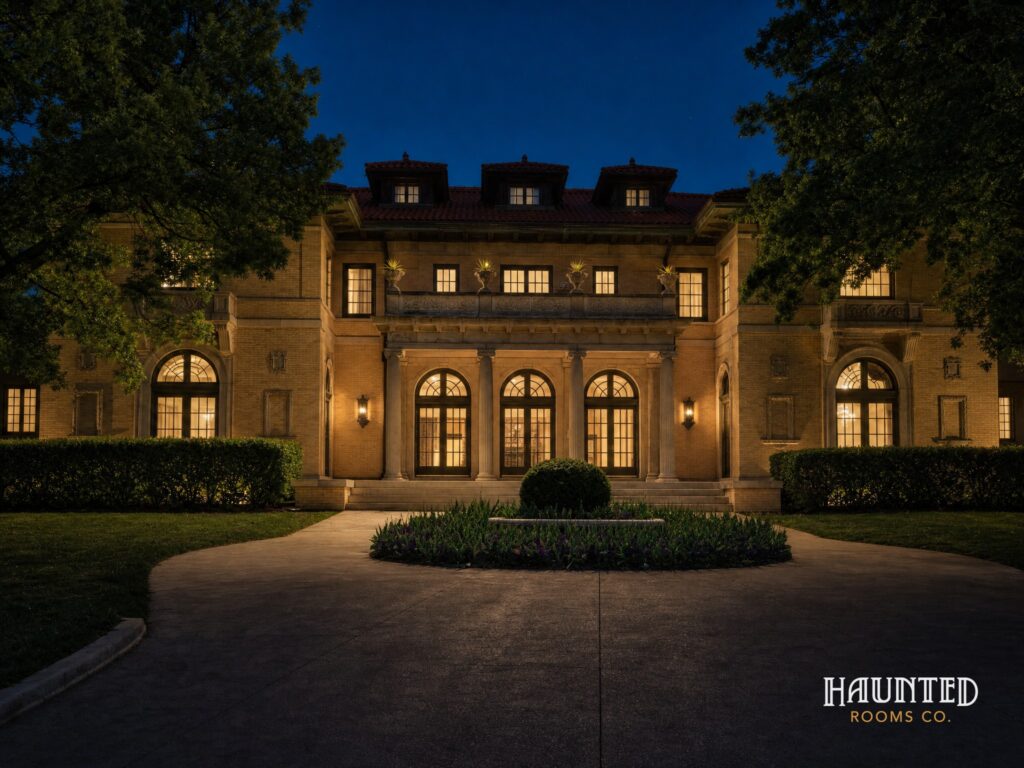
Oilman David R. Travis built this Italian Renaissance style villa in 1919 to a design by Noble B. Fleming. J. Arthur Hull bought it in 1923 and added the conservatory, and his wife Mary died soon after the move; accounts differ on whether it was illness or childbirth. The city bought the estate in 1954 for the Tulsa Garden Center, which still runs it beside Woodward Park and the Tulsa Rose Garden.
The Garden Center’s director told News On 6 in 2009 that staff had felt figures brush past them on the stairs, and she believed Mary Hull was the cause. Teri French’s team said an elevator opened and closed by itself, the doorbell chimed, phones rang together and brochures flew off library shelves. A room where Mary is said to have lain in state stays cool all year.
What investigators report
Investigator Teri French says that on her team’s first visit the elevator opened and closed by itself and brochures flew off the shelves in the library, a room she notes has no ventilation.
Where to look The old stage, George's seat in the auditorium and the street outside
Reported ghosts George, a longtime director; Sara, a little girl; a light near the curtains
Visiting A private building; the theater is used for concerts and rented events
Tours Open for events; Tulsa Spirit Tours has run tours and classes here
Ghost hunting No regular public investigations
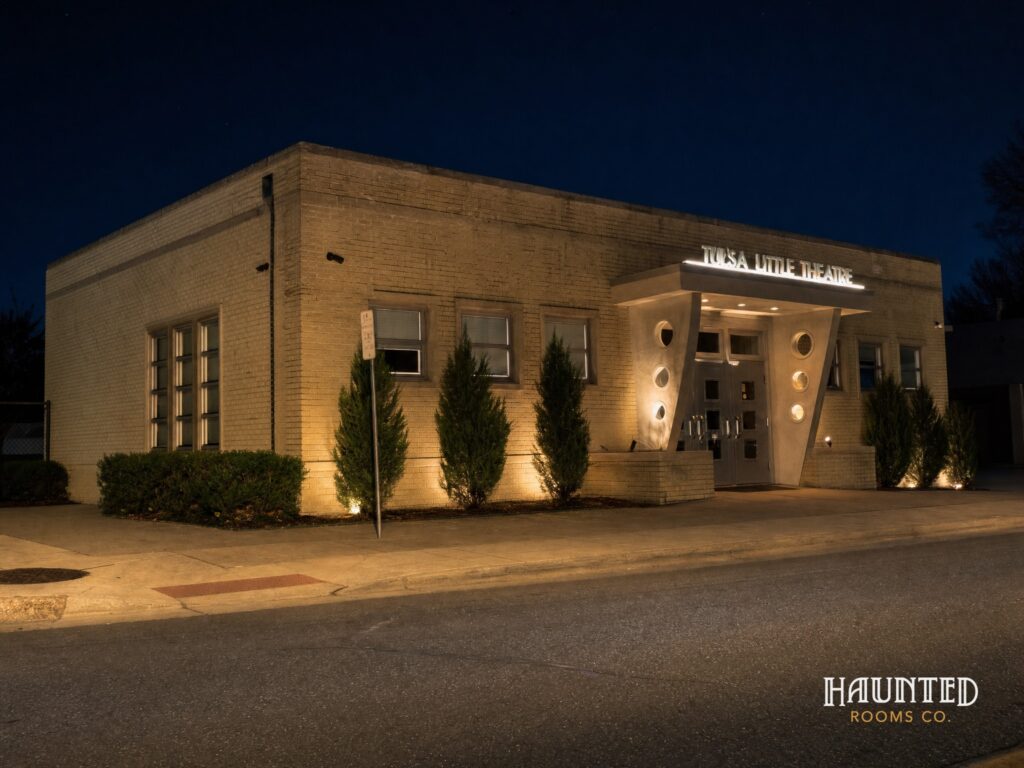
The Tulsa Little Theatre company, founded in 1922, built this brick playhouse at 15th and Delaware in 1932 and opened it with The Cradle Song. As Theatre Tulsa it moved to the Performing Arts Center in 1989, and the building passed through life as a church, a nightclub and a studio. Attorney Bryce Hill and his wife Sunshine restored it in 2004 and 2005; his law office is in the front and the theater hosts events.
The Hills told News On 6 that neighbors warned them it was haunted, and they report sandbags swinging, footsteps, voices and a photo of a boy they can’t explain. Older performers spoke of George, a director said to have died in his favorite seat, and left a light on for him. Neighbors describe a girl called Sara. Legends of America adds a ball of light near the curtains.
What investigators report
The owners keep “George’s light” burning over the auditorium seat where a former director is said to have sat, a tradition carried on from performers, and say a flicker of that light is George making himself known.
Address E 50 Rd (Spooklight Road), Ottawa County, OK, west of Hornet, MO
Where to look The higher points along E 50 Road, looking west
Reported ghosts A floating orange light; legends of Quapaw lovers, a miner with a lantern and a headless Osage chief
Visiting A public farm road; watch from the roadside
Ghost hunting No organized access; do not trespass on farmland
On a farm road called E 50, on the Oklahoma side of the line a few miles west of Hornet, Missouri, people have long reported a bright light that bobs along the road, hangs above the trees and vanishes. It is often called the Hornet or Joplin Spook Light, and a Spooklight museum stood at the east end of the road in the 1960s. Legends of America repeats claims of sightings back to the 1800s, but researcher Paul W. Johns found no printed mention before 1926.
That date matters: 1926 is when Route 66 was laid out south of Quapaw, in line with E 50 about ten miles west. Experiments in 1946, 1955, 1965 and 2015 showed that headlights on that highway, seen from the high points of E 50, look just like the light, and a telescope in 1965 showed paired headlights. The legends of Quapaw lovers, a miner searching for his family and an Osage chief looking for his head live on anyway.
Haunted Rooms tip: Go late on a quiet night, park well off the road, turn your lights off and look west; stay on the public road, as the land on both sides is private.
Where to look The third step of the main staircase, the basement and the sunroom
Reported ghosts Governor William H. 'Alfalfa Bill' Murray
Visiting The working governor’s residence; free public tours on set weekdays by reservation
Tours Free guided tours on a weekday morning or afternoon by reservation; none in summer
Ghost hunting Not allowed
The limestone Dutch Colonial mansion two blocks from the State Capitol was finished in 1928 to a design by the Oklahoma City firm Layton, Hicks and Forsyth. It has been home to every governor since, and the main staircase has a step for each one.
Legend says Governor William H. “Alfalfa Bill” Murray, in office from 1931 to 1935, never left. Former first lady Cathy Keating said she was tripped on the third step and put a doll of Murray there to keep him happy, and Governor Frank Keating said his teenage sons saw Murray walk through the basement. Governor Mary Fallin fell on the same stairs in 2018. Writers Jeff Provine and Tanya McCoy add knocks, footsteps and cabinet doors that open.
Haunted Rooms tip: Book a free weekday tour ahead by phone (405-888-6353); tours do not run on weekends, holidays or in summer.
Address Pawnee Bill Ranch, west of Pawnee on US 64, OK
Where to look The mansion's parlor and May Lillie's chair, and the paintings
Reported ghosts Pawnee Bill; May Lillie in 1930s clothes; their son Billie
Visiting State historic site; temporarily closed for restoration work
Ghost hunting Not offered
Wild West showman Gordon W. “Pawnee Bill” Lillie and his wife May, a sharpshooter, built their stone house on their Buffalo Ranch on Blue Hawk Peak in 1910 from rock quarried on the land. Their adopted son Billie died in an accident in 1925 at age eight, May died after a car crash in 1936, and Bill died in his sleep in 1942. The Oklahoma Historical Society runs the ranch, with the house, a 1903 log cabin, a 1926 barn and a museum.
The Oklahoma Gazette reports guests and staff telling of paintings that seem to change, sudden electrical shocks, a woman in 1930s clothes in May’s favorite chair, and a child heard laughing or crying. A historical interpreter told 405 Magazine that Billie seems to switch off cameras, and staff speak of cigar smoke they put down to Pawnee Bill. These are visitor and staff stories.
Haunted Rooms tip: The ranch is temporarily closed for restoration and construction; check with the Oklahoma Historical Society before you drive out.
Hours and season Tuesday to Sunday, 1 PM to 5 PM; closed major holidays
Tickets Adults $5, ages 6 to 15 $3
Ghost hunting Not offered
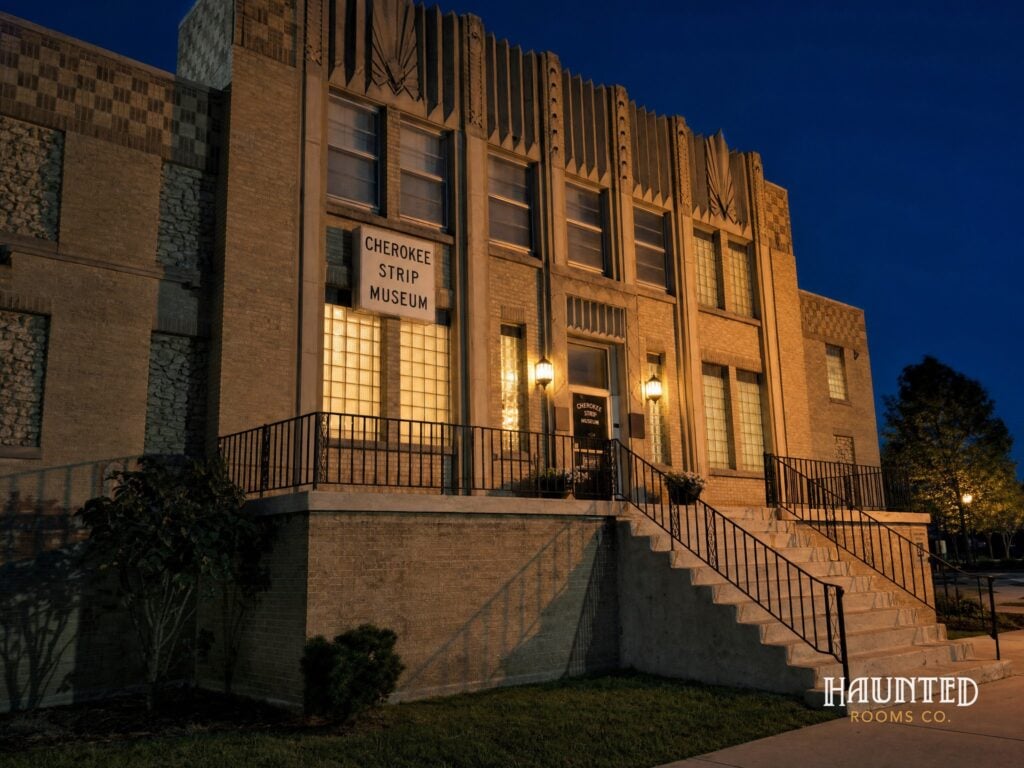
This museum on the west side of Alva, in northwest Oklahoma, fills about 40 rooms of the old Alva General Hospital, which opened in 1932 and closed in 1972; the museum moved in in 1976. Its collections tell the story of the Cherokee Outlet, opened in the 1893 land run, with a schoolroom, drugstore, a World War II POW camp room, vintage medical instruments and an embalming table.
TravelOK says patients from botched surgeries are said to haunt the building. Visitors and volunteers describe a piano that plays on its own, lights switching on in empty rooms, children heard laughing or crying, a figure on the roof and a friendly German ghost staff call Trapper, said to have arrived with an object donated to the POW exhibit. These are visitor and staff stories.
What investigators report
Staff single out the former emergency room from the building’s days as Alva General Hospital as the most active spot, and say security cameras caught unexplained floating orbs during a 2016 paranormal investigation.
Where to look The basement, the old servants' quarters and the knotty pine booths
Reported ghosts A floating face with a mustache; cold spots and voices
Visiting An open restaurant and lounge
Ghost hunting No public investigations
This roadhouse off old Route 66 near the Cowboy Museum began as a 1920s tavern outside the city limits and opened as the Kentucky Club in October 1938 under Tony Marneres, with gambling and bootleg liquor until Oklahoma ended prohibition in 1958. It became the County Line barbecue restaurant in the early 1980s, closed in 2010, and new owners restored it; the Kentucky Club now runs as a speakeasy-style lounge at Carletti’s.
Logan Corelli of the Oklahoma City Ghost Club told the Oklahoma Gazette in 2007 that on his first investigation here he saw a red mist in the dark basement, then a blue face with a mustache float toward his group. A local history blog records a real 1938 killing in the servants’ quarters. Older stories that Pretty Boy Floyd drank here have no record behind them.
What investigators report
Investigators who ran EVP sessions in the dining room, by the fireplace and in the basement report recording a male voice saying “Russell” and, when they asked how they could help, a reply of “stay out!” Another team says it sat in darkness in the basement and saw a face appear and fade.
Address 2224 Exchange Ave, Oklahoma City, OK 73108
Where to look The upstairs floor and the foot of the stairs
Reported ghosts Sisters Patty and Rose, taxi dancers in the old dance hall
Visiting An open store
Hours and season Monday to Saturday 10 AM to 8 PM, Sunday noon to 5 PM
Ghost hunting Not offered
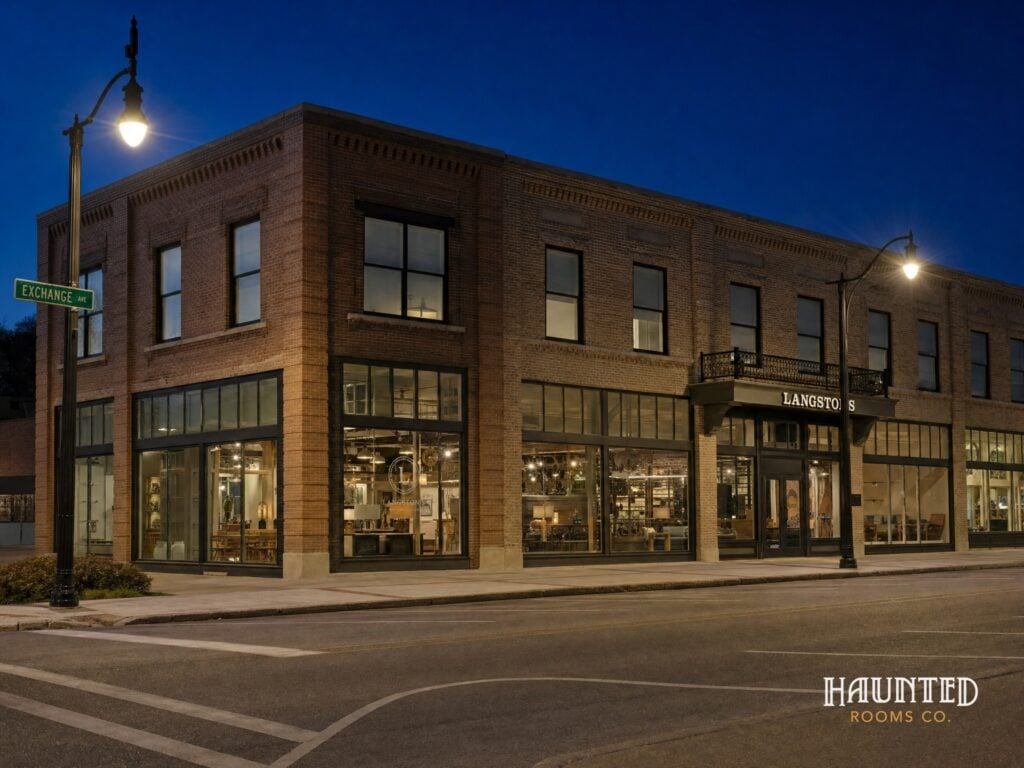
Langston’s has sold western wear for more than a century and keeps its flagship in a restored brick building in Stockyards City, the cattle market district just south of downtown that still holds livestock auctions. The story goes that the ground floor was once a bar and dance hall with a hotel upstairs.
Staff tell of two sisters, Patty and Rose, who worked the old dance hall as taxi dancers. In the legend Patty was shot by a jealous boyfriend and Rose hanged herself upstairs. Employees describe lights going on and off, a presence on the stairs and a worker who said she was pushed. Writer Jeff Provine notes these stories may not be factual, and we found no record of the deaths.
Haunted Rooms tip: Pair a visit with Cattlemen’s Steakhouse a few blocks away, and look at the upstairs windows from across Exchange Avenue.
Address 201 Student Union, Oklahoma State University, Stillwater, OK 74078
Where to look The long guest corridors inside the Student Union
Reported ghosts Unexplained lights, shadows and doors that lock and unlock
Visiting A working hotel; book a room to stay
Ghost hunting No public investigations
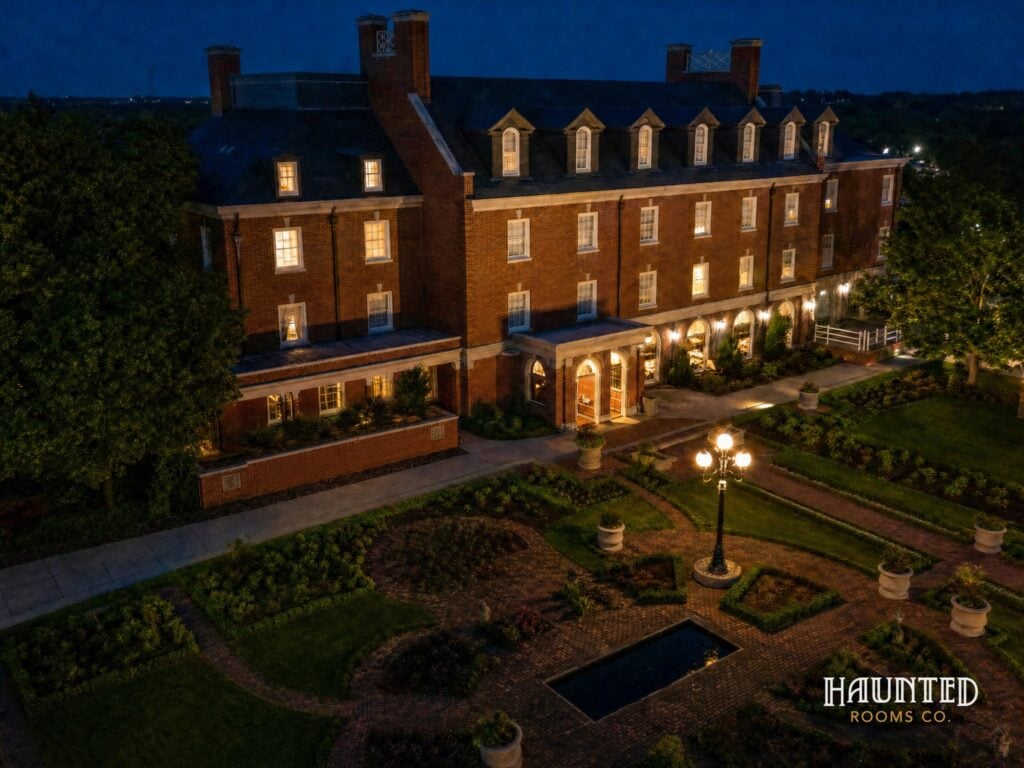
The Atherton opened in 1950 as the Union Club, a hotel built inside Oklahoma State University’s Georgian-style Student Union and said to be the first purpose-built hotel in a student union. It is run with OSU’s School of Hotel and Restaurant Administration, was renamed for donor Bill Atherton after a 2001 to 2004 renovation and joined Historic Hotels of America in 2005. A $20 million refurbishment finished in 2016 left it with 69 rooms.
Its ghost stories are low-key. Guests have described odd lights, shadowy figures and doors that lock or unlock by themselves along the long, quiet corridors, and the wind makes some eerie noises in the old building. The hotel’s general manager told the student newspaper in 2017 that nothing has been documented, so this is one for gentle curiosity rather than a guaranteed scare.
Haunted Rooms tip: Book on a football weekend only if you like crowds; midweek the corridors are at their quietest.
Reported ghosts Footsteps overhead, cold presences and whispering
Visiting A working hotel; book a room to stay
Ghost hunting No public investigations
The Noble House began life in 1912 as a boarding house in Watonga, northwest of Oklahoma City, and was roughly doubled in size in 1937 when it became the Noble Hotel. The building is on the National Register of Historic Places, and today it is a small bed and breakfast with rooms named after Watonga figures such as Gene Wheeler, Dr. Theresa Tyler and Clarence Nash, each furnished with antiques and its own bathroom.
Local ghost lists have long called it one of the most haunted places to stay in western Oklahoma. Guests on the second floor describe footsteps on the roof above them, cold presences in their rooms and whispering voices with no one there. The owners do not promote the stories, so treat them as local lore.
Haunted Rooms tip: Combine a night here with Roman Nose State Park, a few miles north of town.
These places appear in older lists of haunted spots. We keep them here so you know the facts before you go, but you cannot (or should not) visit them.
St. Vincent's (former asylum), Oklahoma City
Built in 1945 for the Brothers of Mercy and now abandoned, overgrown, posted no trespassing and unsafe. Its real history includes a 1962 murder charge and the 1988 killing of a priest. See our Oklahoma City guide.
The Black (First Territorial Prison), Guthrie
Built in 1892 of dark limestone and later used by a church and a foundation until health inspectors shut it in 1995. The Oklahoma Gazette describes it as empty and in disrepair, with stories of an inmate named James Phillips at his cell window. It is not open to visitors.
The Hex House, Tulsa
Carolann Smith’s duplex, where two women were kept in the basement in the 1940s, was razed in the 1970s and is now a parking lot. See our Tulsa guide.
Ghost Mounds, near Hydro
Mesas tied to a legend of a girl who fell from the top while looking for her lover. Oklahoma Today says they are on private property and not open to the public; you can see them from I-40.
Changed from our older guide: the Stone Lion Inn’s child ghost is usually named Irene or Augusta, and census records show Augusta grew up and married; the Skirvin’s Effie has no record behind her; the Belvidere Mansion was built in 1907, and the historical society has found no record of the 1940s suicide often told there; the Brady Theater is now the Tulsa Theater; Cain’s ghost is Bob Wills, not “Bob Willis”. We could not confirm current details or reliable sources for Veterans Lake in Sulphur, Bird Creek School near Pawhuska, Blanchard Cemetery or the Blue Belle Saloon in Guthrie this time, so they are not listed while we check. New in this update: Fort Washita, Fort Reno, the Spook Light, the Overholser and Governor’s mansions, the Constantine Theater, Pawnee Bill Ranch and full guides to Cain’s Ballroom, Dead Woman’s Crossing and the Belvidere Mansion.
Visited one of these places? Tell us what happened
We collect first-hand accounts from visitors and add the best ones to our guides, with your first name and the date of your visit. We read every story before it’s published.
The Skirvin Hilton in Oklahoma City is the most famous, thanks to the legend of Effie and NBA players who said they slept badly there. Fort Washita near Durant, with its headless Aunt Jane, and Guthrie’s Stone Lion Inn are the other names that come up most.
Is Dead Woman's Crossing real?
Yes. Schoolteacher Katie DeWitt James was murdered near Deer Creek, northeast of Weatherford, in July 1905, and a coroner’s jury named Fannie Norton as the killer. The ghost stories of a woman calling for her baby are legend. Read our full Dead Woman’s Crossing guide.
Where can you go on a ghost tour in Oklahoma?
Fort Reno in El Reno runs Historic Spirit Tours, Fort Washita has held candlelight ghost tours in October, Guthrie has a ghost walk, and Tulsa Spirit Tours runs downtown Tulsa tours. The Cave House in Tulsa gives tours by appointment.
Can you stay overnight in a haunted place in Oklahoma?
Yes. The Skirvin Hilton in Oklahoma City, the Stone Lion Inn in Guthrie, the Atherton Hotel in Stillwater and the Noble House in Watonga all take guests. See our guide to haunted hotels in Oklahoma.
What is the Oklahoma Spook Light?
A light reported on E 50 Road in Ottawa County, near Quapaw and the Missouri line. Legends tie it to lost lovers and a miner with a lantern, but experiments since 1946 have shown it matches distant headlights on Route 66. Watch from the public road and do not trespass.
Does Haunted Rooms run ghost hunts in Oklahoma?
Not at the moment. See the nearest dates we have below, or our ghost hunts in Texas, Kansas and Missouri.
Sources and how we research
Every place in this guide is checked against its official website, historic register listings and news coverage, and we confirm whether it is open, closed, private or gone before we list it. Ghost stories are reported as staff, visitors and local historians tell them; we say so where records contradict a story. Each place shows how many independent sources we checked it against; our own Haunted Rooms pages are not counted.
New guides, haunted places to visit and ghost hunt dates near you. No spam, unsubscribe any time.
About the authors
The Haunted Rooms Team runs public ghost hunts and overnight investigations at historic venues across the United States. We research every place in our guides using official sites, historic registers, local archives and news coverage, and we report ghost stories as the stories they are. We review each guide regularly so you are not sent to a place that has closed, changed hands or banned visitors. Spotted something out of date? Let us know.