Haunted Places in Chicago: 17 Haunted Sites and Hotels to Visit
A hitchhiker in a white dress on Archer Avenue, a woman in white on a broken gravestone, a settlement house with a haunted bedroom and two of the worst disasters in American history. These are Chicago’s best-known haunted places, with what is true, what is legend and how to visit.
Chicago’s ghost stories grow out of real and often terrible history: the Great Fire of 1871, the Iroquois Theatre fire of 1903, the capsizing of the Eastland in 1915, Prohibition gangland and the thousands of graves left behind when the old City Cemetery became Lincoln Park. Add a few of the most famous legends in America, from Resurrection Mary to the Madonna of Bachelor’s Grove, and you have a city where the stories are as much history lesson as fright. We have checked every place below against current sources, so you know which are open, which you can only see from the street and which allow ghost hunting. Haunted Rooms runs its own ghost hunts at one of them: the Old Joliet Prison, southwest of the city. And if you would rather sleep somewhere haunted, the Congress Plaza, the Drake and Hotel Baker are all here too.
Most of the downtown list can be walked in one evening: the Iroquois Theatre alley on Randolph Street, the Eastland marker on the Riverwalk, the Water Tower on Michigan Avenue and the Congress Plaza and Drake hotels. Hull-House is a short ride west on the UIC campus, Graceland and the Green Mill are on the North Side, and Lincoln Park and the Biograph are close together. Resurrection Cemetery and Bachelor’s Grove are a short drive apart in the southwest suburbs, with Joliet beyond them.
Visit on a tourGhost toursHaunted Rooms ghost hunts
Address 1125 Collins St, Joliet, IL 60432
Where to look The processing area, the cellblocks and the yard
Reported ghosts Figures in empty cells, a woman in white in the yard
Visiting Guided and self-guided tours run by the Joliet Area Historical Museum
Tours Historical tours, flashlight tours and seasonal haunted history tours
Ghost hunting Yes: Haunted Rooms ghost hunts
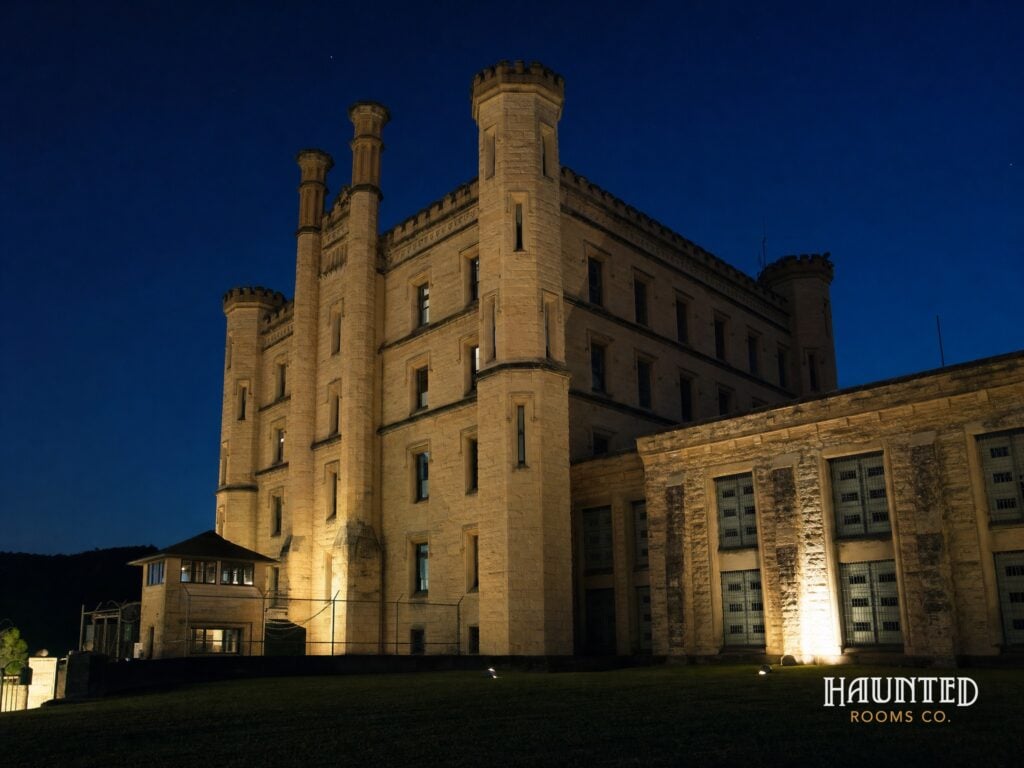
Designed by William W. Boyington, who also drew Chicago’s Water Tower, Joliet Prison was built from limestone quarried on the site and opened in 1858. Inside 25-foot walls it held as many as 2,000 men in its worst years, with no running water. Leopold and Loeb served their sentences here, and in 1915 the warden’s wife, Odette Allen, was found beaten and burned in her bedroom. The prison closed in 2002 and later starred in The Blues Brothers and Prison Break.
The city of Joliet owns the site and the Joliet Area Historical Museum runs tours. A guide told WBEZ of a menacing presence in the old processing area, and guests have described figures in empty cells and a woman in white in the yard; the museum’s historian says he has seen nothing but stray animals. Haunted Rooms runs its own ghost hunts here.
What investigators report
Investigators report spirit box and REM pod sessions on Death Row, in the Segregation Building and in the prison hospital picking up short phrases, with quiet-time EVP sessions run in the East Cell Block.
Where to look The second-floor bedroom known as the haunted room, the attic windows and the courtyard
Reported ghosts A woman in white said to be Mrs. Hull, the Devil Baby legend
Visiting Museum open to the public, run by the University of Illinois Chicago
Tours Museum visits; evening ghost tours each October
Ghost hunting No paranormal investigations
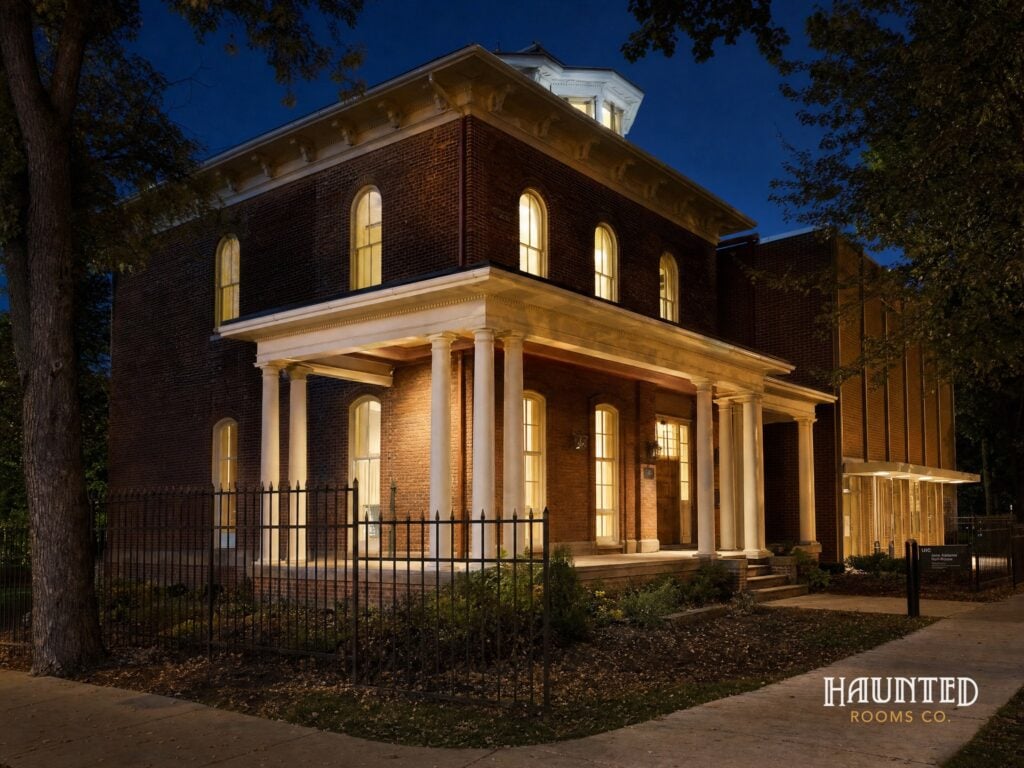
Charles J. Hull built this Italianate mansion on Halsted Street in 1856. In 1889 Jane Addams and Ellen Gates Starr opened it as Hull-House, the settlement house that served immigrant families on the Near West Side. Only the mansion and the 1905 dining hall survive, run by the University of Illinois Chicago as a museum. It is a National Historic Landmark.
Addams wrote of the house’s half-skeptical reputation for a haunted attic and of tenants who left pitchers of water on the stairs; the museum says the ghost was believed to be Hull’s wife, Millicent, who died in the house in 1860. In 1913 a rumor of a Devil Baby kept in the house drew crowds for weeks. Addams called it a legend, and so does the museum, which now runs ghost tours each October.
Haunted Rooms tip: See the bedroom Addams called haunted, then join one of the museum’s own October ghost tours.
Where to look The alley behind the theatre, once Couch Place
Reported ghosts Children's laughter and cries, shadow figures in the alley
Visiting Working Broadway theatre; the alley is a public way
Ghost hunting No; ghost tours stop in the alley
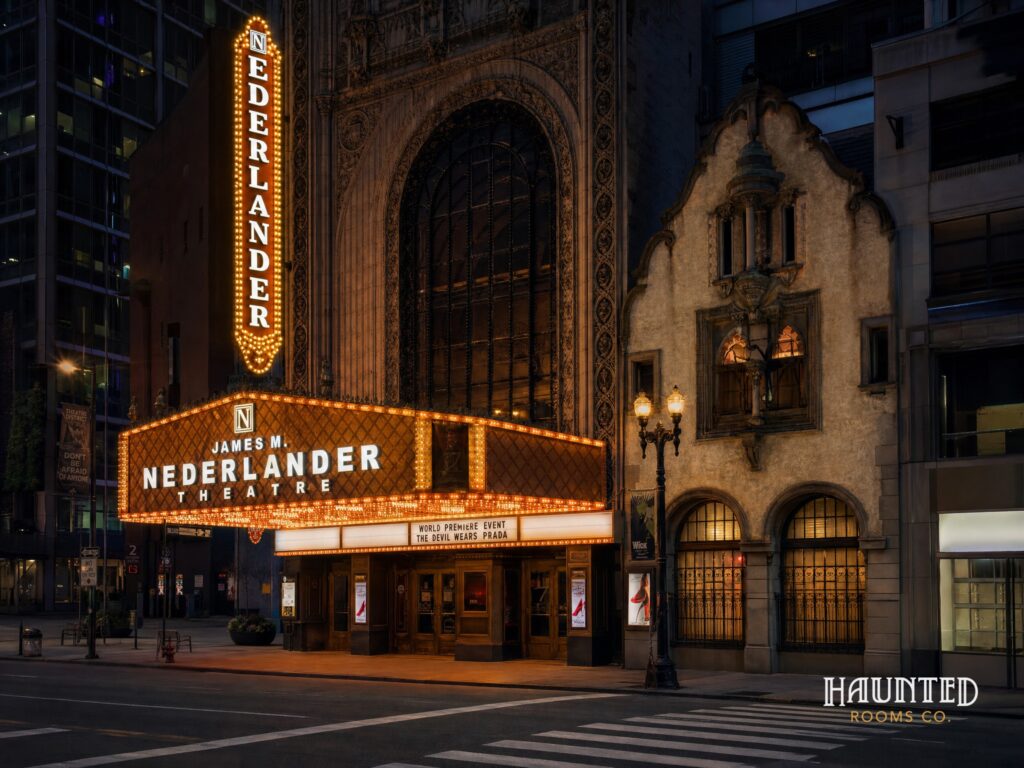
The Iroquois Theatre on Randolph Street was advertised as fireproof. On December 30, 1903, during a packed afternoon performance of Mr. Blue Beard, an arc light set a curtain alight. Many exits were blocked, and at least 602 people died, the deadliest single-building fire in US history. Many died in the icy alley behind, then called Couch Place, after jumping from the upper floors.
The Oriental Theatre was built on the site in 1926 and renamed the Nederlander in 2019; it still stages Broadway shows. Ghost hunters call the rear alley Death Alley and describe shadow figures, cries and the sound of children laughing, and one woman said a small hand took hers. These are stories; the fire itself is fully documented.
What investigators report
Ghost tour visitors report cold spots and whispers in Couch Place, the alley behind the theatre known as Death Alley, which tours treat as the focal spot.
Address 520 South Michigan Avenue, Chicago, IL 60605
Where to look Room 441, the 12th floor, the Gold Room, the eighth-floor elevator, the South Tower
Reported ghosts A shadow woman in Room 441; Peg Leg Johnny; the 'hand of mystery'; a mother and two sons tied to 1939
Visiting A working hotel; book a room to stay
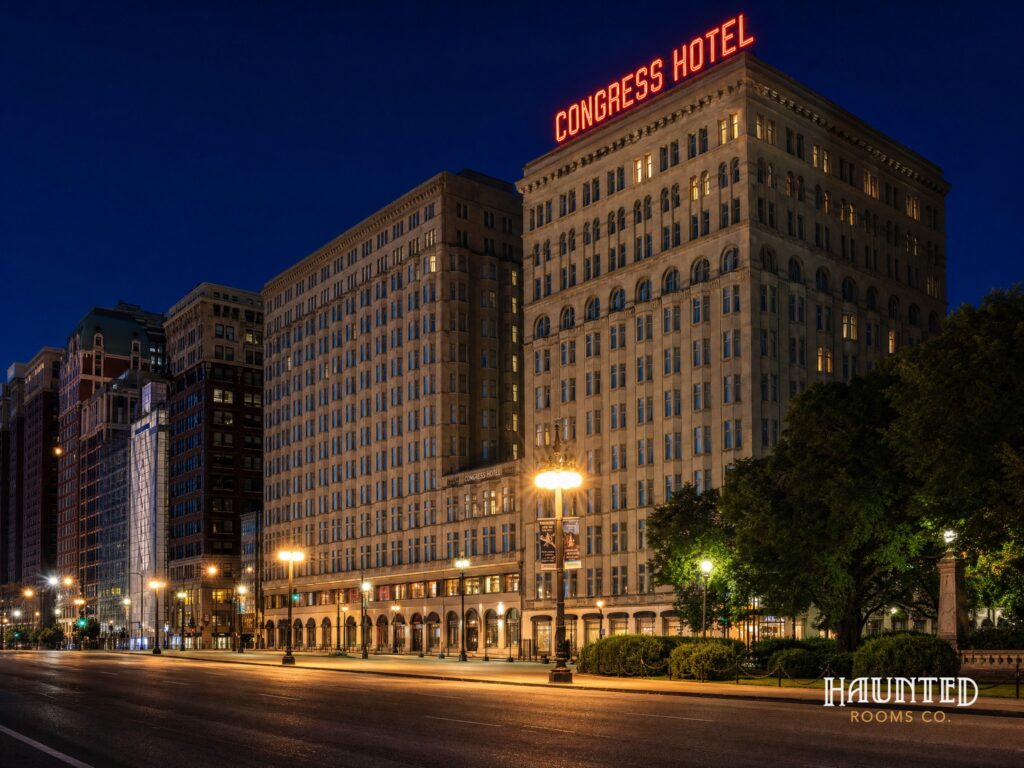
The Congress Plaza opened in 1893 as the Auditorium Annex, built for crowds heading to the World’s Columbian Exposition, and it still faces Grant Park across Michigan Avenue. Presidents from Grover Cleveland to Franklin Roosevelt stayed here, Theodore Roosevelt spoke to a crowd from its balcony in 1912, and the Army took it over in World War II. With 871 rooms, it is one of the largest historic hotels in Chicago.
It is also the Chicago hotel with the longest list of ghost stories. Security is said to be called to Room 441 more than any other room, after guests report a shadowy woman at the foot of the bed. A room on the 12th floor is said to have been sealed, staff talk about a one-legged drifter called Peg Leg Johnny, and wedding guests in the Gold Room tell of bridesmaids missing from photos.
What investigators report
One investigation team reports EMF spikes, a sharp temperature drop and whispering on EVP recordings in the south tower stairwell on the 3rd floor, plus cigar smoke and EMF spikes on the 8th floor of the north tower; Room 441 was quiet during their session.
Haunted Rooms tip: Request Room 441 or a 12th-floor room when you book, and walk Peacock Alley and the Gold Room level in the evening. Rooms with a lake view look straight over Grant Park.
Where to look The front gates on Archer Avenue and the road toward Willow Springs
Reported ghosts Resurrection Mary, the vanishing hitchhiker in a white dress
Visiting Working Catholic cemetery; grounds open daily in daytime
Ghost hunting No: a working cemetery. Chicago ghost bus tours pass the gates
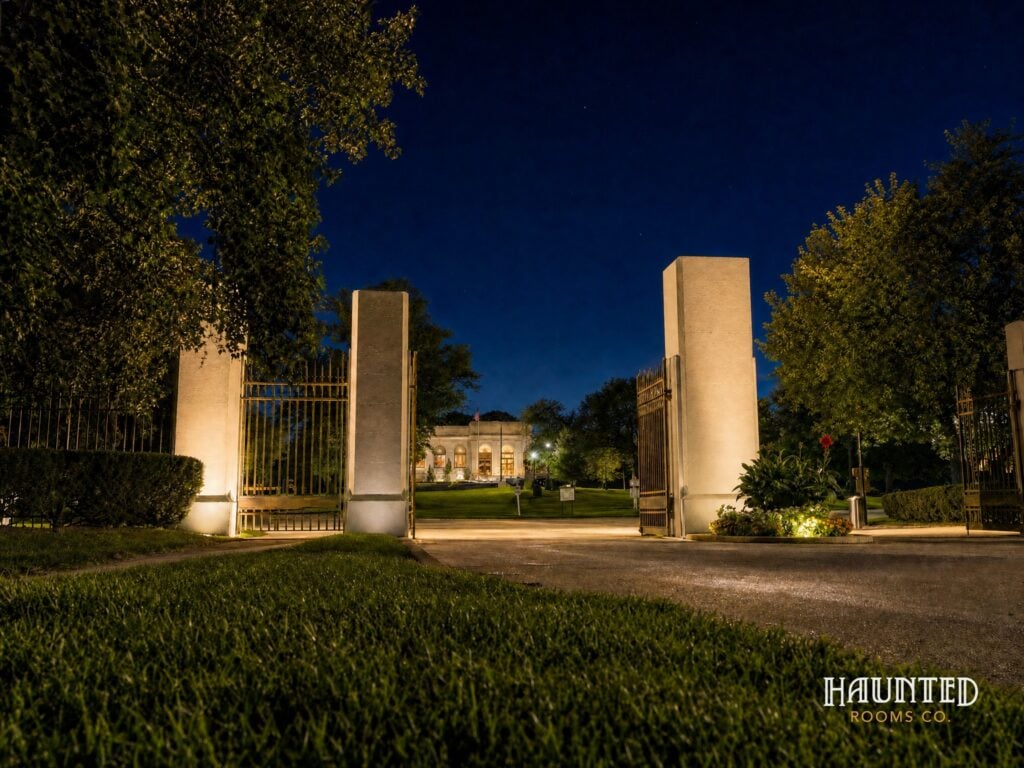
Resurrection Cemetery was consecrated in 1904 on Archer Avenue in Justice, southwest of Chicago, and has grown to more than 540 acres with over 150,000 graves. Its 1969 mausoleum is wrapped in a vast wall of dalle de verre stained glass. It is also the home of Chicago’s best-known ghost. Since the 1930s drivers on Archer Avenue have told of picking up a young woman in a white dress who asks for a ride and vanishes as the car reaches the cemetery gates.
The story says she died after leaving a dance at the Oh Henry Ballroom (later the Willowbrook), which burned in 2016. In August 1976 police found two gate bars bent with marks like handprints; the cemetery blamed a truck and later removed the bars. Researchers have named Mary Bregovy, killed in 1934, but she died downtown, not on Archer Avenue, and no identity has ever been proven.
What investigators report
Ghost hunters report driving repeated late-night loops along Archer Avenue past the main gates looking for the woman in white, and watching the mausoleum, where lights and faint organ music are reported.
Address Chicago Riverwalk between Clark St and LaSalle St, Chicago, IL
Where to look The south bank of the river between the Clark and LaSalle bridges
Reported ghosts Faces in the water, cries and splashing
Visiting Public riverwalk with a historical marker, open at all hours
Ghost hunting No organized investigations; Chicago ghost tours stop here
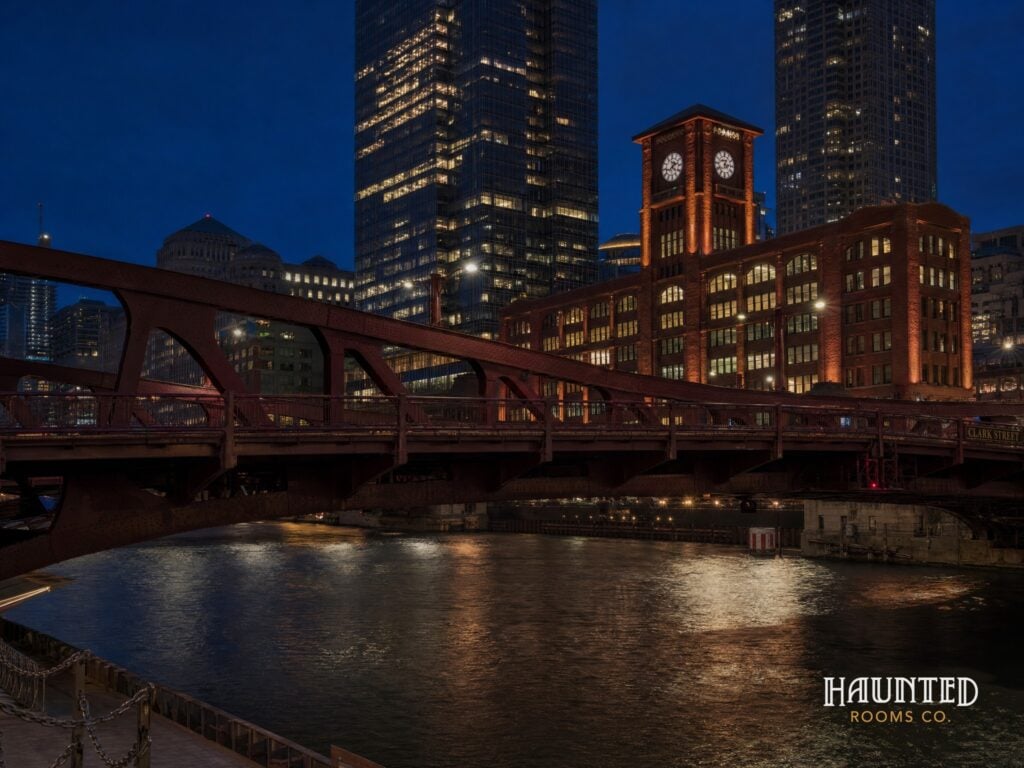
On the morning of July 24, 1915, the excursion steamer Eastland, packed with Western Electric workers and their families bound for a company picnic in Michigan City, rolled over at her dock on the Chicago River between Clark and LaSalle streets. She went over while still tied to the wharf, and 844 passengers and crew died, the worst loss of life in any Great Lakes shipwreck. Twenty-two whole families were lost.
The dead were laid out in temporary morgues, including the 2nd Regiment Armory, which much later became Oprah Winfrey’s Harpo Studios. Ghost hunters and tour guides say people on the riverbank have heard screams and splashing or felt sudden panic, and apparitions have been reported at the old armory. A historical marker on the Riverwalk tells the story.
What investigators report
Investigators report recorder and app-based word sessions on the Wacker Drive riverfront where the ship capsized, logging replies such as “east” when asked where passengers were going, though wind, water and boat noise make EVP work hard.
Visiting a haunted place by day is one thing. Investigating one after dark is another. On a Haunted Rooms ghost hunt our team takes you through a historic building with professional ghost hunting equipment, runs EVP sessions and vigils, and gives you time to explore on your own. These are the nearest ones we run.
Mortuary Manor Ghost Hunt, Toledo: investigate a former north Toledo funeral home with its embalming rooms, basement morgue and viewing parlors still in place.
Address Rubio Woods Forest Preserve, off Midlothian Turnpike, Midlothian, IL
Where to look The quarry pond, the Fulton family stones and the old road bed
Reported ghosts The Madonna of Bachelor's Grove, a phantom farmhouse, lights and phantom cars
Visiting Open grounds in a Cook County forest preserve; short walk from the Midlothian Turnpike
Ghost hunting No organized events; respect the graves and the preserve’s rules
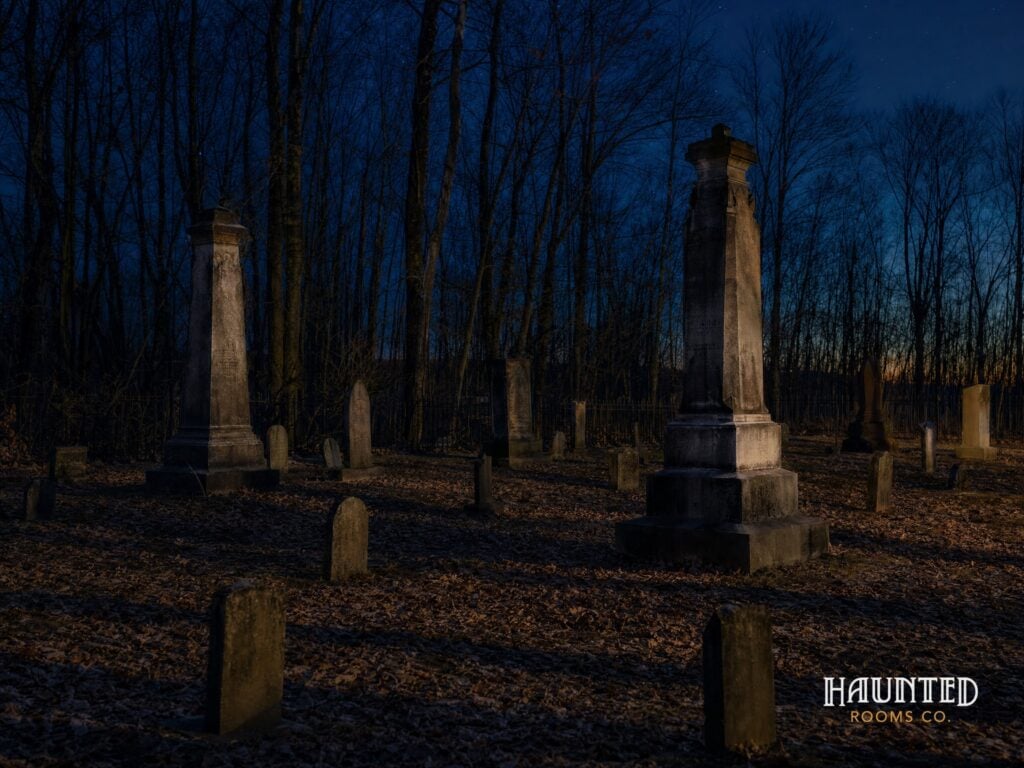
This one-acre pioneer graveyard sits inside the Rubio Woods forest preserve near Midlothian, reached by a short foot path from the Midlothian Turnpike. Settlers arrived in the 1830s and the name probably comes from the Batchelder family. The first burials date from 1838 to 1844 and the last from 1989, with about 200 people buried here. Vandals broke, sprayed and stole most of the stones from the 1960s on, some thrown into the quarry pond beside it. Cook County has looked after it since about 1976.
Ghost stories took off in the 1970s: floating lights, phantom cars, a farmhouse that vanishes as you approach, and the Madonna of Bachelor’s Grove, a woman in white photographed sitting on a stone by a Ghost Research Society member in 1991. Local historian Brad Bettenhausen says few of the tales have any basis in fact and asks visitors to treat it as a burial ground.
What investigators report
Investigators report Ovilus and EVP sessions at the checkerboard tombstone and by the lagoon getting one-word replies, with dowsing rods and Mel meters also reacting near the infant headstone.
Where to look The Inez Clarke monument and the Eternal Silence statue
Reported ghosts The girl in the glass box who vanishes in storms; the statue that shows your death
Visiting Working cemetery; grounds open to visitors in daytime
Ghost hunting No: a working cemetery
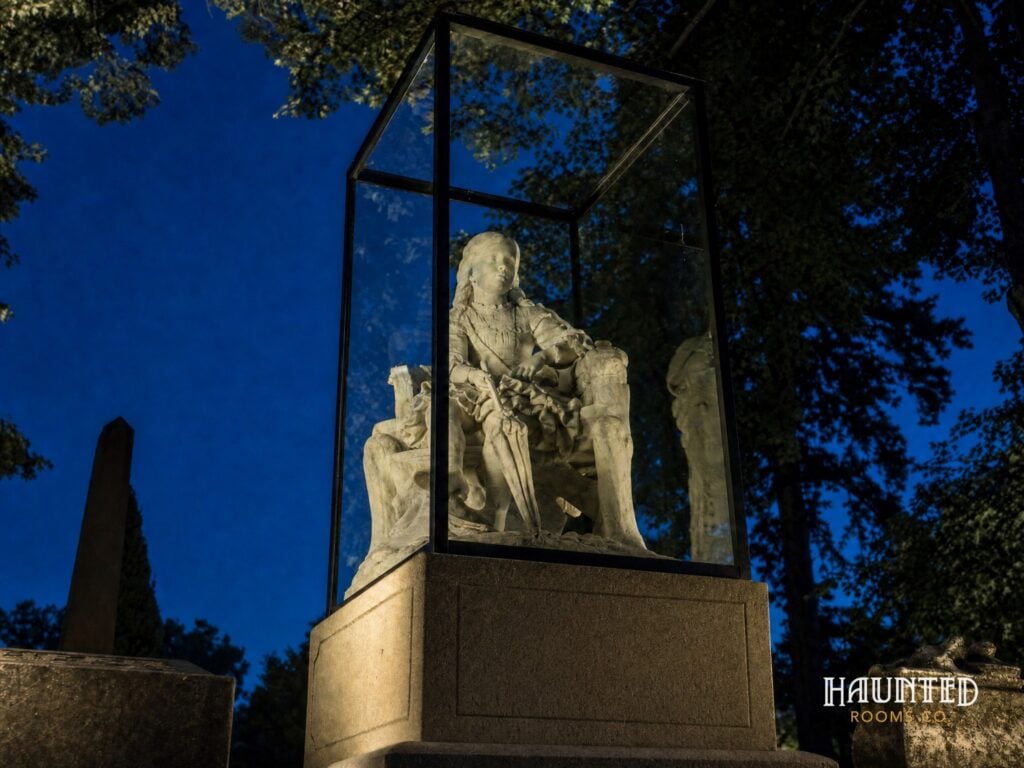
Thomas Bryan founded Graceland in 1860, and its landscaped grounds hold Daniel Burnham, Louis Sullivan, Mies van der Rohe, Marshall Field, Potter and Bertha Palmer, George Pullman and Jack Johnson. It is listed on the National Register. Two monuments draw the ghost stories. The first is a life-size girl with a parasol in a glass case, marked Inez Clarke, 1873 to 1880. The second is Lorado Taft’s hooded bronze Eternal Silence on the Dexter Graves grave.
Legend says Inez was killed by lightning and that her statue vanishes from its glass box when it storms; guards have been quoted saying it disappears. Records tell a different story: the cemetery says she was almost certainly Inez Briggs, who died in 1880, apparently of diphtheria, and one historian thought the statue was a sculptor’s sample. Locals also say that looking into the eyes of Eternal Silence shows you your own death.
Haunted Rooms tip: Pick up a map at the gate, find Inez Clarke, then see Eternal Silence: both are easy walks from the entrance.
Reported ghosts A hanging man seen in an upper window
Visiting Plaza open at all times; City Gallery open free during exhibitions
Hours and season Gallery Monday to Friday 10 AM to 7 PM, weekends 10 AM to 5 PM, during exhibitions
Ghost hunting No
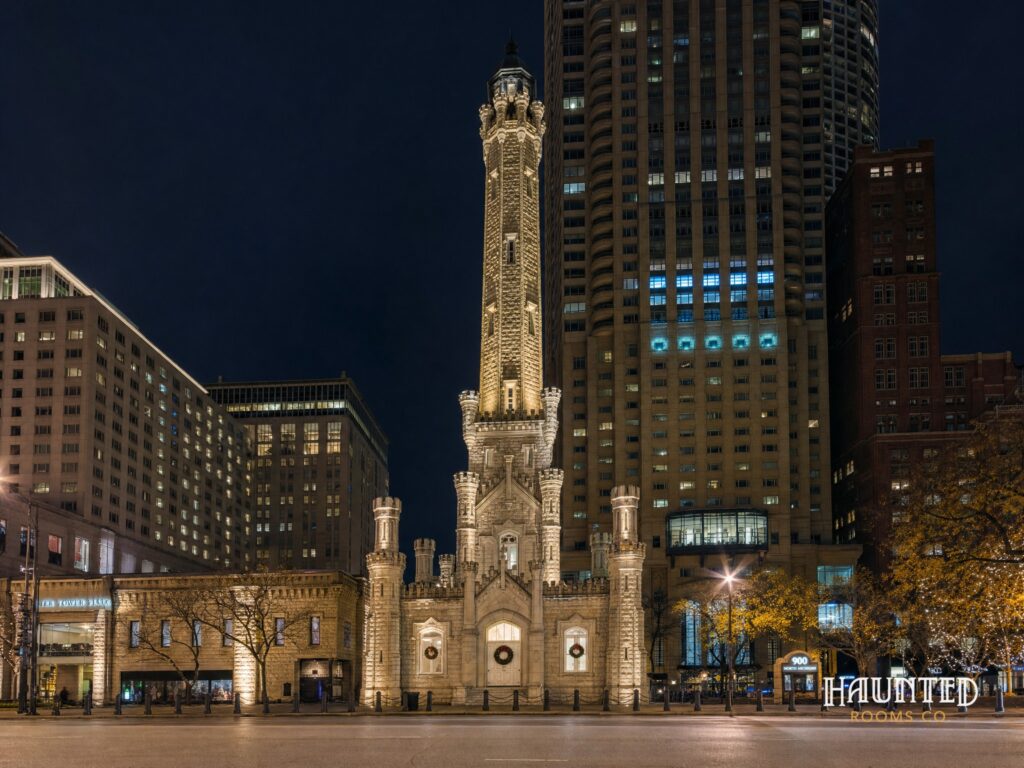
William W. Boyington designed the castle-like Water Tower, built from yellow Lemont limestone between 1867 and 1869 to hold a 135-foot iron standpipe for the city’s water system. It was one of the few buildings to survive the Great Chicago Fire of 1871 and is now the landmark of the Magnificent Mile. Its ground floor is the free City Gallery, open during exhibitions.
The ghost story says a pump worker stayed at his post as the fire closed in and hanged himself in the tower rather than burn, and that his figure is seen hanging in an upper window. There is no record of any such death, and the tower held a standpipe rather than firefighting pumps, so treat this as legend. Time Out and local tour guides still tell it.
Haunted Rooms tip: Look up at the tower from the plaza after dark, then step inside the City Gallery if an exhibition is on.
Where to look The 10th floor, the Gold Coast Room, the Palm Court, the eighth floor
Reported ghosts The Lady in Red; Jacob and Flora Franks; a Woman in Black
Visiting A working hotel; book a room to stay
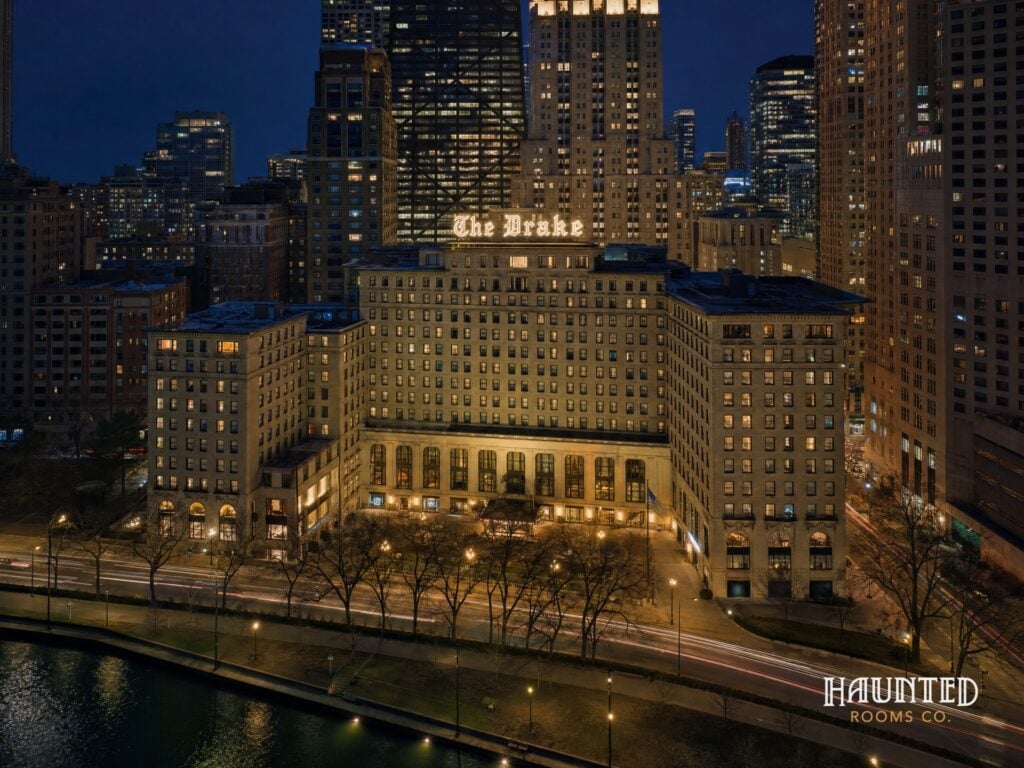
The Drake opened on New Year’s Eve 1920 at the top of the Magnificent Mile, an Italian Renaissance palace by Marshall and Fox built for brothers Tracy and John Drake. Winston Churchill, Princess Diana, Walt Disney and Frank Sinatra all stayed, Marilyn Monroe and Joe DiMaggio carved their initials into a bar here, and afternoon tea in the Palm Court is still a Chicago ritual. It is now part of Hilton, with 535 rooms.
Its ghost is the Lady in Red. The story says that on opening night she found her fiance with another woman and jumped to her death from the 10th floor or the roof. Guests report a woman in a red dress on the 10th floor, in the Gold Coast Room and in the Palm Court. Other stories tie the parents of murdered boy Bobby Franks to the hotel.
Haunted Rooms tip: Book a room on the 10th floor if you can, and take afternoon tea in the Palm Court. Pets are welcome for a fee.
Address South end of Lincoln Park, behind the Chicago History Museum, Chicago, IL
Where to look The Couch Tomb and the lawns at the south end of the park
Reported ghosts Figures and a heavy atmosphere where thousands of graves were never moved
Visiting Public park, open daily
Ghost hunting No
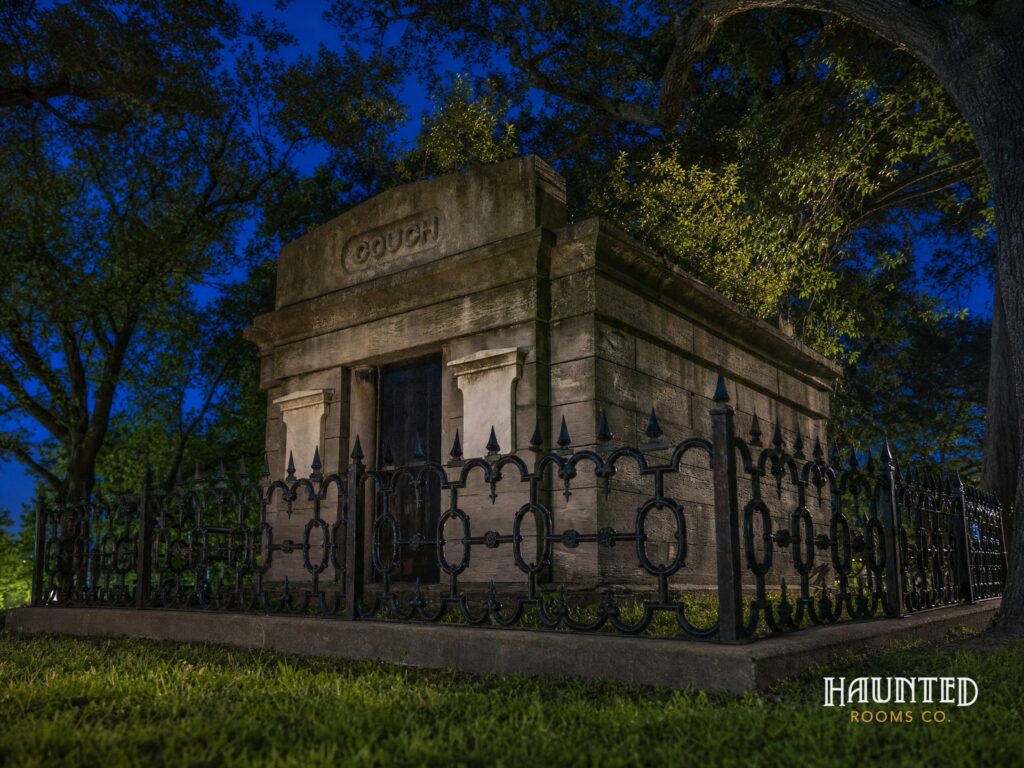
The south end of Lincoln Park was Chicago’s City Cemetery. From the 1860s the city began moving bodies out to make a park, but the work was never finished, and the Great Chicago Fire of 1871 burned the wooden markers. Bones still turn up: workers digging in 1998 found the remains of more than 80 people and an iron coffin. Time Out puts the number of unmarked graves left under the lawns as high as 10,000.
About 35,000 people are thought to have been buried in the park’s cemetery sections. The only marked grave left is the tomb of Ira Couch, the innkeeper who opened the Tremont House, designed by John Van Osdel; a plaque says six Couch family members and a friend lie inside, though other estimates run from one body to 13. Author and tour guide Ursula Bielski calls the park the most active site she has investigated, with reports of figures, heaviness and nausea. The Lincoln Park Zoo runs history tours in October.
What investigators report
Investigators report ghost box and Ovilus sessions by the lagoon and beneath a large old tree on the former cemetery ground picking up short replies, while traffic noise drowned out EVP work at the Couch Tomb itself.
Address 100 West Main Street, St. Charles, IL 60174
Where to look The top-floor penthouse (former staff quarters), the riverside, the Rainbow Room
Reported ghosts A jilted chambermaid said to have drowned in the Fox River
Visiting A working hotel; book a room to stay
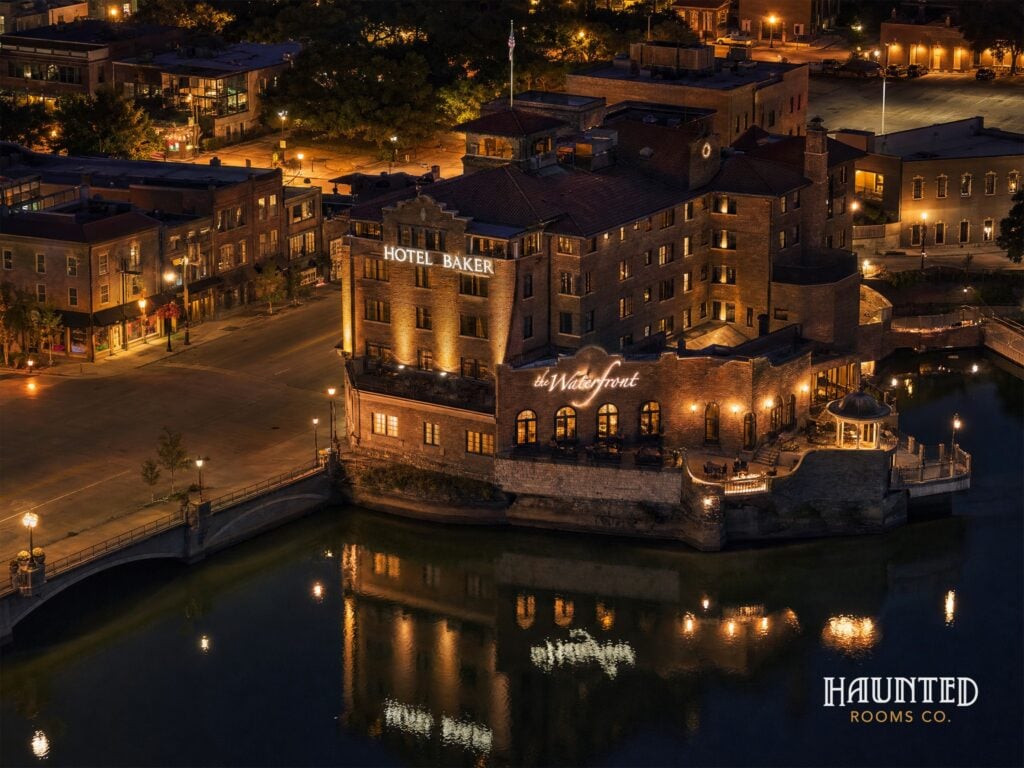
Colonel Edward J. Baker opened his Spanish Revival hotel on the Fox River on June 2, 1928, when a room cost $2.50 a night. Its Rainbow Room had the first lighted dance floor, with 2,620 colored lights under glass, and Louis Armstrong, Tommy Dorsey and Lawrence Welk played there. Nicknamed the ‘Honeymoon Hotel’, it is on the National Register of Historic Places and has 53 rooms, about an hour west of Chicago.
Its ghost story is a sad one. Local legend says a chambermaid who was jilted by her fiance drowned herself in the Fox River, right below the hotel, and came back to work. The maids once lived on the top floor, now a penthouse suite, and guests there have reported sobbing, voices and bedding tugged by unseen hands.
Haunted Rooms tip: Ask about the penthouse suite on the top floor, where the maids once lived, and walk the riverside terrace after dark.
Where to look The Capone booth, the bar and the tunnels below
Reported ghosts Noises from the sealed tunnels below the bar
Visiting Working jazz club, 21 and over
Ghost hunting No
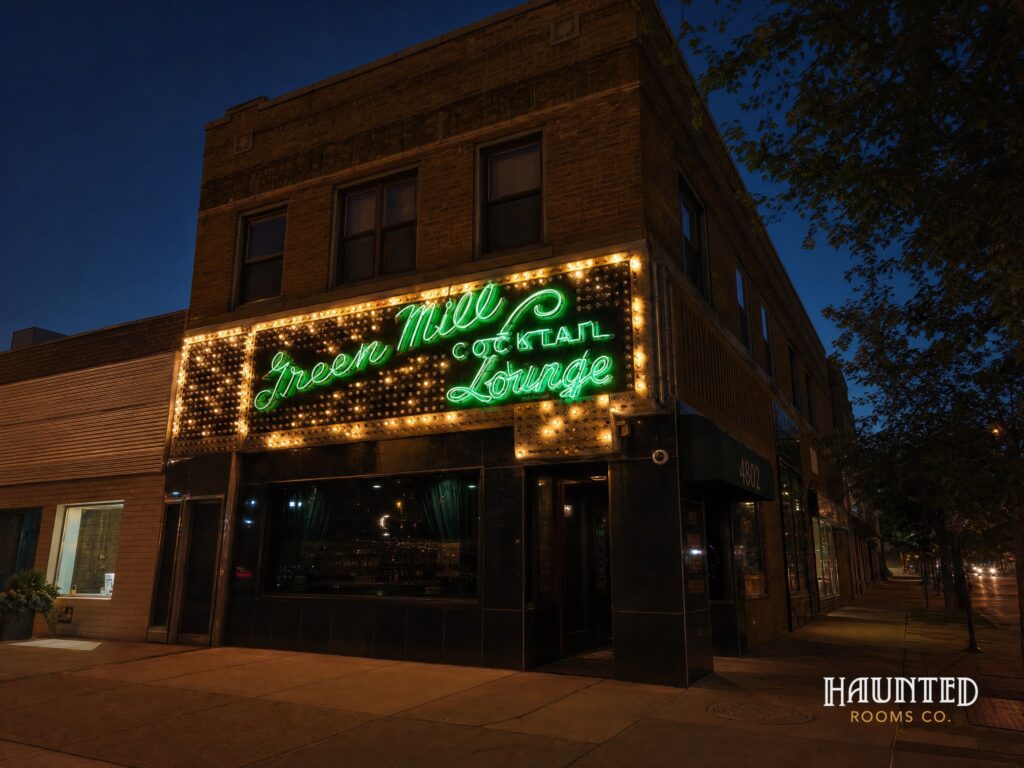
The Green Mill began as Pop Morse’s Roadhouse (city records say 1898; the usual date is 1907) and became Green Mill Gardens. Around 1926 it reopened as the New Green Mill, part-owned by Jack McGurn, the Outfit gunman linked to the St. Valentine’s Day Massacre. Dave Jemilo reopened it in 1986 as one of Chicago’s best-known jazz clubs, and it passed to new owners in June 2026.
The curved booth by the bar is called Al Capone’s booth, though the current room dates from 1935, after Capone went to prison. A trap door behind the bar is said to lead to tunnels used for escapes and bootleg liquor. Staff have told Time Out of noises from the sealed tunnels.
Haunted Rooms tip: Arrive early for a seat near the booth, and keep your phone silent during sets: the house rules are strict.
Reported ghosts John Dillinger, said to haunt the alley where he was shot
Visiting See from the street; the alley is closed off
Ghost hunting No
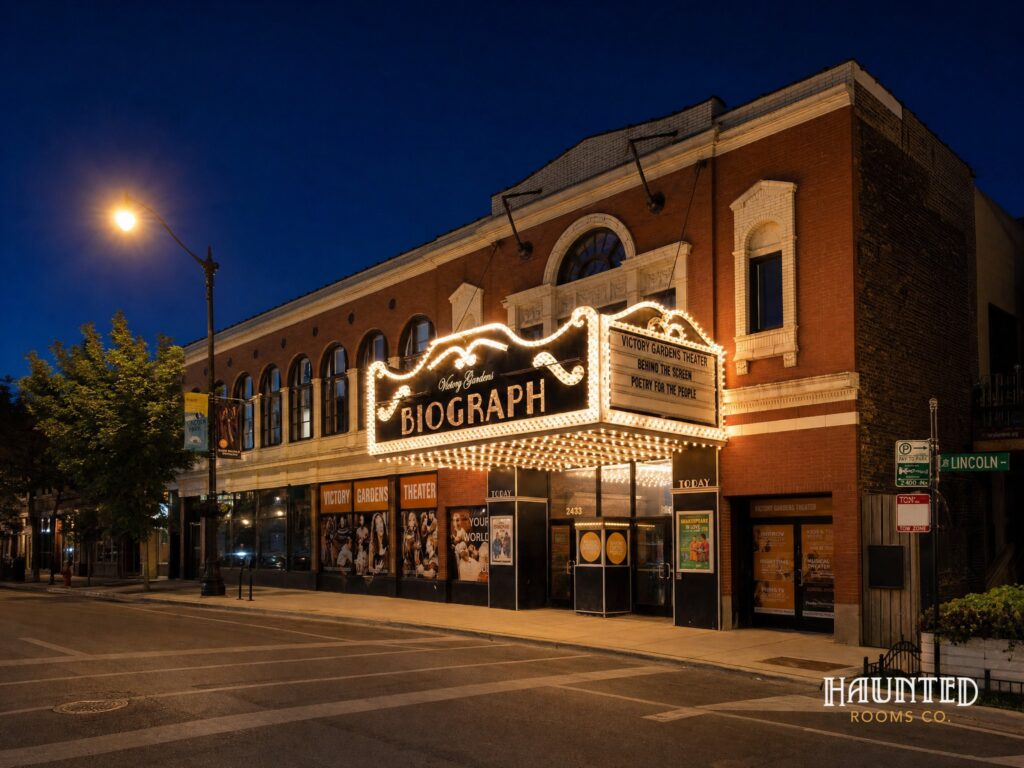
The Biograph opened as a movie house in 1914. On the night of July 22, 1934, FBI agents shot John Dillinger, the bank robber they had named Public Enemy No. 1, as he left a screening here. It is a Chicago Landmark and on the National Register, and Victory Gardens Theater renovated it as a playhouse in 2006. The stage has been mostly dark since the pandemic, but Porchlight Music Theatre plans to stage its 2026 to 2027 season here.
Dillinger had just watched Manhattan Melodrama, and his landlady Anna Sage, the so-called Lady in Red, had tipped off the agents in the hope of avoiding deportation. He fell in the alley just south of the theater. Legend says his ghost haunts that alley, and some visitors say they have felt a presence there. Each July the Died for You Society marks the anniversary with a procession to the alley. Time Out notes the alley itself is now boarded up, so see it from Lincoln Avenue.
Haunted Rooms tip: Stand under the restored marquee on Lincoln Avenue at night and imagine the summer evening in 1934.
Address Woodlawn Cemetery, 7750 Cermak Rd, Forest Park, IL
Where to look The mass grave and its five elephant statues
Reported ghosts Elephants heard trumpeting at night
Visiting Working cemetery, open daily until dusk
Ghost hunting No: a working cemetery
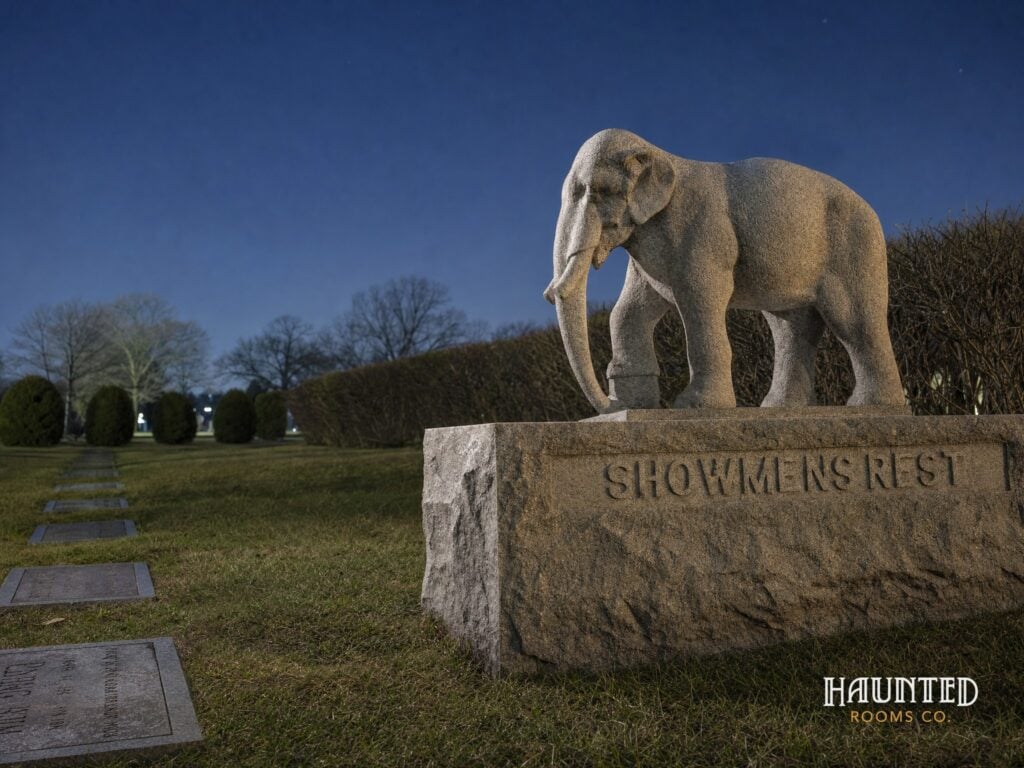
Before dawn on June 22, 1918, an empty troop train ran into the back of the Hagenbeck-Wallace Circus train near Hammond, Indiana, after its engineer fell asleep. The wreck caught fire and 86 people died. Five days later more than 50 of them were buried together in Showmen’s Rest, a plot the Showmen’s League of America had bought at Woodlawn Cemetery. Few could be named, so stones read Unknown Male, Baldy, Smiley and 4 Horse Driver.
Five stone elephants with lowered trunks, a sign of mourning, guard the plot. The legend says elephants died in the wreck and are buried here, and that you can hear them trumpeting at night. No elephants are buried here; the cemetery says there are only people, and the sounds were most likely the elephants at nearby Brookfield Zoo.
Haunted Rooms tip: Ask at the cemetery office for directions to the plot, and visit before dusk when the gates close.
Where to look The front bedroom and the small parlor
Reported ghosts A smoky woman in gray, a little boy in 1890s clothes, the architect himself
Visiting Private residence; view from the street only
Ghost hunting No: private home
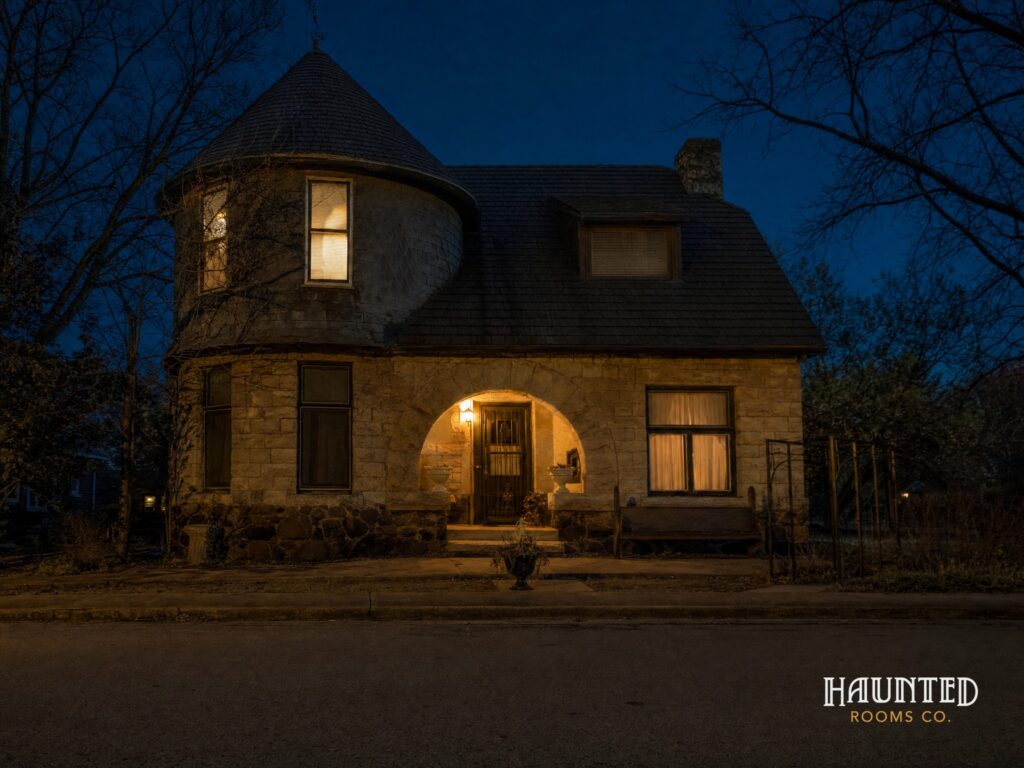
Architect Frank Shaver Allen, who designed Joliet Central High School and the old Christ Episcopal Church, built this limestone cottage with its round tower for his own family in 1887. His first wife, Mary, died in childbirth in 1895, and Allen moved to California in 1904. The Magosky family lived here from the late 1960s to 2014; later owners put it up for sale in 2017 and 2020, and paranormal researcher Mary Lou Wahlstrom bought it in 2023.
Cean Magosky, who grew up here, told the Herald-News of a smoky woman in a gray dress who checked on him at night, once with a boy in 1890s clothes. A meter reader saw a woman in old-fashioned dress vanish in the yard. Wahlstrom believes Allen himself is the figure in the small parlor. It is a private home.
Haunted Rooms tip: Look from the sidewalk on Morgan Street only: this is someone’s home, and trespassers are not welcome.
Address East River Rd at Lawrence Ave, Norridge, IL 60656
Where to look The boulder marking the Robinson graves and the trail toward the Des Plaines River
Reported ghosts Drumming, lights on the trail, the scent of lilacs, the sound of chopping
Visiting Cook County forest preserve of 265 acres with trails and picnic groves; the Robinson family burial ground is marked with historical markers
Hours and season Sunrise to sunset, all year
Tickets Free
Ghost hunting No organized events
Alexander Robinson, known as Chee-chee-pin-quay, was a leader of the Potawatomi, Ottawa and Ojibwe who ran one of Chicago’s first taverns and helped survivors escape the Fort Dearborn fight in 1812. In 1829 his family was granted 1,280 acres along the Des Plaines River. He died in 1872 and was buried on his land, now a Cook County forest preserve, beside a large boulder. Family headstones removed in the 1950s were returned to his descendants in 2016.
The woods carry darker memories. In May 1955 the old Robinson homestead burned in a fire nobody explained, and the county bought the land soon after; that October the bodies of three boys, John and Anton Schuessler and Robert Peterson, were found nearby, a case not solved until 1994. Ghost researchers have reported drumming near the graves since the 1970s, lights in the woods after closing, the sound of an axe, and the scent of lilacs near the boulder in winter. A 2022 Ghost Research Society visit recorded nothing unusual.
Haunted Rooms tip: Visit in daylight, walk to the boulder quietly and remember this is a family burial ground.
These places appear on most lists of Chicago’s haunted places. We keep them here so you know the facts, but there is nothing left to visit.
H.H. Holmes's Murder Castle, Englewood
Herman Mudgett, who called himself Dr. H.H. Holmes, built his so-called castle in Englewood near the 1893 World’s Fair and confessed to 27 murders, many of women drawn to Chicago by the fair. The building was demolished in 1938. The site is now an empty lot beside the Englewood post office, whose basement staff have reported odd sightings, but there is nothing of the castle left to see.
St. Valentine's Day Massacre site, Lincoln Park
On February 14, 1929, gunmen killed seven men from Bugs Moran’s gang in a garage on North Clark Street; Al Capone was widely blamed and later said he was haunted by one of the victims. The garage was demolished, and the site is now a grassy lot. Some say dogs still react as they pass.
Willowbrook Ballroom, Willow Springs
The Oh Henry Ballroom, later the Willowbrook, is where Resurrection Mary is said to have danced on her last night. It was gutted by fire on October 28, 2016, and the site has been redeveloped for housing. Follow the story at Resurrection Cemetery instead.
Removed from this guide: Prairie Avenue’s mansions (the Glessner House is a fine museum, but we could not find a reliable source for the ghost stories once told here), the old Excalibur club at 632 North Dearborn (now the Tao Chicago nightclub; its ghost stories are rumors only) and Hunter’s on Halsted (we could not confirm its current status). The Clark Street Bridge story is now told under the Eastland disaster site.
Visited one of these places? Tell us what happened
We collect first-hand accounts from visitors and add the best ones to our guides, with your first name and the date of your visit. We read every story before it’s published.
Frequently asked questions
What is the most haunted place in Chicago?
Resurrection Cemetery, home of the Resurrection Mary legend, and Bachelor’s Grove Cemetery are the two most often named. Downtown, the alley behind the old Iroquois Theatre and the Congress Plaza Hotel top most lists.
Who is Resurrection Mary?
Chicago’s vanishing hitchhiker: a young woman in a white dress who asks drivers on Archer Avenue for a ride and disappears at the gates of Resurrection Cemetery in Justice. The story has been told since the 1930s, and her identity has never been proven.
Can you go ghost hunting in Chicago?
Yes, at the Old Joliet Prison southwest of the city, where Haunted Rooms runs its own ghost hunts and the Joliet Area Historical Museum runs haunted history tours. Hull-House runs ghost tours each October but does not allow investigations, and the cemeteries are for daytime visits only.
Is Bachelor's Grove Cemetery open to visitors?
Yes. It sits in the Rubio Woods forest preserve near Midlothian, reached by a short path from the Midlothian Turnpike. Visit in daylight and treat it as the burial ground it is.
What is the most haunted hotel in Chicago?
The Congress Plaza Hotel on Michigan Avenue, with Room 441 and the 12th floor. The Drake and its Woman in Red are a close second. See our guide to haunted hotels in Chicago.
Where was the Eastland disaster?
On the Chicago River between the Clark Street and LaSalle Street bridges, where the steamer rolled over at her dock on July 24, 1915, killing 844 people. A marker stands on the Riverwalk.
Sources and how we research
Every place in this guide is checked against its official website, historic register listings and news coverage, and we confirm whether it is open, closed, private or gone before we list it. Ghost stories are reported as staff, visitors and local historians tell them; we say so where records contradict a story. Each place shows how many independent sources we checked it against; our own Haunted Rooms pages are not counted.
New guides, haunted places to visit and ghost hunt dates near you. No spam, unsubscribe any time.
About the authors
The Haunted Rooms Team runs public ghost hunts and overnight investigations at historic venues across the United States. We research every place in our guides using official sites, historic registers, local archives and news coverage, and we report ghost stories as the stories they are. We review each guide regularly so you are not sent to a place that has closed, changed hands or banned visitors. Spotted something out of date? Let us know.