Haunted Places in Indiana: 22 Places You Can Visit, Tour or Investigate
A library ghost watched on live cameras, the jail John Dillinger walked out of, a scholar who vanished into the dunes and a sanatorium in the woods. These are Indiana’s haunted places, checked against the records, with the ones you can visit, tour or investigate yourself.
Indiana’s best ghost stories come with real history attached: tuberculosis and county poor asylums, gangsters and Klan leaders, gold rush fortunes and a mineral spa that drew presidents. Our older list mixed those with stories that do not hold up, so we have gone back to the sources for every place: National Register records, the places’ own websites and handouts, Wikipedia, Indiana Public Media and local news. Where a story has no record behind it, we say so. Five of the places below are venues where Haunted Rooms runs its own ghost hunts, and four are haunted hotels where you can spend the night.
For more depth, see our city guides to haunted Indianapolis and haunted Fort Wayne, and our full guides to Willard Library, the Hannah House, Central State Hospital and the Old Whitley County Jail.
Visit on a tourGhost toursParanormal investigations allowed
Address 3801 Madison Ave, Indianapolis, IN 46227
Where to look The cellar (especially its southwest corner), the bedroom at the top of the stairs, the upstairs hall and the parlor chandelier
Reported ghosts Alexander and Elizabeth Hannah, a man in a black suit, a stillborn baby; the cellar fire legend
Visiting A privately owned historic house, open on event nights and open house days
Tours Open houses, Halloween haunted house nights and event rentals
Hours and season Event dates only; check the website
Ghost hunting Yes, private paranormal investigations can be booked with the house
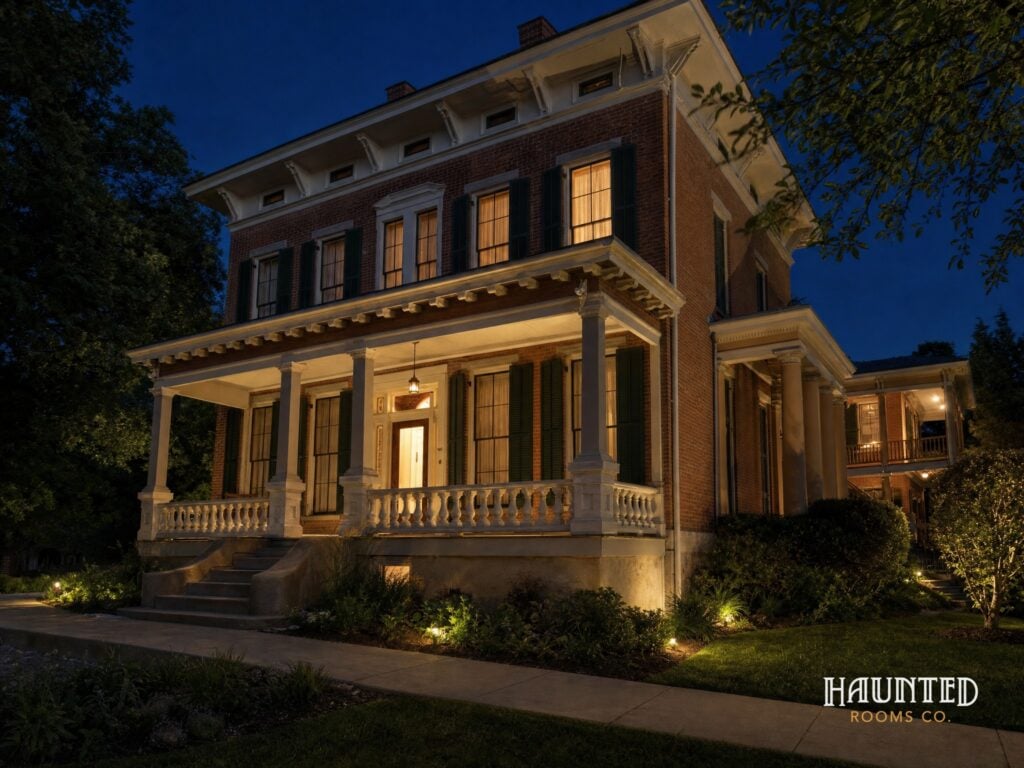
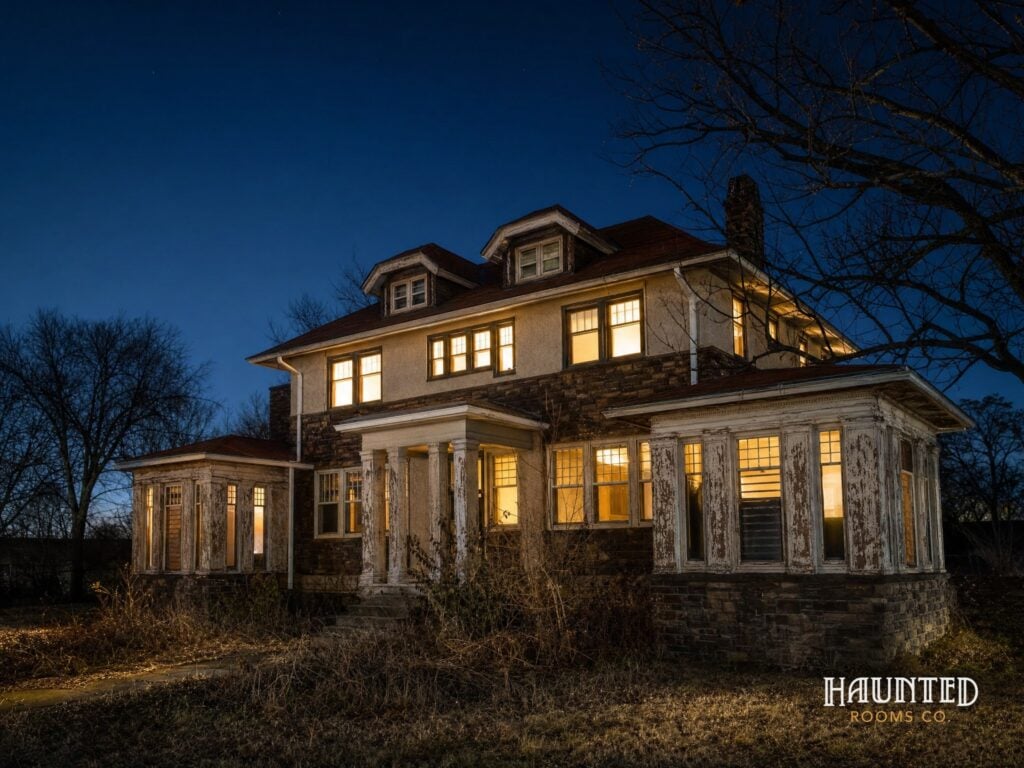
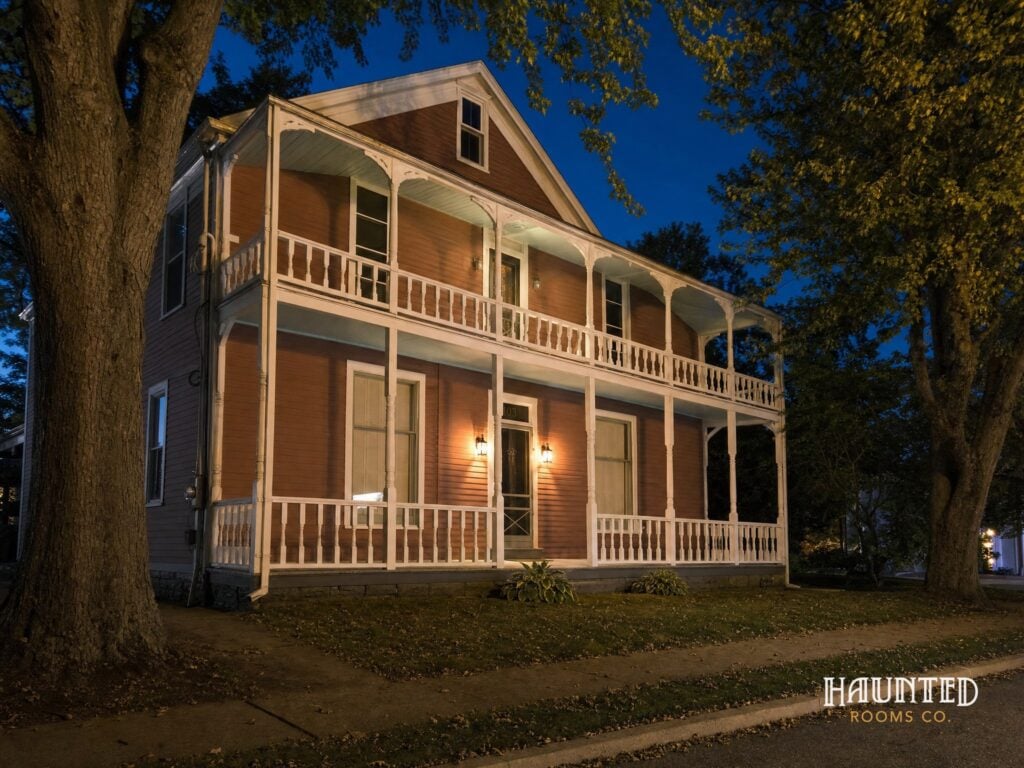
Alexander Moore Hannah, a harness maker who came home from the California gold rush with money to invest, built this 24-room Italianate brick house on his south side farm in 1858 and 1859. He married Elizabeth Jackson in 1872; their only child was stillborn in 1875. German-born Civil War veteran Roman Oehler bought the house in 1899, and his descendants, the Elder family, still own it. It has been on the National Register since 1978.
The haunting stories began in the 1960s, when the house was rented to an antique dealer: a smell of decay in an upstairs bedroom, swaying chandeliers, breaking glass in an empty cellar, and figures at the windows. The famous legend says people escaping slavery died in a cellar fire and were buried there. Indianapolis historians say there is no evidence Hannah ever sheltered freedom seekers, so treat that story as legend. The house raises restoration money with haunted house nights, investigations and open houses.
What investigators report
Ghost Research Society investigators report that Ovilus X sessions in the attic and parlors produced replies including names and fire-related words, and a motion detector was set off in the empty attic. They also ran dowsing rod and SB-11 ghost box sessions in the basement, where the box reportedly answered “male” to a question.
Haunted Rooms tip: The Elder family opens the house for open houses, Halloween haunted house nights and private paranormal investigations. Check the Hannah Mansion website for the current dates.
Address 226 to 232 S Main St, Crown Point, IN 46307
Where to look The cell blocks, Dillinger's cell and the kitchen door he walked out of, and the sheriff's residence
Reported ghosts Voices and footsteps in the empty cell blocks, doors that close on their own
Visiting Opened to the public by the Old Sheriff’s House Foundation; on our events you investigate the jail after hours
Ghost hunting Yes, on Haunted Rooms ghost hunts
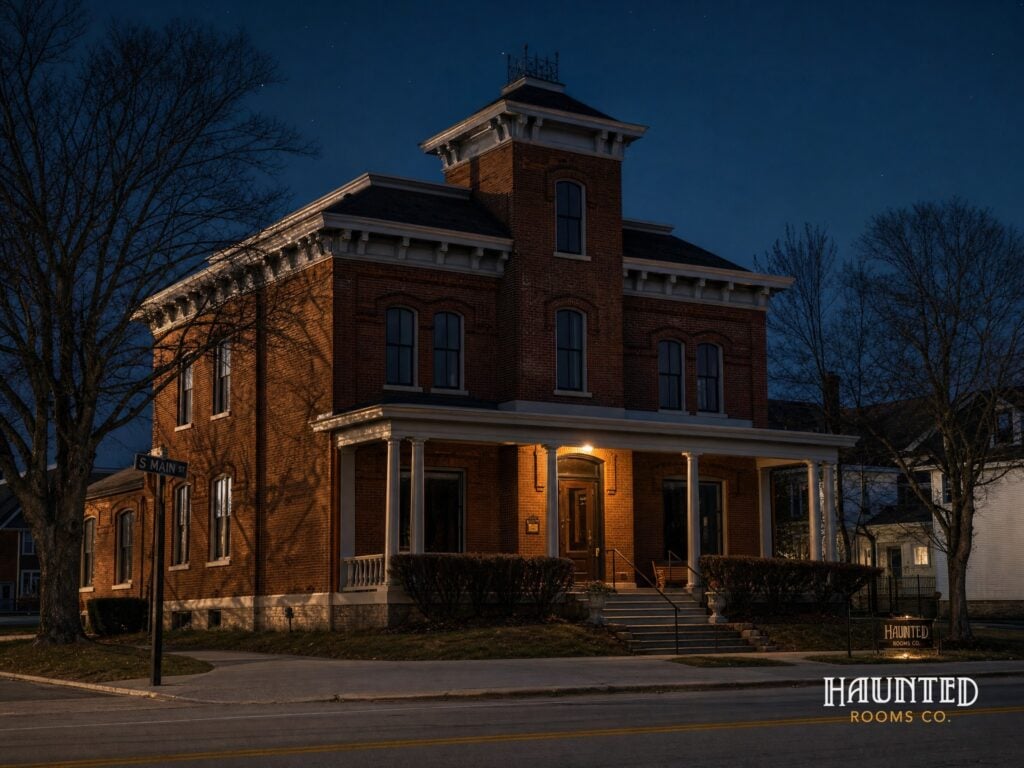
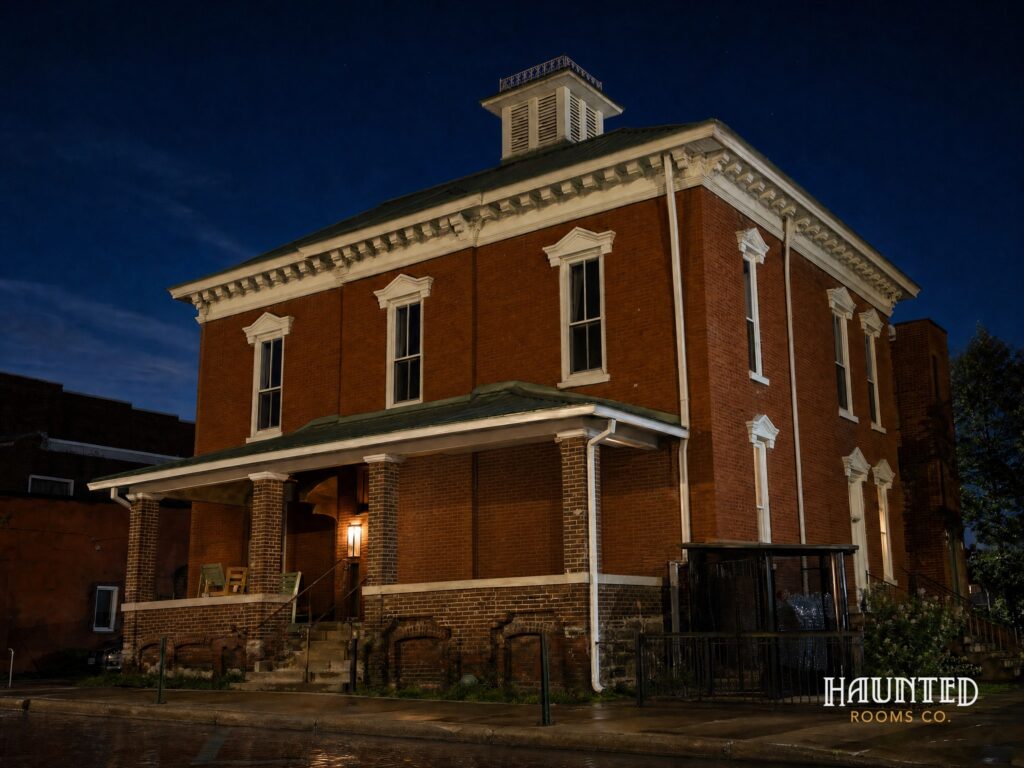
Lake County built this Italianate sheriff’s house, with the jail behind it, on Crown Point’s South Main Street in 1882; it was a residence until 1958 and a jail until 1974. On March 3, 1934, John Dillinger escaped from the jail authorities had called escape-proof, waving a pistol the FBI said was carved from wood and blackened with shoe polish, and drove off in Sheriff Lillian Holley’s new Ford. In 2008 Johnny Depp filmed scenes for Public Enemies inside.
The building is on the National Register and is cared for by the Old Sheriff’s House Foundation, which opens it to the public. Its ghost stories are the ones you would expect from a jail that held thousands of prisoners: voices from empty cells, footsteps on the upper tiers and doors closing by themselves, told by visitors and investigators rather than written records. Haunted Rooms runs ghost hunts here, investigating the sheriff’s house and the cell blocks after dark.
What our team has found
The bottom-floor bullpen is the hot spot, where the dead bell answers questions, K2 meters go to red, the REM pod triggers and guests report being touched; one EVP answered “bell” when asked about favorite equipment. On the second floor dowsing rods pointed to a corner where the K2 was very active, and Estes in the tunnels guided a group to the top-floor juvenile and women’s ward.
From Haunted Rooms event reports
Haunted Rooms tip: Join our ghost hunt at the Old Lake County Jail to investigate Dillinger’s cell block after dark, and visit the 1878 courthouse on the square while you are in Crown Point.
Where to look The basement children's room near the old furnace room, the elevator, the second-floor Special Collections and Bayard Room
Reported ghosts The Grey Lady, said by many to be Louise Carpenter
Visiting A working public library, free to visit
Hours and season Open most days; check the library website for hours
Tickets Free
Ghost hunting No ghost hunting events of its own; anyone can watch the live ghost cams online
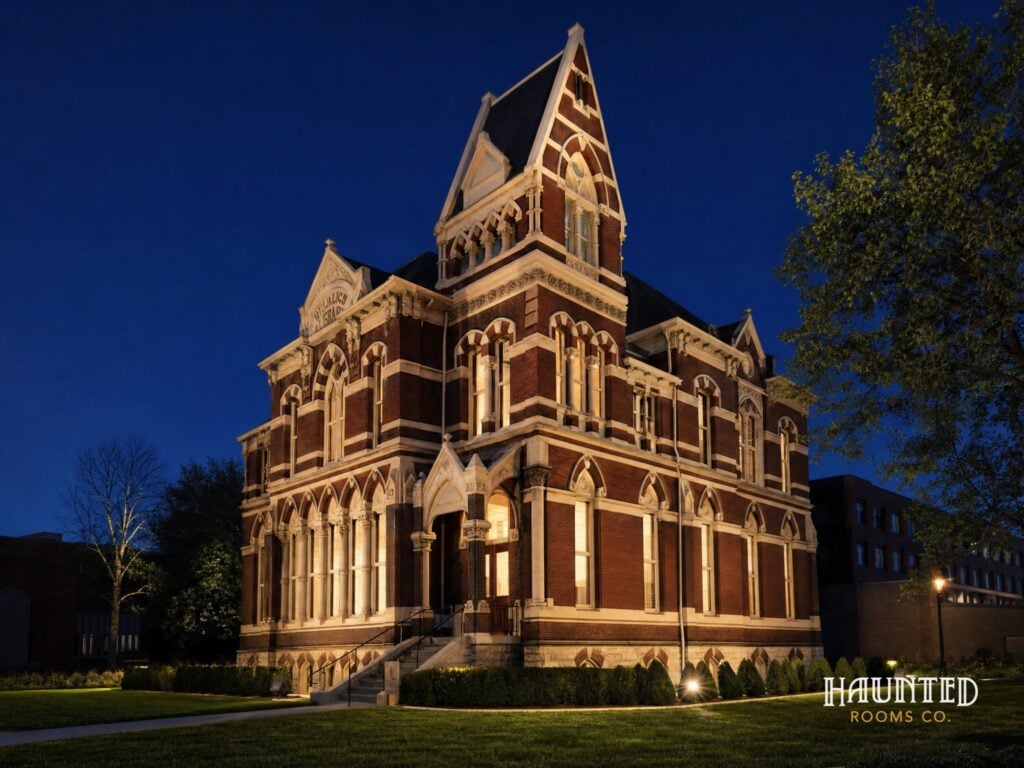
Willard Carpenter, a Vermont-born Evansville businessman, set up a trust in 1876 to found a free public library “for the use of the people of all classes”. He died in 1883, and the High Victorian Gothic building designed by James and Merritt Reid opened in 1885. It is the oldest public library building in Indiana still in use and has been on the National Register since 1972. Carpenter famously left his children out of his will.
The Grey Lady story starts in 1937, when a custodian stoking the basement furnace early one winter morning saw a woman in a flowing grey dress and veil, then quit soon after. Staff and patrons since have reported a strong perfume, books falling from shelves, faucets running in empty restrooms and the elevator moving by itself. Many believe she is Louise Carpenter, the daughter cut out of the will, though that is a theory, not a record. The library runs live ghost cams anyone can watch online.
What investigators report
The library streams ghost cams from the Children’s Room, Basement Hall, Stairway and other areas, and staff say visitors report a lilac or old-fashioned perfume scent, unexplained footsteps and chairs moving. The library hosts after-dark paranormal investigations and invites investigators to send in their evidence.
Haunted Rooms tip: Ask at the desk for the library’s Grey Lady handout, which lists where each story happened, then watch the ghost cams from home after dark.
Where to look The attic, the basement and the old isolation cell on the wards
Reported ghosts Mary, said to be a former cook; voices and footsteps in empty corridors
Visiting Privately owned; open for booked paranormal investigations and events
Ghost hunting Yes, on Haunted Rooms ghost hunts
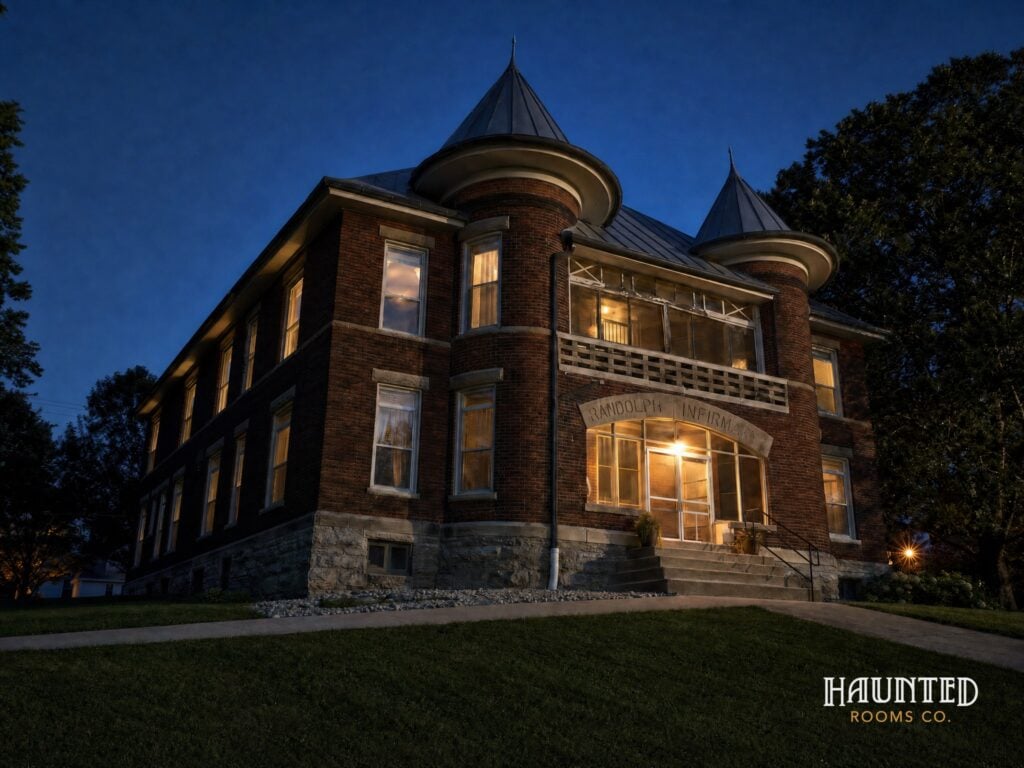
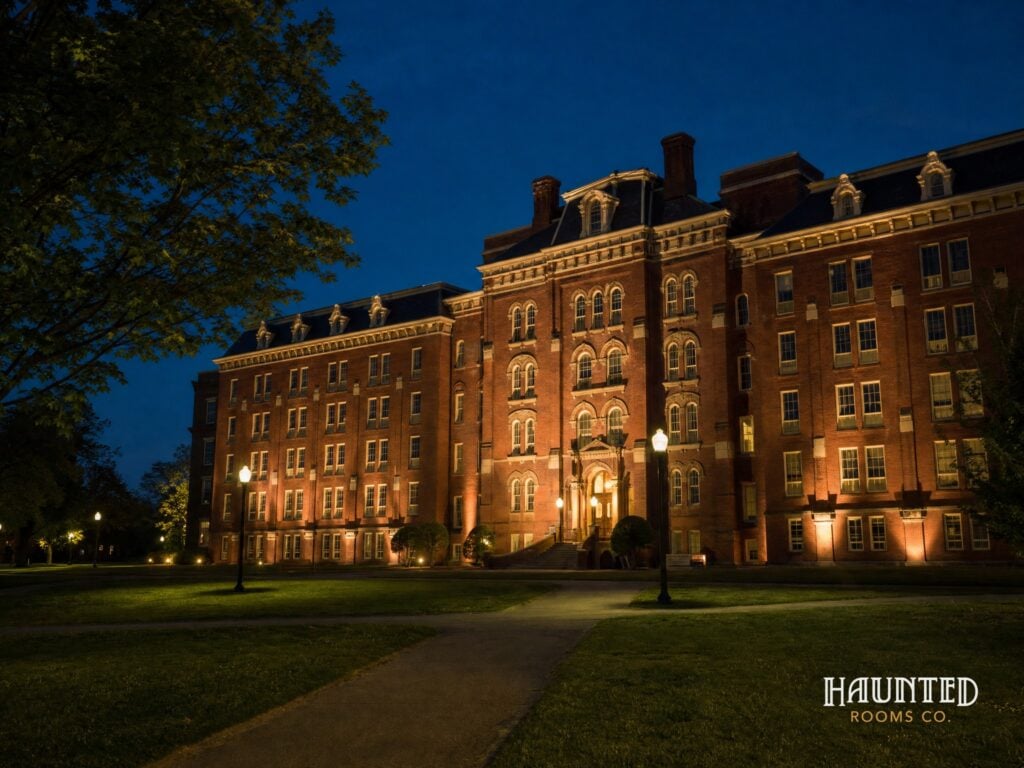
This red brick building with its two round corner towers was Randolph County’s poor asylum, later the county infirmary: the place for the poor, the elderly, orphans, the sick and people with mental illness who had nowhere else to go. Two earlier infirmaries stood here, one from 1851 that burned two years later; this one went up in 1899 on US 27 just south of Winchester for about $40,000. Renamed Countryside Care Center in 1996, it closed in 2008 with five residents left. Hundreds died here over the years, and unclaimed residents lie in unmarked graves on the grounds. It joined the National Register of Historic Places in 2018.
Paranormal investigators have made it one of the best-known haunted buildings in eastern Indiana, describing voices answering questions, footsteps in empty corridors and figures in the upper wards and stairwells. Many speak of Mary, said to be a former cook, as a protective presence; we found no record that identifies her. Haunted Rooms runs ghost hunts here with the building to ourselves for the night.
What our team has found
Activity has been reported on every floor. In the attic dowsing rods and a cat ball responded to a resident called Judge, the spirit box said a host’s name within seconds, and on the first floor the SLS camera mapped a figure that waved on request. Teams have also heard a child’s music box tune in the basement mirror room and the old dinner buzzer sounding.
From Haunted Rooms event reports
Haunted Rooms tip: See our Randolph County Asylum ghost hunt page for dates; the attic and basement vigils are the ones people talk about afterward.
Where to look The laundry, the office areas and the basement
Reported ghosts A weeping woman near the laundry; a man's and a woman's voices
Visiting Private property; open only for booked investigations and events
Ghost hunting Yes, on Haunted Rooms ghost hunts
In the woods east of Rockville, off US 36, the State of Indiana began building its tuberculosis hospital in 1907, and from 1908 to 1968 it was the state’s main TB sanatorium, where patients came for rest, fresh air and isolation before antibiotics. The nearby State Sanitorium covered bridge, on the National Register since 1978, still carries the name. In 1976 the campus reopened as the Lee Alan Bryant Health Care Center, a nursing home and private mental hospital, which closed suddenly in 2011 and left about 100 acres and 11 buildings empty.
Civil engineer Gregg Larson later bought the property and opened it to visitors and paranormal investigators; the sheriff warns that it is private and trespassers are arrested. Former staff stories passed on by the owners tell of objects moving in the laundry, a woman seen weeping near the laundry and offices, and a man’s and a woman’s voices calling out in empty halls, with the basement the place people most want to leave. Rooms still hold furniture and belongings left behind. Haunted Rooms runs ghost hunts here.
What investigators report
Investigators writing for The Scare Factor report getting knocks in answer to questions and describe Adams Hall as especially active, with touches reported on the second floor and a heavy, oppressive feeling on the fifth.
Address Stephenson Mansion: 5432 University Ave, Indianapolis, IN 46219 (private); Bona Thompson Memorial Center: 5350 University Ave
Where to look The Stephenson Mansion on University Avenue (from the sidewalk), the H.H. Holmes cottage site and the old rail line
Reported ghosts Cigar smoke, music and crying at the Klan leader's house; a White Lady in the Oberholtzer window; the Lincoln ghost train
Visiting Public streets in a historic district; the Stephenson Mansion and other houses are private homes
Tours Irvington Ghost Tours walk the neighborhood on Friday and Saturday nights in October
Hours and season Historical society museum: Saturday and Sunday, 1 PM to 4 PM
Ghost hunting No. The haunted houses are private residences
Irvington, a leafy east side suburb founded in the 1870s, holds some of the darkest history in Indianapolis. In October 1894 serial killer H.H. Holmes rented a cottage here and murdered 10-year-old Howard Pitezel. In the 1920s D.C. Stephenson, Grand Dragon of the Indiana Klan, ran state politics from his 1889 Colonial Revival house at 5432 University Avenue. In March 1925 he abducted and assaulted Madge Oberholtzer, a young Irvington woman who died in April; his murder conviction helped break the Klan in Indiana.
Local storyteller Al Hunter’s Irvington Ghost Tours, which have walked the neighborhood every October for more than twenty years, tell of passersby smelling cigar smoke and liquor and hearing music and screams at the Stephenson house, a glowing White Lady in an upstairs window of the Oberholtzer home, a cold spot at the Holmes cottage, and Lincoln’s 1865 funeral train passing in the night. The houses are private homes; the stories are folklore built on very real crimes.
Haunted Rooms tip: Join an Irvington Ghost Tour on a Friday or Saturday in October (cash tickets, about two hours of walking), or visit the Irvington Historical Society museum at the Bona Thompson Memorial Center on weekend afternoons.
Visiting a haunted place by day is one thing. Investigating one after dark is another. On a Haunted Rooms ghost hunt our team takes you through a historic building with professional ghost hunting equipment, runs EVP sessions and vigils, and gives you time to explore on your own. These are the nearest ones we run.
Visiting A working hotel that takes overnight guests
Ghost hunting Yes, on Haunted Rooms ghost hunts and sleepovers
From 1879 until 1998 this brick building on Rockville’s courthouse square was the Parke County Jail. Owner Debra Ackerman turned it into an inn with nine cells: some are former cells with their barred doors still in place and a shared prison-style bathroom, others are suites with more comfort. The old drunk tank downstairs is now a wine bar. In 1883 Parke County’s last hanging took place behind the jail.
Owners, staff and guests describe heavy footsteps pacing the empty cell block, the crash of iron doors that are chained open, names called out from locked rooms, and shadow figures on the second floor. Haunted Rooms runs its own ghost hunt and sleepover here, so this is one Indiana stay where you can investigate with our team and then sleep in a cell.
What our team has found
The cell blocks are the most active area, where the bell has held intelligent yes/no conversations and K2 meters respond strongly, especially at the John Dillinger cell. Dowsing rods and pendulums answer questions inside and out, and in the basement teams have seen the sink turn on, the mannequin swing and the music box go off by themselves.
From Haunted Rooms event reports
Haunted Rooms tip: Book a barred cell for the full experience, and see our Old Jail Inn ghost hunt page for overnight event dates.
Where to look The 1913 schoolhouse, Dr. Rice's office, the 1886 St. Joseph's church and the covered bridges
Reported ghosts A child seen in the schoolhouse; a doctor said to keep working in his old office
Visiting The village, General Store and Gaebler Cafe are open daily; festivals and events through the year
Hours and season Daily 10am to 4pm (longer hours during the Covered Bridge Festival)
Ghost hunting Yes, on Haunted Rooms ghost hunts
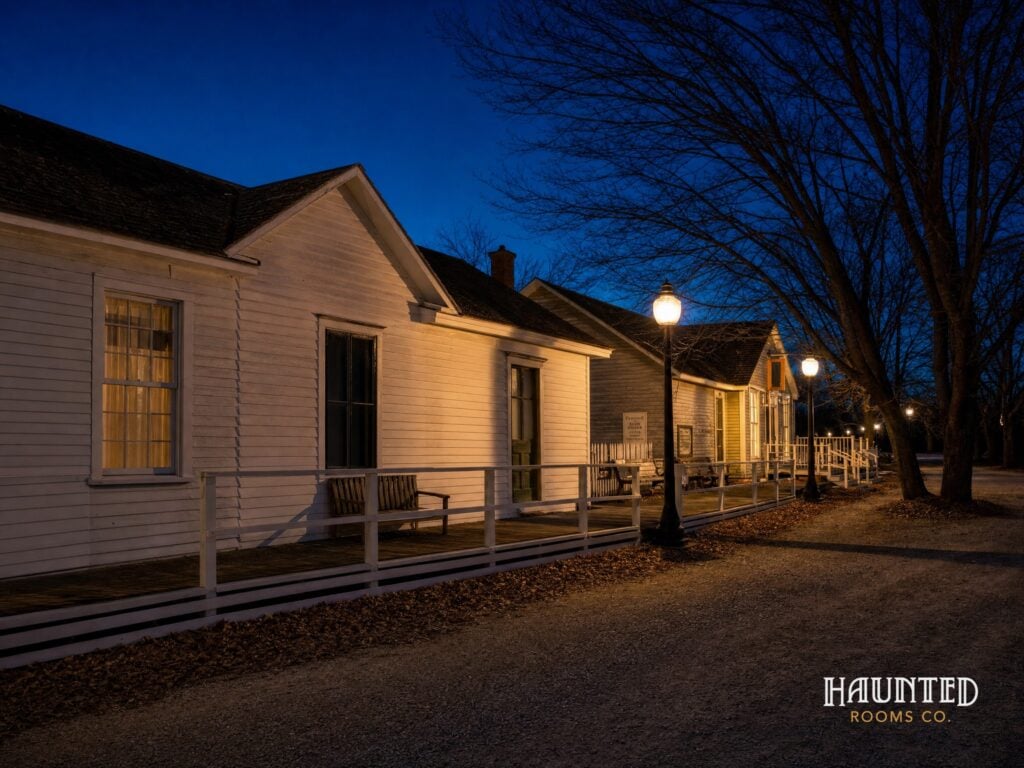
Parke County residents formed Billie Creek Village in 1964 and 1965 and opened it in 1969 as a 70-acre open-air museum just east of Rockville, in the county that calls itself the Covered Bridge Capital of the World. It gathers 38 historic buildings and structures, from an 1830s log cabin to a 1913 schoolhouse, with a general store, a bank, a mill, an 1886 Catholic church and the Billie Creek covered bridge, which has been on the National Register since 1978.
Funding trouble saw the village offered at auction in 2012, reopened in 2014 and closed again before new management took over in April 2022 and reopened it for events. Its ghost stories are local lore rather than history: a child glimpsed in the schoolhouse, a doctor still busy in his 1850s office and footsteps on the bridges. Haunted Rooms runs ghost hunts here, with the whole village to investigate after closing.
Haunted Rooms tip: Come back in October for the Parke County Covered Bridge Festival, then join our Billie Creek Village ghost hunt to see the village after dark.
Address 3045 W Vermont St, Indianapolis, IN 46222 (museum)
Where to look The Old Pathology Building's autopsy room and teaching amphitheater, and the old administration building (now apartments)
Reported ghosts Unexplained voices, including one heard by investigators in the administration building
Visiting Museum in the 1895 pathology building, open on guided tours; the rest of the old campus is apartments and private land
Tours Guided tours of the Old Pathology Building
Hours and season Check the museum website for tour days
Ghost hunting No public ghost hunting; the old campus buildings are private
The Indiana Hospital for the Insane opened on West Washington Street in 1848 with five patients. By the 1890s it held close to 3,000. Chronic underfunding and overcrowding led to decades of abuse and neglect, and an 1870 superintendent described the dark, damp cells where unruly patients were kept. Renamed Central State Hospital, it closed in 1994. Most of the campus was cleared and redeveloped; the 1895 Old Pathology Building survives as the Indiana Medical History Museum.
Ghost stories followed the closure. Investigator Maggie Zoiss of Indiana Paranormal Investigations told WRTV that her team heard a voice say “Pull down from the top” in a second-floor room of the old administration building, which is now student apartments. Online lists add apparitions and screams from basements, but those reports are unsourced. The museum, with its original autopsy room, labs and teaching amphitheater, takes no position: staff told Indiana Public Media they let visitors decide for themselves.
Haunted Rooms tip: Take the guided tour of the Old Pathology Building: the original autopsy room and teaching amphitheater are genuinely unsettling, and the guides know the hospital’s real history.
Where to look The doll room, the upstairs bedrooms, the staircase
Reported ghosts Everett Roads and members of the Roads family; apparitions of men, women and children
Visiting A working hotel that takes overnight guests
The Roads Hotel was built around 1893 in Atlanta, a small railroad town in Hamilton County north of Indianapolis, as a layover stop for rail passengers. It worked as a hotel until the 1920s, later became apartments, and was listed on the National Register of Historic Places in 1987. Local legend says Al Capone and John Dillinger stayed here, but nobody has proved it.
Today it no longer runs as a regular hotel: you book an overnight paranormal investigation instead, public or private, and proceeds help preserve the building. Fox 59 reported that Everett Roads was isolated here with tuberculosis until he died, and that Clara, Newton and Catherine Roads also died in the house. Visitors report apparitions, lights switching on, doors opening and voices in empty rooms.
What investigators report
Ghost Research Society investigators report Phasmabox sessions in the main dining room drew replies such as “Hello” and “Stay here”, and an EM meter spiked unusually in the first-floor Doll Room.
Haunted Rooms tip: Book a private overnight investigation for your group, and spend time in the upstairs doll room, where visitors say they have recorded voices.
Address Washington Hall, University of Notre Dame, Notre Dame, IN 46556
Where to look The stage, the back steps and the roof
Reported ghosts George Gipp; a steeplejack said to have fallen in 1886
Visiting On the Notre Dame campus; grounds open to visitors, building used for student theater
Ghost hunting No ghost hunting; it is a working campus building
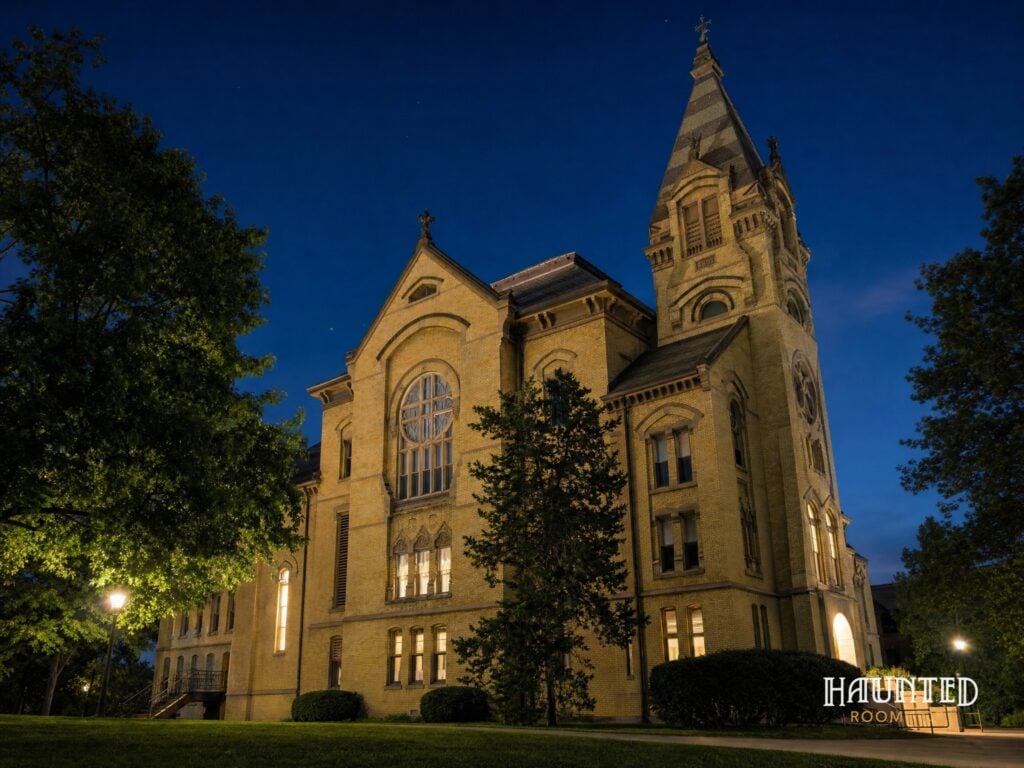
Washington Hall stands just east of the Golden Dome on Notre Dame’s main quad. After the great fire of April 1879, Father Edward Sorin had Chicago architect Willoughby J. Edbrooke build it in 1881 as the home of the university’s music and theater, and he named it for George Washington rather than a saint. Eamon de Valera spoke here in 1919. Since the DeBartolo Performing Arts Center opened in 2004 it has been a student theater and activities building.
It is Notre Dame’s most famous haunted building. The best-known story says football star George Gipp, locked out after curfew, slept on the steps, caught pneumonia and died. He did die in December 1920, of strep throat and pneumonia, but theater professor Mark Pilkinton, who wrote the hall’s history, calls that tale probably apocryphal: the first ghost report came in 1920 to 1921, Gipp was linked to it only in 1926, and he suspects student pranks. Others blame a steeplejack said to have fallen during construction. Students tell of doors closing and flickering lights.
Haunted Rooms tip: Walk the main quad by day and see the hall from outside; to go in, catch a student production.
Where to look The cell block, the cellar, the attic and the passage from the jail to the sheriff's quarters
Reported ghosts Charles Butler, hanged for murdering his wife; a sheriff; an unknown woman
Visiting Seasonal haunted house attraction on select fall nights; the rest of the year, see it from the street
Tours Haunted attraction tickets in the fall season
Ghost hunting No public paranormal investigations; it runs as a haunted house attraction
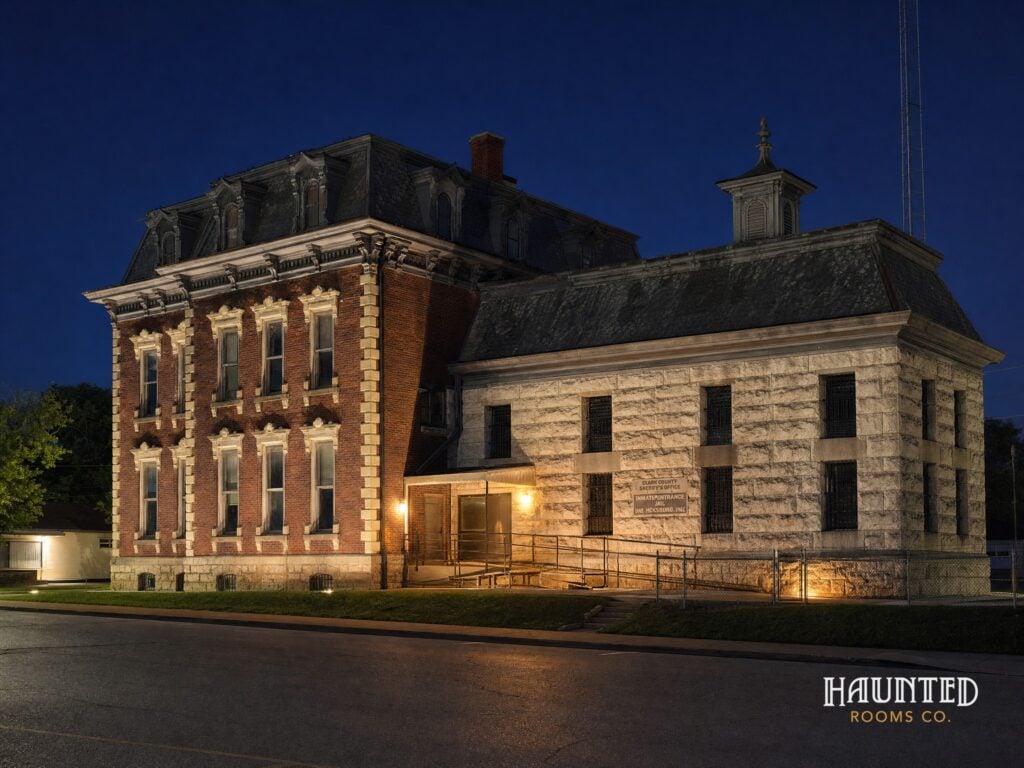
Whitley County built this three-story jail in 1875 for $34,486, to a design by self-taught architect J.C. Johnson: a Second Empire sheriff’s residence in red brick with a mansard roof, dormers and carved trim in front, and the blocky cell block behind. It is a contributing building in the Columbia City Historic District, on the National Register since 1987. It stood empty after a new county jail opened in 1987, and since the early 1990s it has been the Columbia City Haunted Jail, a seasonal haunted house attraction that opens on select nights each fall.
Its central ghost story is real history turned legend: Charles Butler was convicted in 1883 of murdering his wife Abbigail in Pierceton and was publicly hanged beside this jail, and the story goes that the drop failed and he strangled slowly. Some believe he never left. Visitors and investigators describe footsteps, laughter, a crash on the empty third floor, a touch on the hand or shoulder and failing cameras, and some link a figure near the old sheriff’s quarters to a former sheriff. These are reports, not records.
Haunted Rooms tip: Go in autumn, when the Columbia City Haunted Jail opens its doors as a haunted attraction; the rest of the year, see the Second Empire front from Market Street.
Address 125 W Jefferson Blvd, Fort Wayne, IN 46802
Where to look The Grande Page organ console, the stage and the old Indiana Hotel floors
Reported ghosts Bud Berger, stage manager from 1936 until 1965
Visiting A working theater and concert hall
Tours Historical tours; see Plan Your Visit on the Embassy’s website
Tickets Show tickets from the box office
Ghost hunting No public ghost hunting
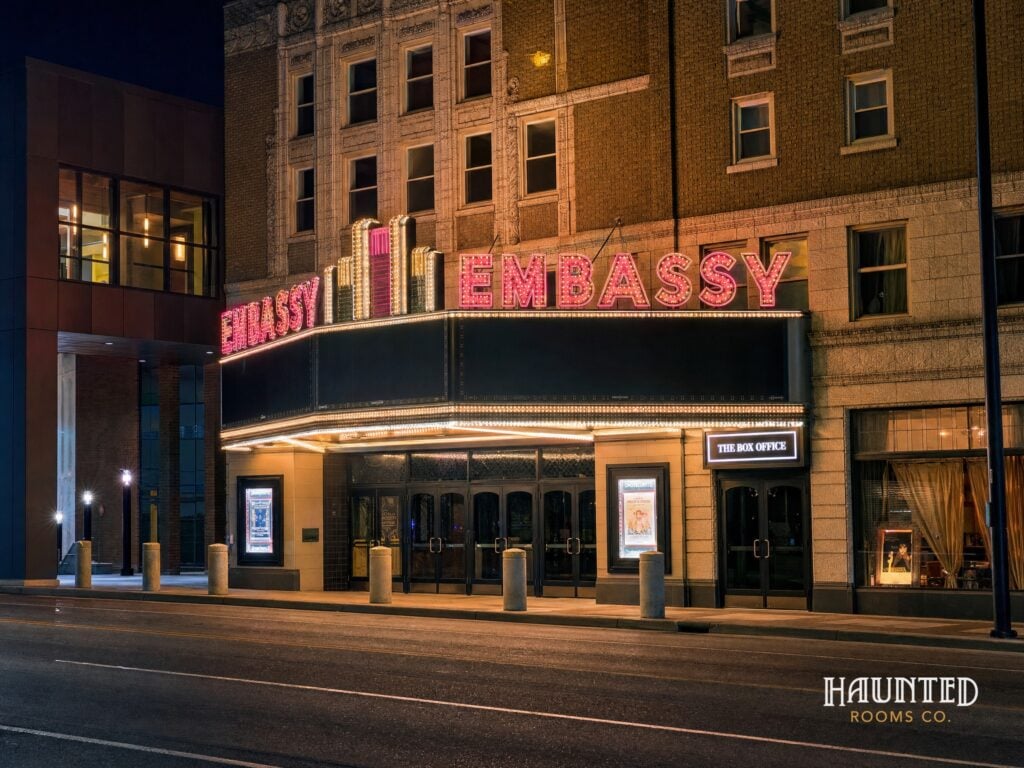
Clyde Quimby opened the Emboyd, named for his mother Emilie Boyd, on May 14, 1928, a movie palace and vaudeville house by A.M. Strauss and John Eberson wrapped by the seven-story Indiana Hotel. Bob Hope played here in 1928. Renamed the Embassy in 1952, it faced the wrecking ball in 1972 until volunteers led by Robert Goldstine raised $250,000 to save it. It joined the National Register in 1975, and its 1928 Grande Page pipe organ is still played every week.
The Embassy has one well-loved ghost, and staff name him. Executive director Kelly Updike told Visit Fort Wayne the ghost is said to be Bud Berger, the stage manager from 1936 until his death in 1965, who took impeccable care of the building. Organists practicing alone see a seat drop as if someone sat down. A former director, woken by dreams of Bud, came in at 5 AM to find a burst pipe, and staff credit him with warning them about a failing sewage pump.
Haunted Rooms tip: Book one of the theater’s historical tours, or catch a Fort Wayne Philharmonic concert, and listen for the organ.
Where to look The basement (bullet slugs in the east wall) and the second floor, where the bordello was
Reported ghosts George the caretaker in overalls, a cowboy killed in a fight, women from the old bordello
Visiting A working bar and live music venue
Hours and season Open most days from lunch until late; check the website
Ghost hunting No ghost hunting events of its own
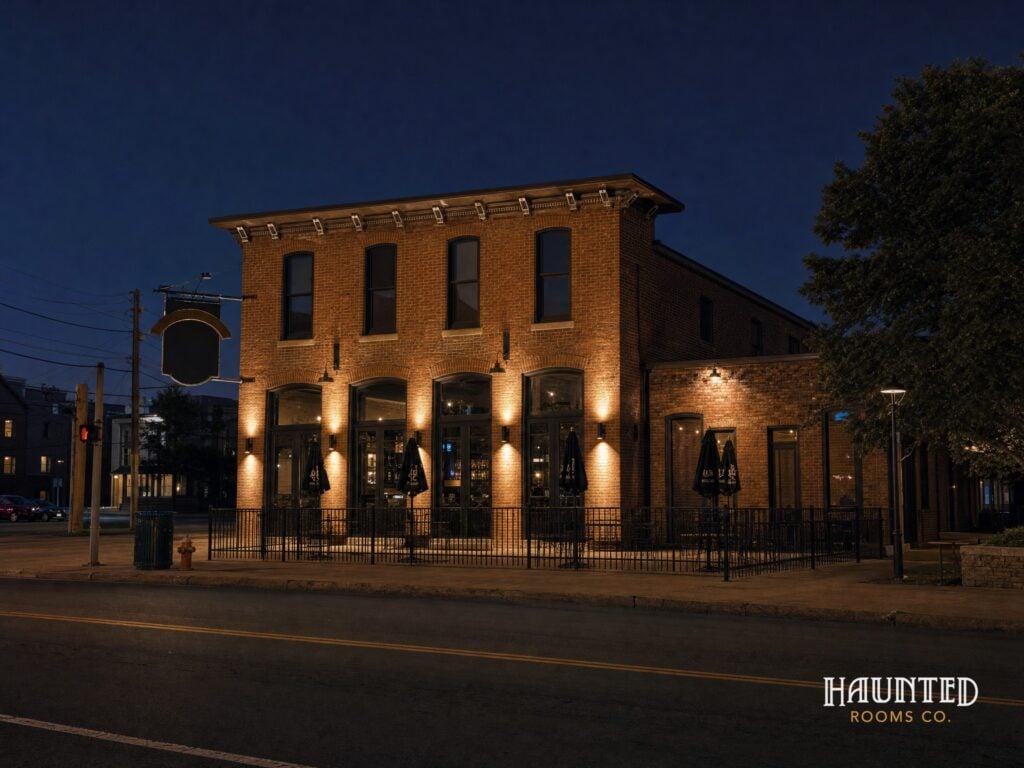
Indiana’s oldest bar opened in 1850 as the Tremont House, a roadhouse near the railroad. It became the Concordia House and Germania House for the German immigrant trade, Beck’s Saloon in World War I and Moore’s during Prohibition, when beer was still brewed in the basement. The bar says the Brady and Dillinger gangs used the back building for target practice, and slugs remain in the lower east wall. The Yeagy family bought it in 1963 and named it the Slippery Noodle; it became a famous blues club and is on the National Register.
The bar’s own history says it was an Underground Railroad stop and later held a bordello where a customer was killed in a fight over a woman. Those are traditions rather than documented events. Staff have told Indianapolis Monthly about George, a caretaker in overalls said to give keg delivery men a shock in the basement, a cowboy said to be the man killed in the fight, and women seen on the second floor. A manager admitted she avoids parts of the basement.
What investigators report
Staff report encounters with a presence they call George in the basement, and a visiting psychic said a female spirit claiming to be the old brothel’s madam came through on the second floor.
Address 8670 West State Road 56, French Lick, IN 47432
Where to look The sixth floor, the service elevator, the ballroom, the front desk
Reported ghosts Owner Thomas Taggart; a phantom bellhop
Visiting A working hotel that takes overnight guests
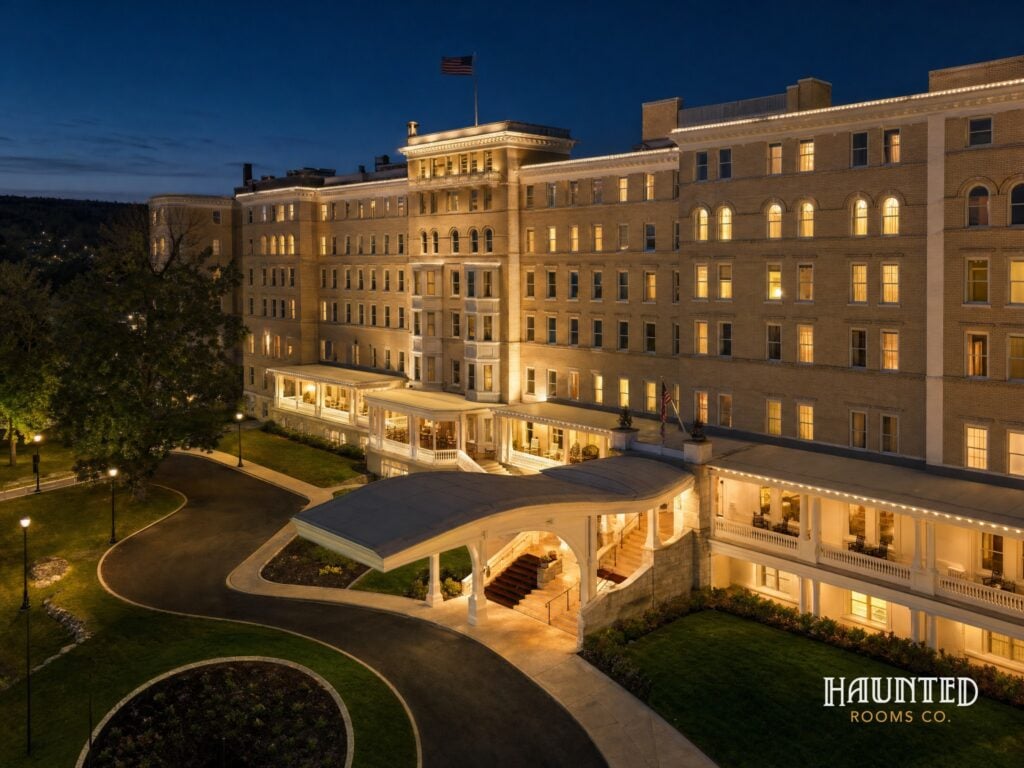
French Lick Springs Hotel dates to about 1845, when Dr. William Bowles opened an inn by the sulfur springs, and it grew into one of America’s great spa resorts under Thomas Taggart, the Indianapolis mayor and Democratic national chairman who bought it in 1901. Pluto Water, tomato juice and FDR’s 1931 visit are all part of its story. Restored and reopened in 2006, it has 443 rooms and a casino.
Its best-known ghost is Taggart himself. Guests and staff say he still checks on his hotel, especially on the sixth floor and around the service elevator, with voices and the smell of tobacco where nobody is smoking. Some even describe a man on horseback in the hallways. A bellhop in an old uniform is said to walk the halls too, and is often mistaken for a member of staff.
Haunted Rooms tip: Request a sixth-floor room and take the hotel’s historic tour to see the old photographs of the staff, including the bellhops.
Address 6404 South State Road 135, Nashville, IN 47448
Where to look The Blue Lady Room, the second floor of the old general store
Reported ghosts The Blue Lady
Visiting A working hotel that takes overnight guests
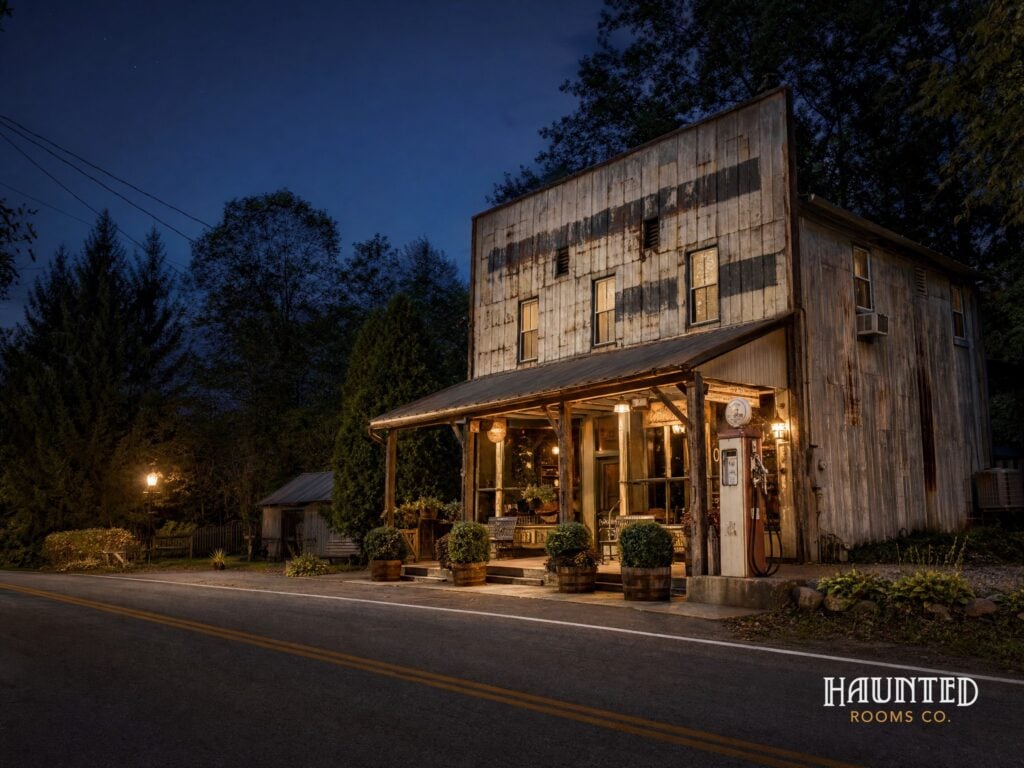
The Story Inn fills most of the tiny village of Story in Brown County, about 30 minutes south of Nashville, Indiana. Dr. George P. Story received the land patent in 1851, and the inn’s main building is the 1915 general store, its pressed-tin front little changed. Rooms are upstairs and in the village’s old houses and cottages, with no TVs or clocks, and a restaurant and the Story Still tavern downstairs.
The inn’s ghost is the Blue Lady, reported by staff and guests since the 1970s on the second floor of the old store. Guests leave their encounters in diaries kept in each room, and the tradition says that switching on the blue lamp in the Blue Lady Room invites her to appear. Some say she smells of cherry pipe tobacco.
What investigators report
Guests say switching on the blue light on the nightstand in the Blue Lady Room, above the old general store, can bring her out, with sightings reported by the bed and in the mirror. Hoosier Paranormal reported doors opening and closing and objects moving during an investigation of that room.
Address County Road 625 E, south of US 36, Washington Township Park, Avon, IN 46123
Where to look Under the arches on County Road 625 East and the trail down from Washington Township Park
Reported ghosts A worker said to be sealed in the concrete, a mother who lost her baby from the tracks
Visiting Free to see from Washington Township Park or by driving under it; the railroad tracks above are off-limits
Hours and season Park hours
Tickets Free
Ghost hunting No organized investigations; never go onto the tracks
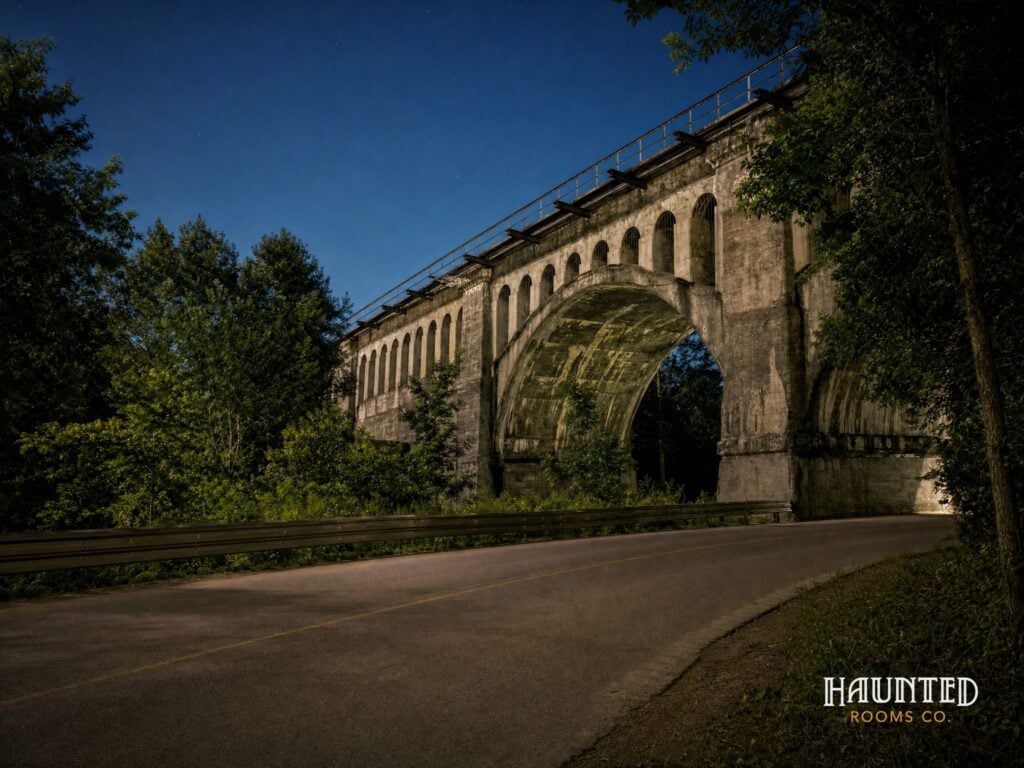
The Big Four Railroad (the Cleveland, Cincinnati, Chicago and St. Louis) built this 305-foot concrete viaduct over White Lick Creek and County Road 625 East in 1906 and 1907, and double-tracked it in 1908. Passenger trains once ran across it to Indianapolis Union Station; today it carries CSX freight. It is so loved locally that it appears on the Town of Avon’s seal, and Indianapolis Monthly put driving under it on its list of things every Hoosier must do.
The legends are many and none is verified, as Avon’s own library historian says. The most famous tells of a worker, sometimes named Henry Johnson, who fell into wet concrete and was left inside; people say they hear him knocking or moaning when trains pass. Another tells of a mother who dropped her baby from the tracks. A 1908 local paper already reported spirits near the bridge. A DePauw professor suggested trains rumbling through the hollow chambers explain the sounds.
Haunted Rooms tip: Park at the top of Washington Township Park and take the short trail down to see the arches. Never climb onto the tracks: it is an active CSX line.
Address Indiana Dunes State Park, near Chesterton, IN 46304
Where to look The Lake Michigan beach and dunes at dusk
Reported ghosts Alice Mabel Gray, seen swimming or running along the shore
Visiting A state park on Lake Michigan, open all year
Hours and season Open all year; daytime use
Tickets State park entrance fee
Ghost hunting No organized ghost hunting; follow state park hours
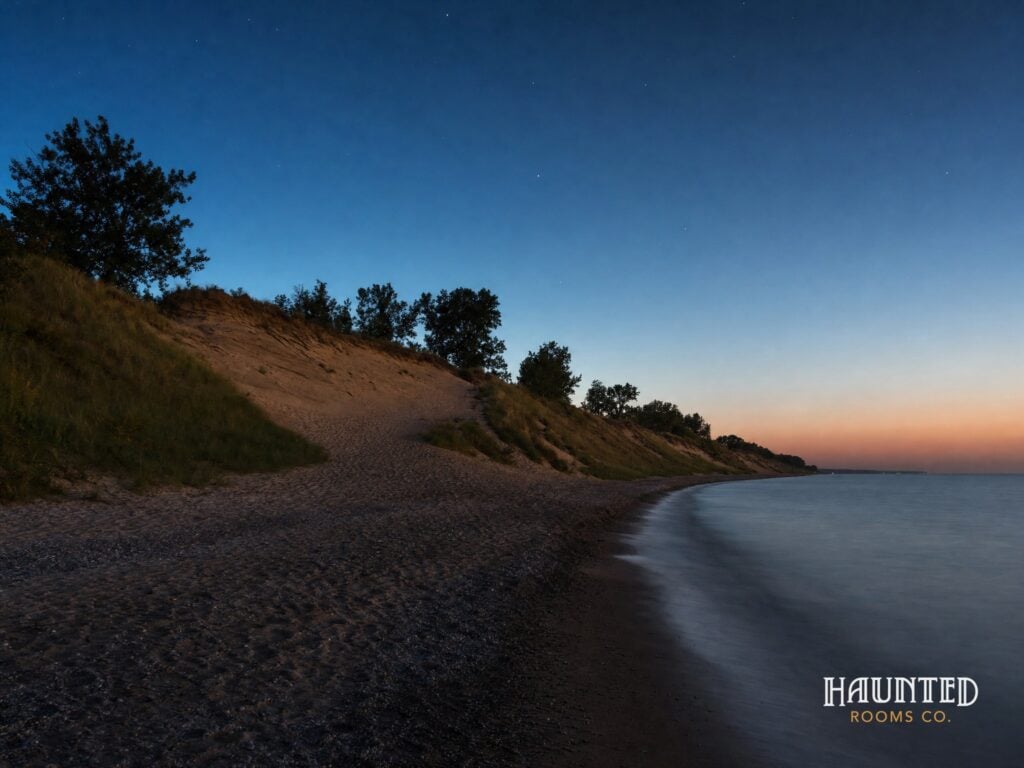
Alice Mabel Gray was a real person. Born in Chicago in 1881, she graduated from the University of Chicago in 1903 and later studied mathematics in Germany. On Halloween 1915 she took the South Shore train to the Indiana dunes, and in 1916 she moved into an abandoned beach shack she called Driftwood. Chicago reporters chasing gossip that she bathed nude in Lake Michigan named her Diana of the Dunes, after the Roman goddess, and the name stuck.
Around 1919 she and Paul Wilson built a shack called Wren’s Nest at what is now West Beach. In 1922 a deputy shot Wilson in the foot and fractured her skull, and she died near Wren’s Nest in February 1925, aged 43, of uremic poisoning, according to the National Park Service. The legend says she never left: beachgoers tell of a woman bathing in the lake, then running along the sand at dusk. The national park dedicates a West Beach dune to her, and the state park lists its haunted shores among things to do.
Haunted Rooms tip: Walk the Dune Succession Trail at West Beach in Indiana Dunes National Park to follow the Diana of the Dunes Dare, then watch the sun set over the lake.
Where to look The rooms that served for decades as the college library
Reported ghosts John H. Bass, said to help people find books
Visiting University of Saint Francis campus; the house holds offices and hosts guided tours and events
Tours Guided one-hour tours, January to October, during business hours
Ghost hunting No ghost hunting; it is a working university building
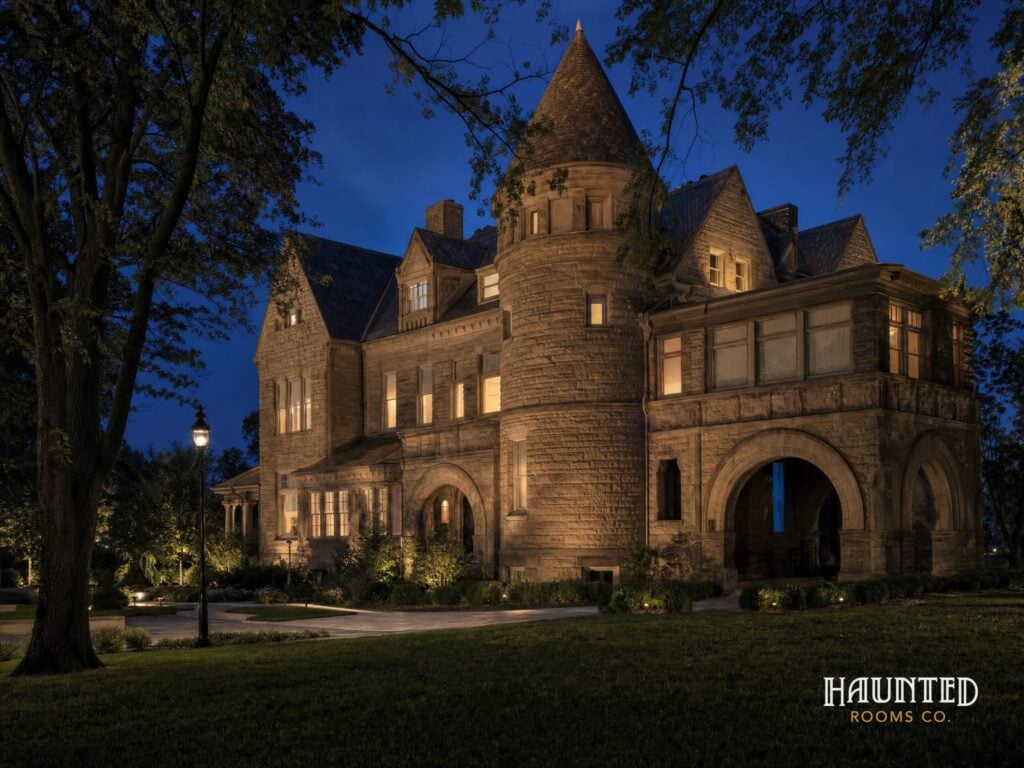
Industrialist John Henry Bass built Brookside in 1889 as the summer home of his 225-acre farm, a castle-like Romanesque mansion of hand-carved sandstone by Fort Wayne architects Wing and Mahurin, wrapped by a lake he made by damming a stream. A gas explosion and fire in 1902 wrecked most of it, and by 1903 Bass had rebuilt it to be fireproof in stone, concrete and steel. The family lived here until 1944, when the Sisters of Saint Francis bought the house and 65 acres and moved their college here from Lafayette. It has been on the National Register since 1982.
For years Brookside held classrooms and offices, and it housed the college library until 2006; a restoration finished in 2010 brought back its painted ceilings and stencils, and today it holds the president’s office. The campus legend, repeated even on Wikipedia, is that Bass never left and will help a library visitor find the book they are looking for. Older retellings add that he drops it at your feet. It is a friendly ghost story, not a documented one.
Haunted Rooms tip: Book one of the university’s guided Brookside tours (January to October) to see the dining room mural and the third-floor ballroom.
Address 140 W Washington St, Indianapolis, IN 46204
Where to look The mezzanine on cold, rainy days, the balcony and the backstage dressing rooms
Reported ghosts Artistic director Tom Haas, said to jog the mezzanine; a woman in white
Visiting A working professional theater; open for performances
Tickets Show tickets from the IRT box office
Ghost hunting No ghost hunting events
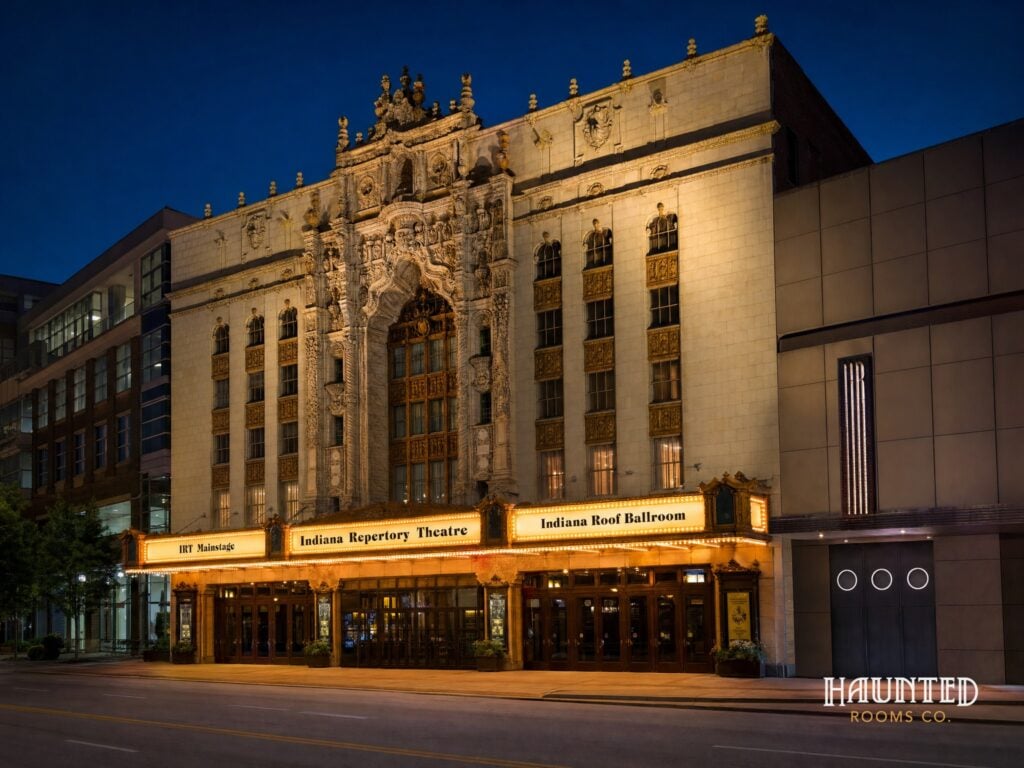
The Indiana Theatre opened in 1927 as a 3,200-seat Paramount movie palace by Rubush and Hunter, with a white terra cotta Spanish Baroque front and the Indiana Roof Ballroom on its top floors. The movie house closed in 1975 and the building was nearly lost before the Indiana Repertory Theatre moved in from the Athenaeum in 1980, turning the auditorium into a 600-seat mainstage. The city owns the building, which is on the National Register.
Its best-known ghost story has a real tragedy behind it. IRT artistic director Tom Haas, who liked to jog, was struck by a van while running on a foggy January morning in 1991 and died about a month later. Soon afterward staff began saying they heard floorboards creaking on the mezzanine on cold, wet days, as if Haas were still running his indoor laps. Tour companies add a woman in white and a gentleman in the balcony; those tales have no named witnesses.
Haunted Rooms tip: See a show: the IRT runs a full season, including A Christmas Carol every winter. Staff keep a ghost light burning on the empty stage at night, an old theater tradition.
Where to look Room 301 and the third floor, the restaurant booths
Reported ghosts Al Capone (cigar smoke near Room 301); a vanishing old man in the dining room; a figure in a third-floor window
Visiting A working hotel that takes overnight guests
The first hotel here, the Hotel Ormond, opened in 1897 to bring tourists to the Barbee chain of lakes; it burned in 1921 and the present building opened in 1923. During Prohibition it became a quiet escape for Chicago visitors: Visit Indiana says Al Capone rented the whole third floor and always took Room 301, and Clark Gable and Carole Lombard are said to have been regulars. Today it is best known as a lakeside restaurant serving Chicago-style pizza, with rooms upstairs.
Staff report cigar smoke drifting from under the door of Room 301, though smoking has been banned for years. Servers tell of an old man sitting alone in a booth who vanishes when they go to take his order, and locals see a man at a third-floor window when no guests are booked. The hotel appeared on The Dead Files in 2014.
Haunted Rooms tip: Call ahead to check which rooms are open, ask for Room 301 or the Gable and Lombard suite, and have dinner downstairs first.
Address 5010 W Southport Rd, Indianapolis, IN 46221 (private)
Where to look The center second-story window seen in the 1997 photograph
Reported ghosts A girl in a blue dress at the upstairs window; a woman; later legends of a hanging and a cellar fire
Visiting Private home; see it from the road only
Ghost hunting No. It is a private residence
Scottish-born stonemason David Nicholson began this Gothic Revival house in 1870 while he was working on the Marion County Courthouse, and finished it about six years later, with carved bargeboards and decorated rafter tails. John Lindsay Rand bought it in 1903 and his family kept it into the 1950s, when it was given to DePauw University and slowly fell apart. In April 1997 the Historic Landmarks Foundation of Indiana moved it about half a mile to save it from a developer. It joined the National Register in 2003.
The ghost story begins with that move. Indianapolis Star photographer Mike Fender thought he saw a figure in an upstairs window, and his front-page photo appeared to show a blond girl in a blue dress at the center window of the empty house. Later tellings added a boarding house suicide, bleeding walls and slaves dying in a cellar fire, but no record supports any of those, and the fire tale is the same legend told about the Hannah House. It is a private home.
Haunted Rooms tip: This is a private residence. See it only from the public road, and do not walk onto the property.
These places appear in older lists of haunted spots. We keep them here so you know the facts before you go, but you cannot (or should not) visit them.
100 Step Cemetery (Carpenter Cemetery), near Brazil
The legend says that if you climb the cemetery’s steps at midnight in total darkness you count 100 going up and 99 coming down, and that the spirit of the first caretaker shows you how you will die. Indiana Public Media, citing local blog Terror Haute, notes the steps are badly deteriorated and dangerous even in daylight, and at any other time of day people count about 60. Do not try it at night.
Rockport Inn, Rockport
This 1850s bed and breakfast was known for a friendly woman in old-fashioned dress walking the halls. A fire in April 2018 closed it, and we found no sign that it has reopened.
Inn at Aberdeen, Valparaiso
Guests at this farmhouse inn reported a little girl on the staircase. The property sold in January 2024 and the inn’s website has gone, so we could not confirm it still takes guests.
Changed from our older guide: we corrected the Hannah House and Nicholson House stories, which repeated an unproven cellar fire legend; noted that the George Gipp story at Notre Dame is considered apocryphal; moved the 100 Step Cemetery to the off-limits list because its steps are dangerous; and added Willard Library’s own handout details, our five Indiana ghost hunt venues, the haunted hotels, Diana of the Dunes, Central State Hospital, Irvington and the Embassy Theatre.
Visited one of these places? Tell us what happened
We collect first-hand accounts from visitors and add the best ones to our guides, with your first name and the date of your visit. We read every story before it’s published.
Willard Library in Evansville has the best-known ghost: the Grey Lady, first reported by a custodian in 1937 and still described by staff and patrons. The library even runs live ghost cams. For a full night of ghost hunting, the Old Jail Inn in Rockville and the Randolph County Asylum near Winchester are among the venues where Haunted Rooms runs events.
Can you ghost hunt in Indiana?
Yes. Haunted Rooms runs ghost hunts at the Old Jail Inn, the Indiana State Sanatorium and Billie Creek Village in Rockville, the Old Lake County Jail in Crown Point and the Randolph County Asylum near Winchester. The Hannah House in Indianapolis also takes private investigations.
Is the Hannah House really haunted?
Odd events have been reported there since the 1960s, and it is one of Indiana’s most famous haunted houses. But the best-known story, that people escaping slavery died in a cellar fire, has no evidence behind it, and historians say there is no record Alexander Hannah sheltered freedom seekers.
Who is the ghost at Notre Dame?
Washington Hall, the 1881 theater on the main quad, is said to be haunted by football star George Gipp, who supposedly caught his fatal illness after sleeping on its steps. Gipp did die in December 1920, of strep throat and pneumonia, but the locked-out story is considered apocryphal.
What haunted hotels can you stay at in Indiana?
French Lick Springs Hotel, the Story Inn near Nashville, the Historic Roads Hotel in Atlanta, the Barbee Hotel in Warsaw and the Old Jail Inn in Rockville all take guests and all have ghost stories. See our guide to haunted hotels in Indiana for rooms and booking.
Can you visit the 100 Step Cemetery?
It is a real cemetery near Brazil, but the steps are badly deteriorated and dangerous, and the midnight legend involves climbing them in total darkness. If you go, go by day and stay off the broken steps.
Sources and how we research
Every place in this guide is checked against its official website, historic register listings and news coverage, and we confirm whether it is open, closed, private or gone before we list it. Ghost stories are reported as staff, visitors and local historians tell them; we say so where records contradict a story. Each place shows how many independent sources we checked it against; our own Haunted Rooms pages are not counted.
New guides, haunted places to visit and ghost hunt dates near you. No spam, unsubscribe any time.
About the authors
The Haunted Rooms Team runs public ghost hunts and overnight investigations at historic venues across the United States. We research every place in our guides using official sites, historic registers, local archives and news coverage, and we report ghost stories as the stories they are. We review each guide regularly so you are not sent to a place that has closed, changed hands or banned visitors. Spotted something out of date? Let us know.