Haunted New Orleans: The 27 Most Haunted Places to Visit
Cemeteries of above-ground tombs, a mansion with a true and terrible past, bars older than the country’s oldest legends, and hotels that tell their ghost stories at the front desk. These are the most haunted places in New Orleans, with what is history, what is legend and how you can visit each one.
Fire, yellow fever, war and hurricanes have all left their mark on New Orleans, and it is no surprise it is so often named one of the most haunted cities in America. We have checked every place below against current sources, so you know which are open, which you can only see from the sidewalk, and which have changed since the stories were first told: Lafayette Cemetery No. 1 has just reopened after seven years, St. Louis Cemetery No. 1 is guided tours only, and the LaLaurie Mansion is a private home. Thirteen of the places are hotels where you can sleep in a haunted room.
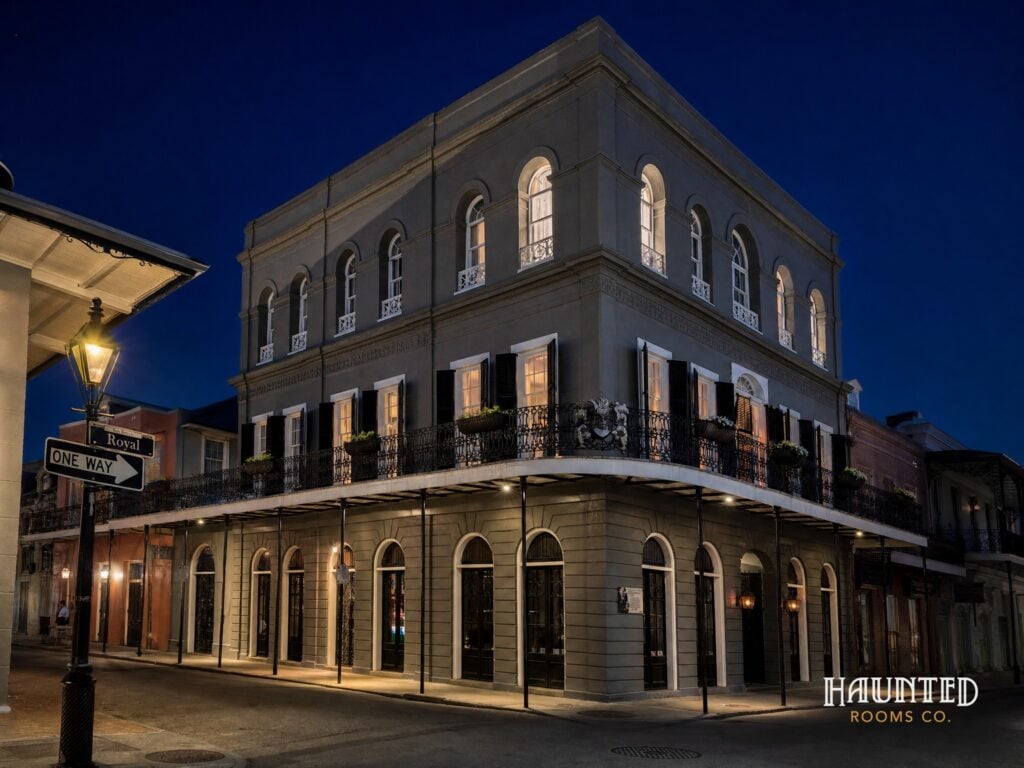
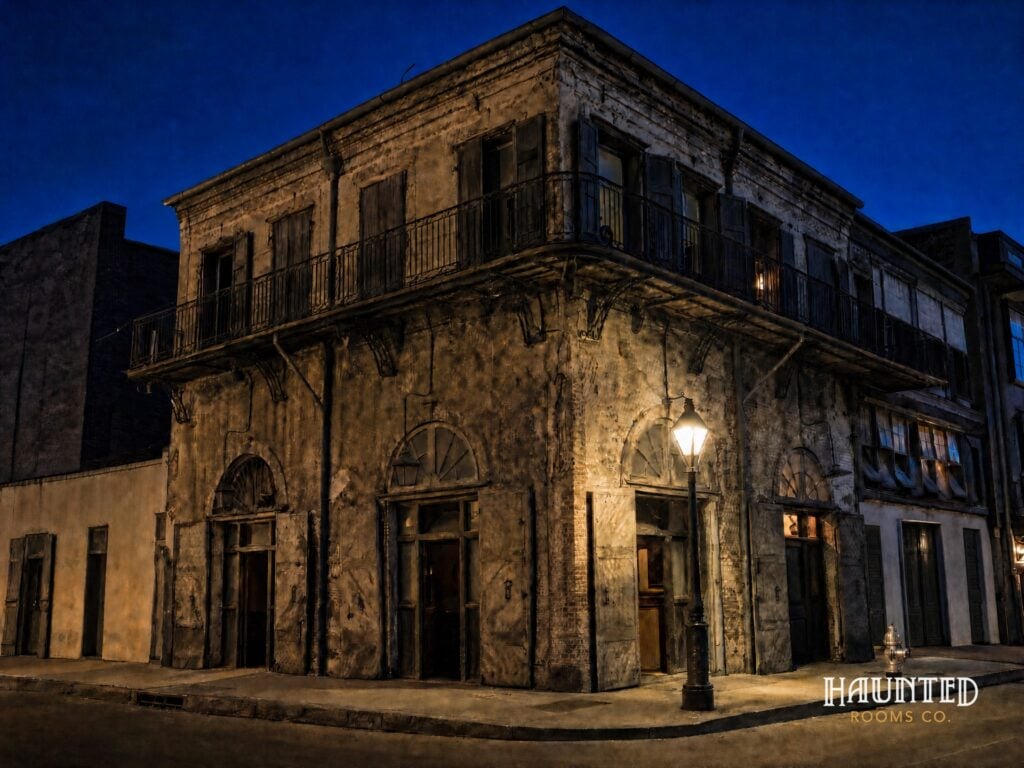
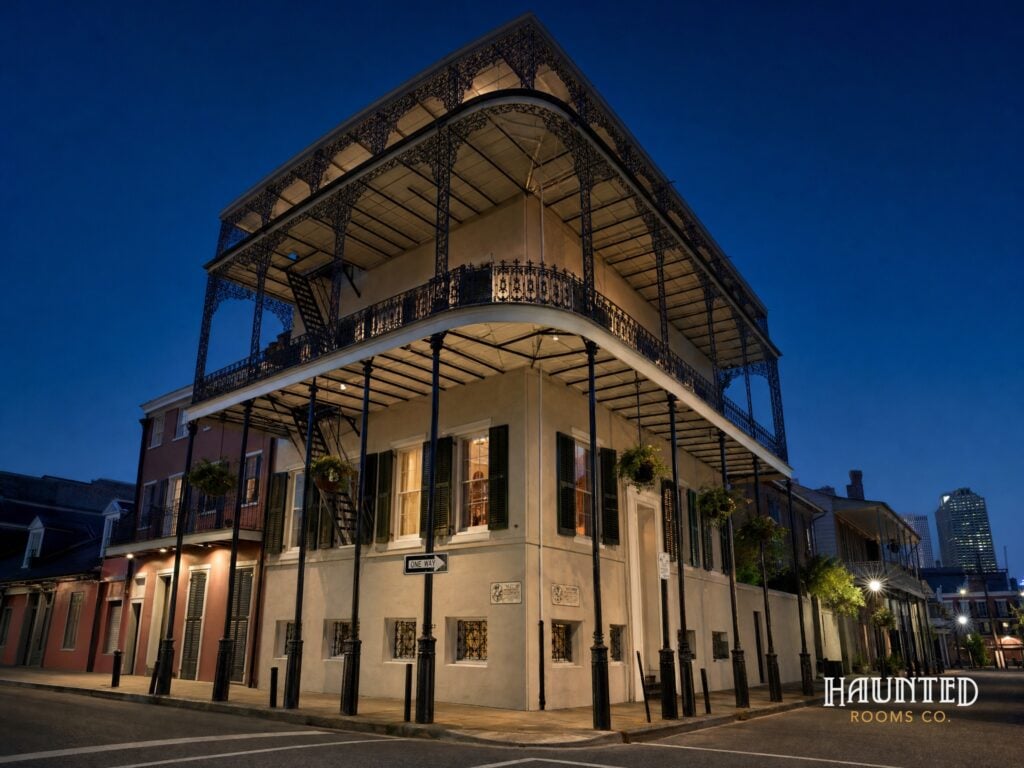
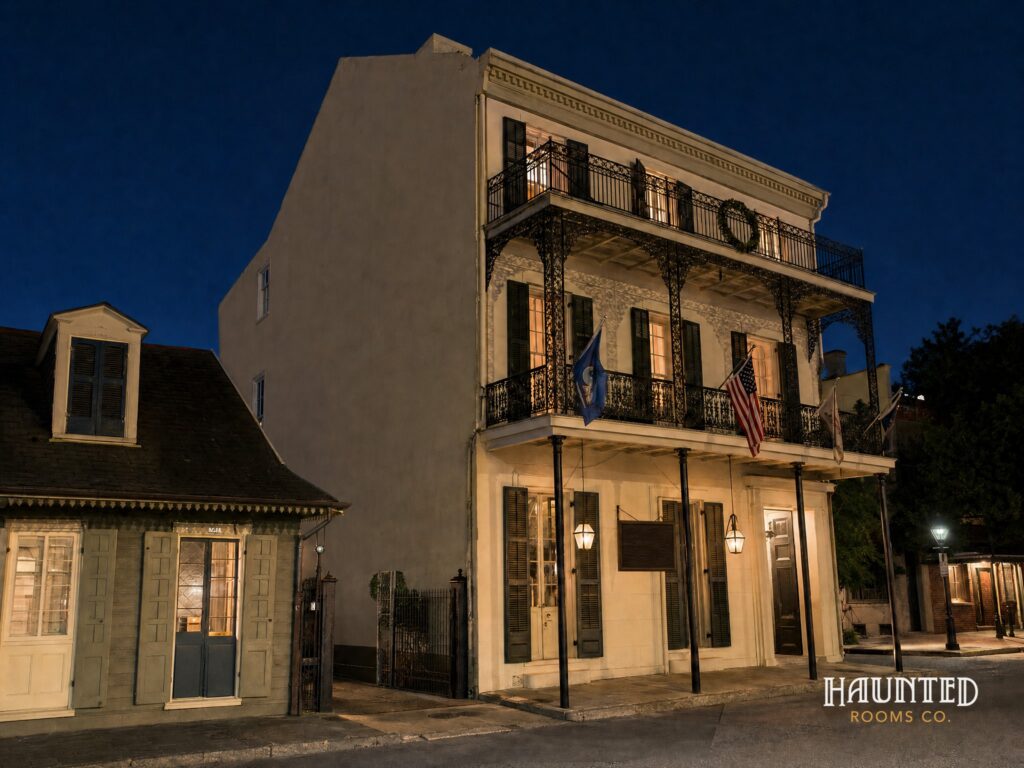
Where to look The Royal Street corner, the upper windows and the balcony
Reported ghosts Enslaved people held in the upper rooms, a girl who fell from the roof, Delphine LaLaurie
Visiting Private residence; exterior only. No tours or investigations are allowed inside
Tours A stop on nearly every French Quarter ghost walk (outside only)
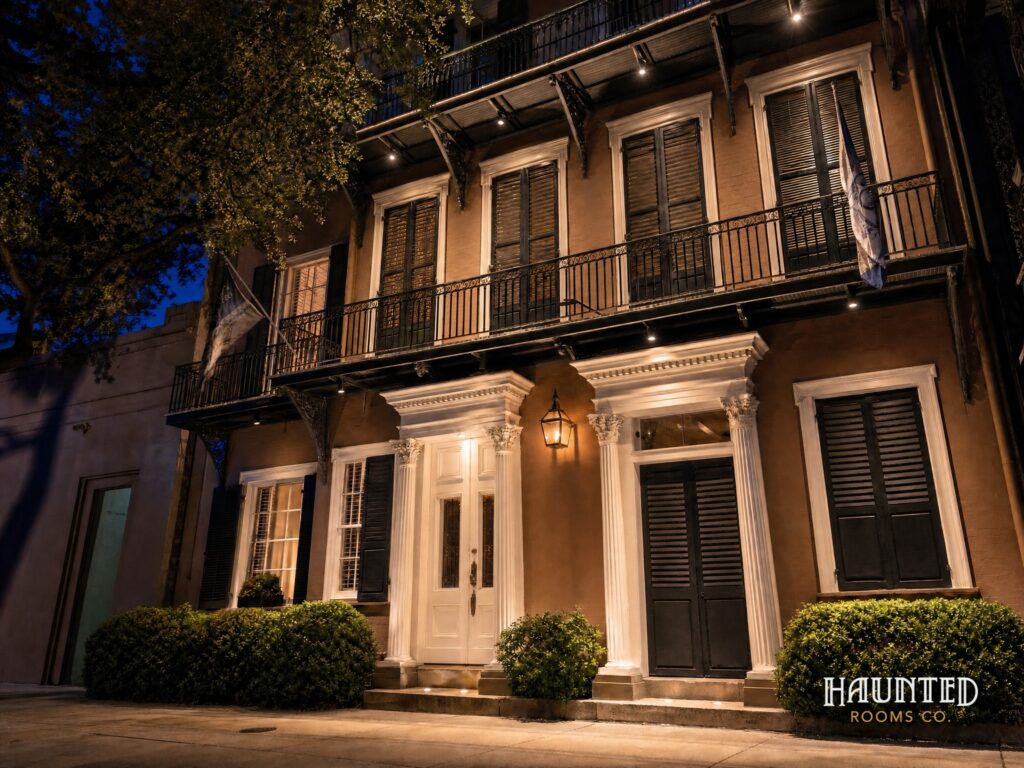
On April 10, 1834, fire broke out in the kitchen of Delphine LaLaurie’s mansion at Royal and Governor Nicholls. Responders found a 70-year-old cook chained to the stove, who said she had set the fire to end her life, and enslaved people starved and chained in the upper rooms. A mob wrecked the house, and LaLaurie fled to Paris and was never tried. The building you see was rebuilt after 1838 and has been a school, apartments, a furniture store and, for two years, Nicolas Cage’s home.
It is the most famous haunted house in New Orleans. People report moans and scratching from upstairs, footsteps and a heavy feeling, and tell of a girl, called Leah or Lia, who fell from the roof fleeing a whip. Records support the cruelty, but not the later tales of medical experiments, which trace to a 1946 book. It is a private home, recently listed for sale at $10.25 million, so you can only look from the street.
Haunted Rooms tip: View it from across Governor Nicholls Street and keep the sidewalk clear: people live here.
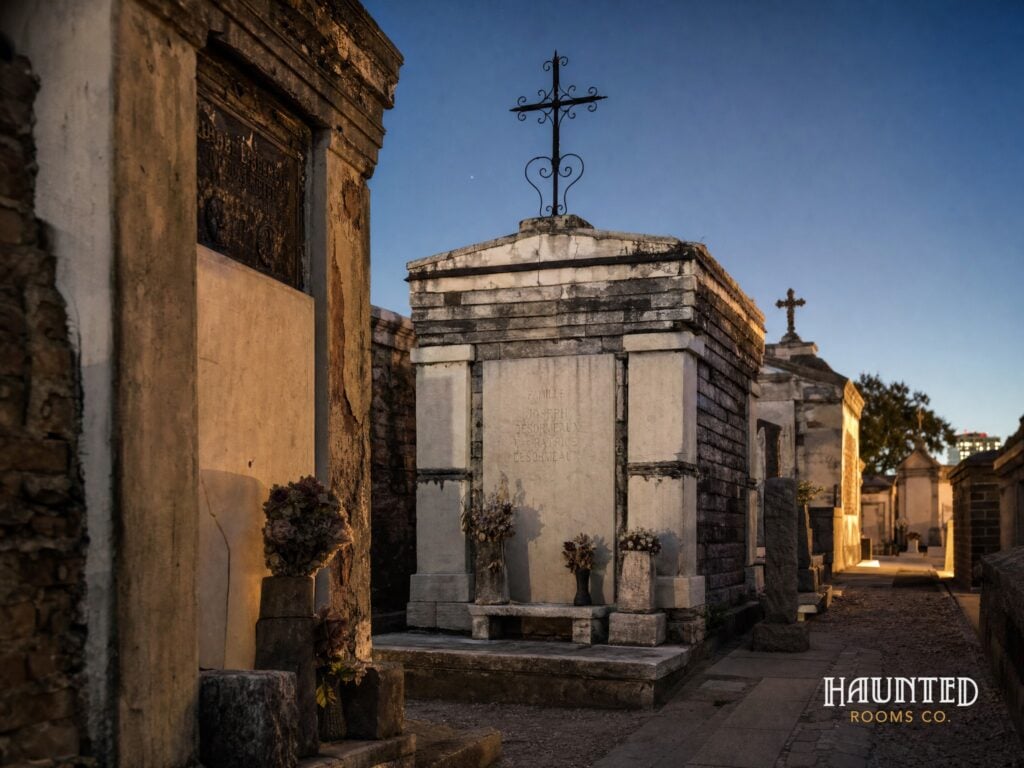
Where to look The Glapion family tomb of Marie Laveau and the narrow aisles between the tombs
Reported ghosts Marie Laveau, the sailor Henry Vignes, a lost spirit called Alphonse
Visiting Entry only on official guided tours (families with a pass excepted)
Tours Official walking tours of about 45 minutes, from Basin St. Station, 501 Basin St.
Tickets About $25 to $33 per adult
Ghost hunting No ghost hunting; tours are history tours with strict rules
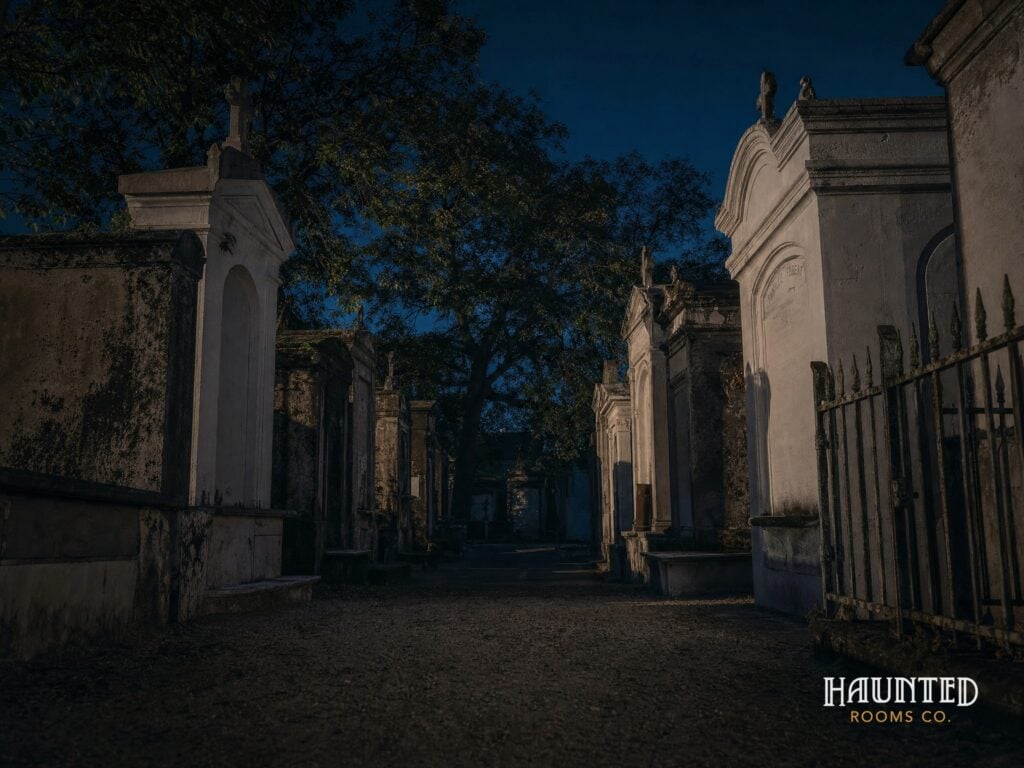
New Orleans’ oldest surviving cemetery was laid out by Spanish royal decree in 1789, after the Great Fire of 1788, just beyond the old city edge. More than 700 above-ground tombs crowd a single block. Among them are the Glapion family tomb where Voodoo priestess Marie Laveau is believed to rest, the grave of civil rights plaintiff Homer Plessy, and the white pyramid Nicolas Cage bought for himself in 2010.
It is also the city’s most famous haunted cemetery. Visitors talk of a woman in a red and white head wrap who walks the aisles and vanishes, said to be Laveau; of a sailor named Henry Vignes who asks where his family tomb is; and of a sad spirit called Alphonse who takes visitors’ hands. Since March 2015 the Archdiocese has let the public in only on licensed guided tours, after years of vandalism, including X marks scratched on Laveau’s tomb.
Haunted Rooms tip: Book the official tour ahead. It leaves from the Basin St. Station visitor center across the street, and you must not mark, touch or leave anything on the tombs.
Where to look The 14th floor and Room 1462, the elevators, the lobby restaurant doors, the Carousel Bar, the rooftop, the lobby grandfather clock
Reported ghosts Maurice Begere, a toddler who died in the 1890s; a former employee known as Red; ghostly children
Visiting A working hotel; book a room to stay the night
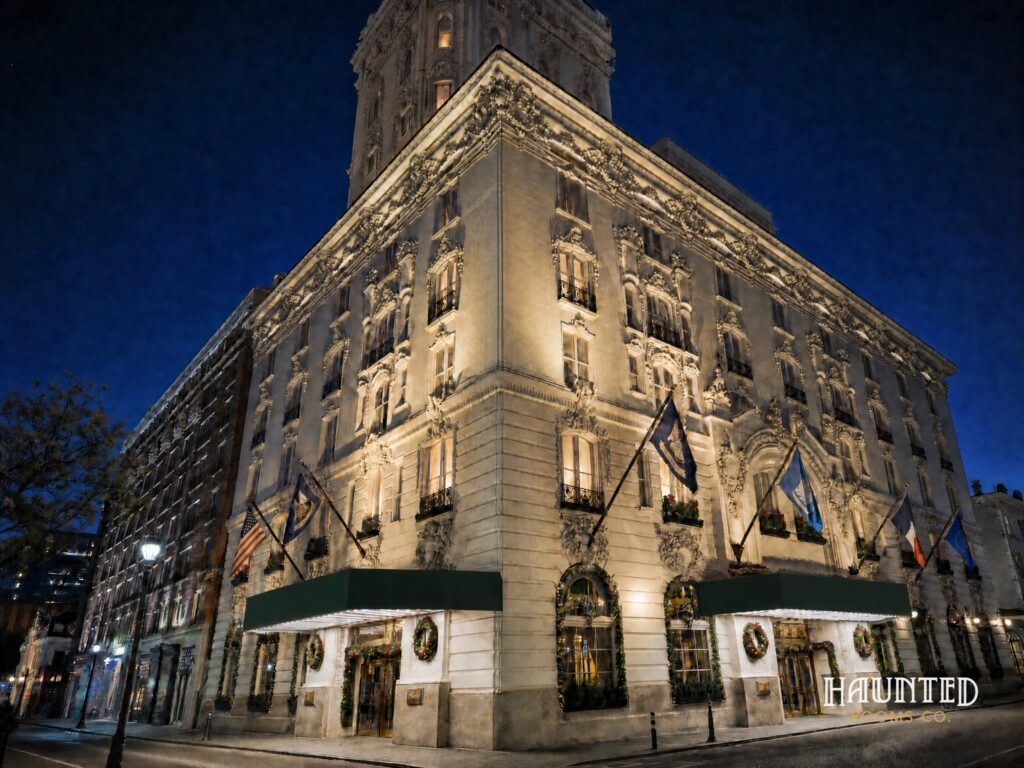
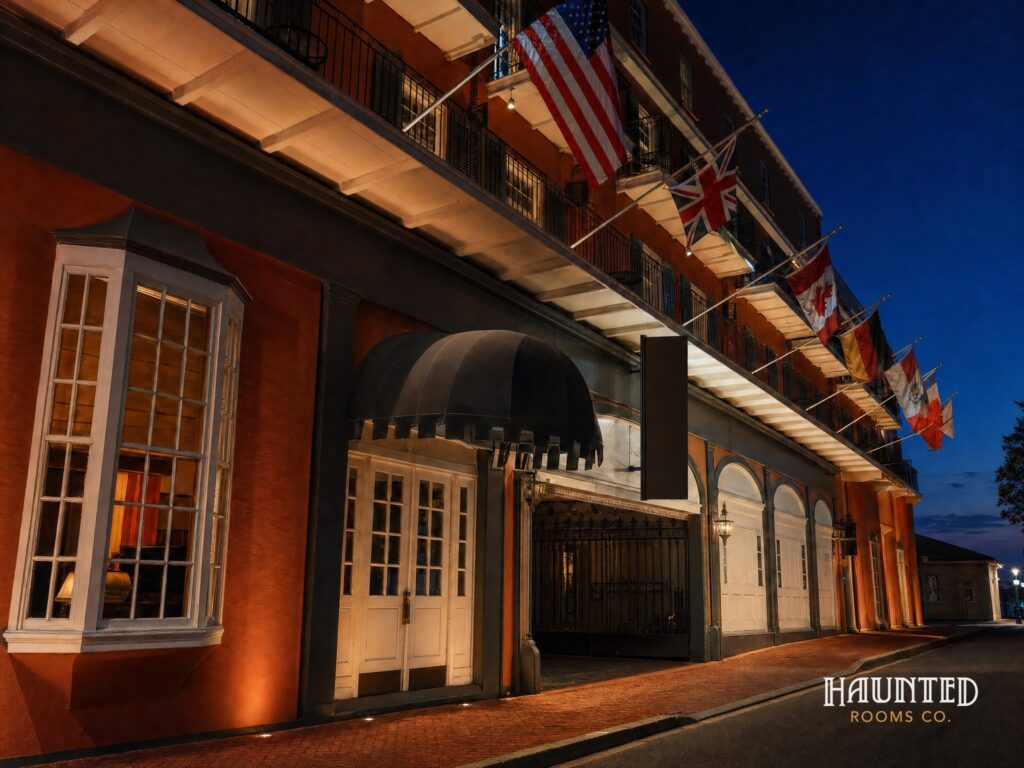
Family owned since 1886, the Hotel Monteleone on Royal Street is the grand dame of French Quarter hotels, home of the revolving Carousel Bar and a National Literary Landmark. It is also one of the most talked-about haunted hotels in America, and the hotel tells its ghost stories itself.
The best known is Maurice Begere, a toddler said to have died of a fever while his parents were at the opera in the 1890s. Guests report a small boy on the 14th floor (really the 13th), especially near Room 1462. In 2003 the International Society for Paranormal Research reported more than a dozen spirits here, and staff talk of doors that open by themselves and elevators that stop on 14.
What investigators report
A family investigation team that stayed on the 14th floor reported EMF meter spikes when they sat on the steps in the main hallway and asked questions aloud, and an EVP of a young male voice saying “What?”. They also described heavy feelings in the side hall toward the Mr. Monteleone suite.
Where to look The Orleans Ballroom, Room 644, the sixth and third floors, the lobby
Reported ghosts A dancer in the ballroom, a nun, children from the old orphanage, a wounded soldier
Visiting A working hotel; book a room to stay the night
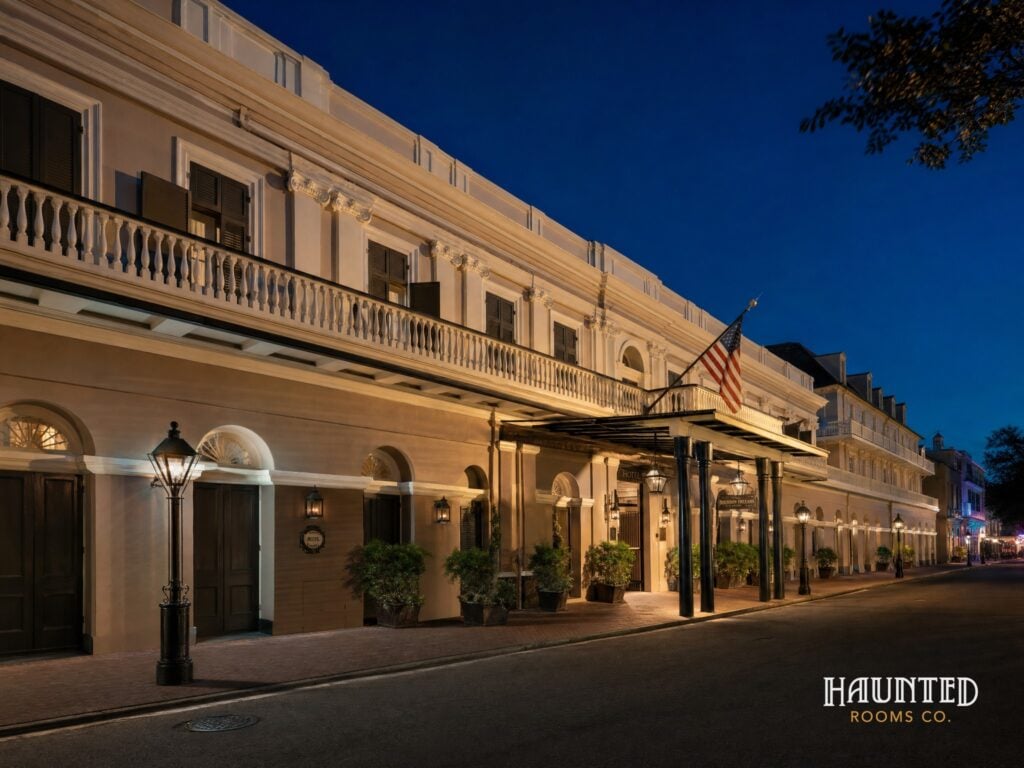
The Bourbon Orleans wraps around the 1817 Orleans Ballroom, where Creole society once danced, and the convent and school of the Sisters of the Holy Family, who owned the property from 1881 until it became a hotel in 1964. The hotel’s own history page names its ghosts: a Confederate soldier, nuns, children and a lonely dancer.
Guests describe a woman in a gown dancing alone under the ballroom chandeliers, children laughing and tugging at clothes on the upper floors, and a limping soldier in the halls. Room 644 is the room most often linked to a ghostly nun. It sits one block off Bourbon Street, behind St. Louis Cathedral.
What investigators report
One visiting investigator reports EMF readings spiking while filming in the second-floor ballroom beneath the crystal chandelier, where they also took full spectrum photos. The sixth-floor hallway is another spot visitors focus on.
Where to look The fireplace in the front room and the upstairs rooms
Reported ghosts A man in sailor's dress by the fireplace, a woman who whispers names upstairs, glowing eyes in the grate
Visiting A working bar, open to the public
Tours A regular stop on French Quarter ghost walks
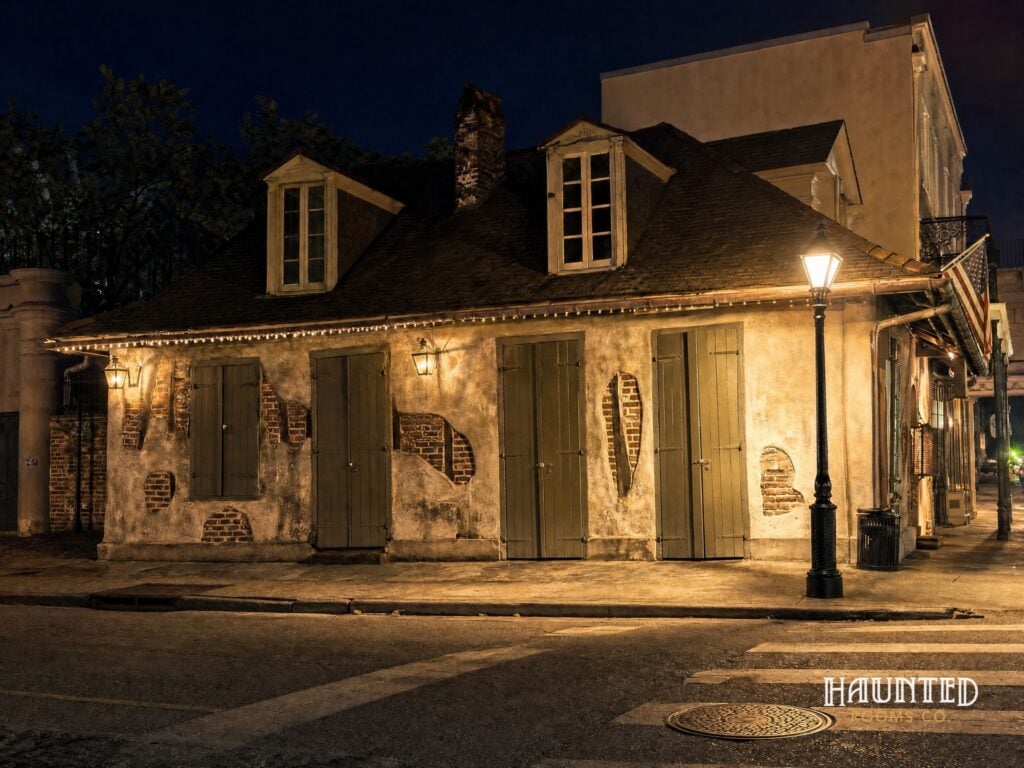
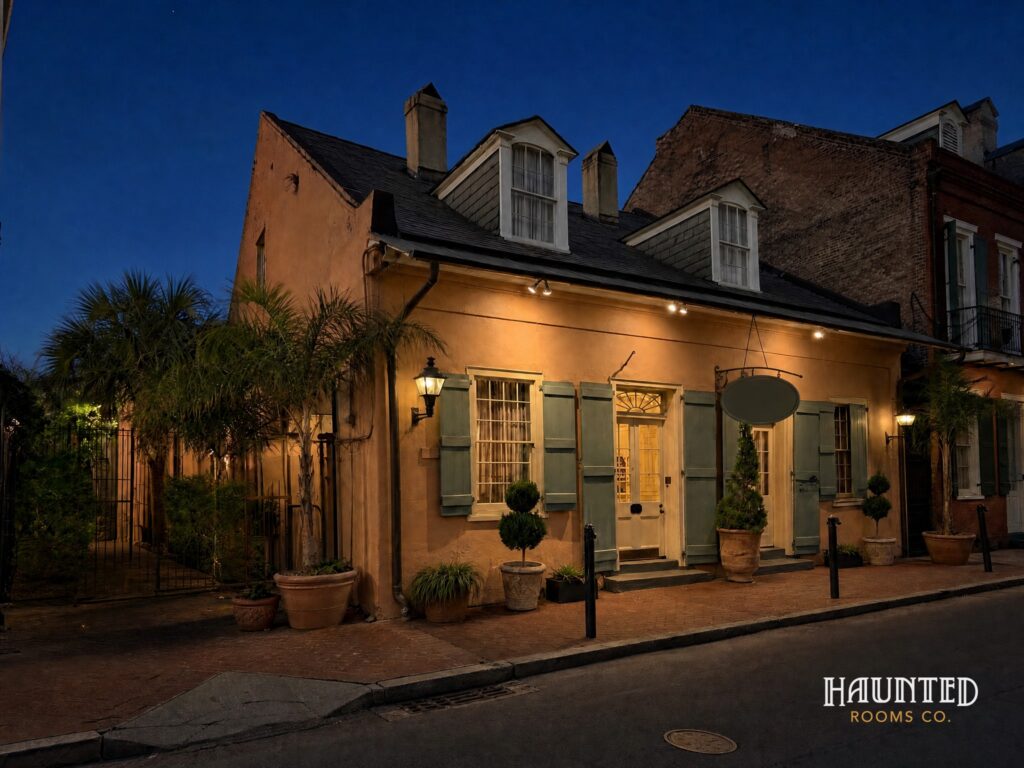
This low, battered cottage on the corner of Bourbon and St. Philip, with soft brick showing through worn plaster, is one of the oldest buildings in the French Quarter and a National Historic Landmark. It was most likely built as a house in the Spanish colonial years, and the bar’s own claim of 1722 is not backed by records. Legend says the privateer Jean Lafitte and his brother Pierre ran a smithy here as a front for smuggling. No document proves it, but the name stuck.
Today it is a dim bar with a piano, and its ghost stories are told over drinks. Regulars describe a man in old sailor’s dress standing by the fireplace in the front room who fades when someone notices him, and a pair of eyes glowing in the dark grate. Upstairs, a woman is said to whisper visitors’ names. Even the ghost tour writers admit none of this ties to a recorded death, so treat it as the bar’s own folklore.
Haunted Rooms tip: Go late in the evening, when the room is at its darkest, and take a seat near the fireplace.
Where to look The back gallery, the courtyard garden and the main hall
Reported ghosts General Beauregard, soldiers in grey, gunfire and shouting at night
Visiting House museum, visited on guided tours
Tours Guided tours on the hour most days except Wednesday; check the website
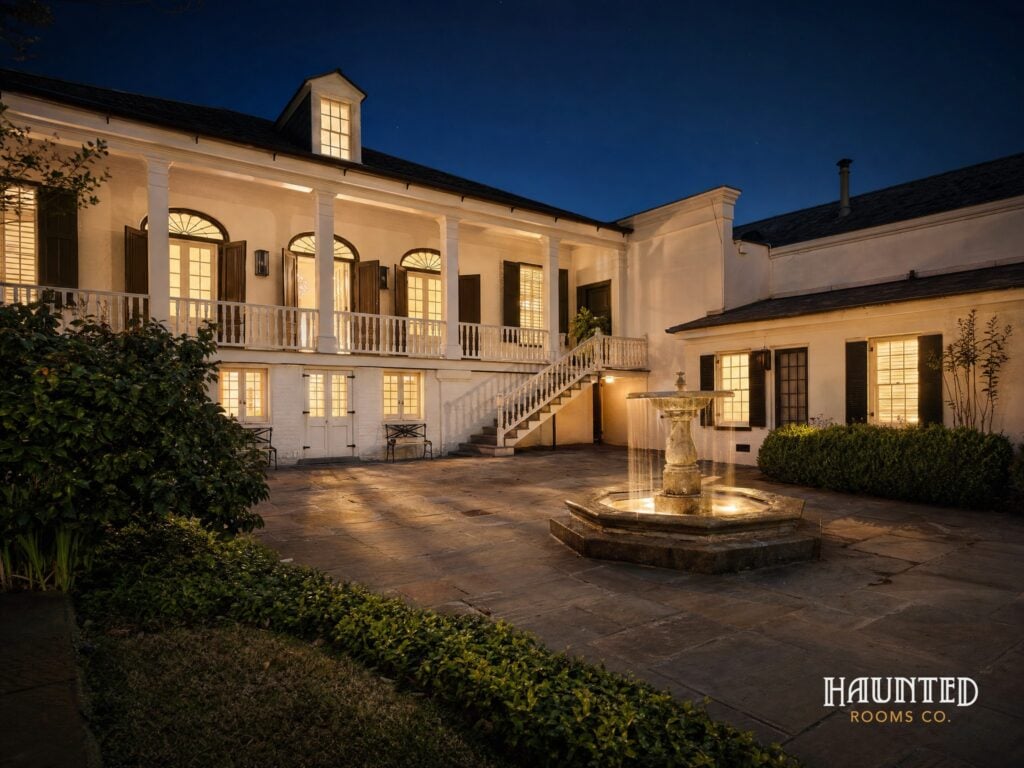
Built in 1826 for auctioneer Joseph LeCarpentier, grandfather of chess champion Paul Morphy, this raised Creole villa across from the Old Ursuline Convent was home to Confederate general P.G.T. Beauregard from 1866 to 1868, and later to novelist Frances Parkinson Keyes, who restored it and its walled garden. It is a National Historic Landmark and runs guided tours.
Its darkest night is on record. Sicilian wine merchants Pietro and Corrado Giacona, threatened by extortionists, invited four of them to dinner and, at about 2 a.m., shot them on the back gallery; three died, and the case was dismissed as self-defense in 1910. Ghost stories add Beauregard himself, whom Keyes wrote of as roaming at night looking for his boots, soldiers in grey who stare and vanish, and the sound of gunfire and shouting.
Haunted Rooms tip: Take the guided tour, then linger in the courtyard garden that Frances Parkinson Keyes restored.
Visiting a haunted place by day is one thing. Investigating one after dark is another. On a Haunted Rooms ghost hunt our team takes you through a historic building with professional ghost hunting equipment, runs EVP sessions and vigils, and gives you time to explore on your own. These are the nearest ones we run.
Where to look The shuttered third-floor windows and the front garden
Reported ghosts The Casket Girls legend of the sealed third floor
Visiting Museum with set opening hours; check before you go
Tours A stop on most French Quarter ghost and vampire tours
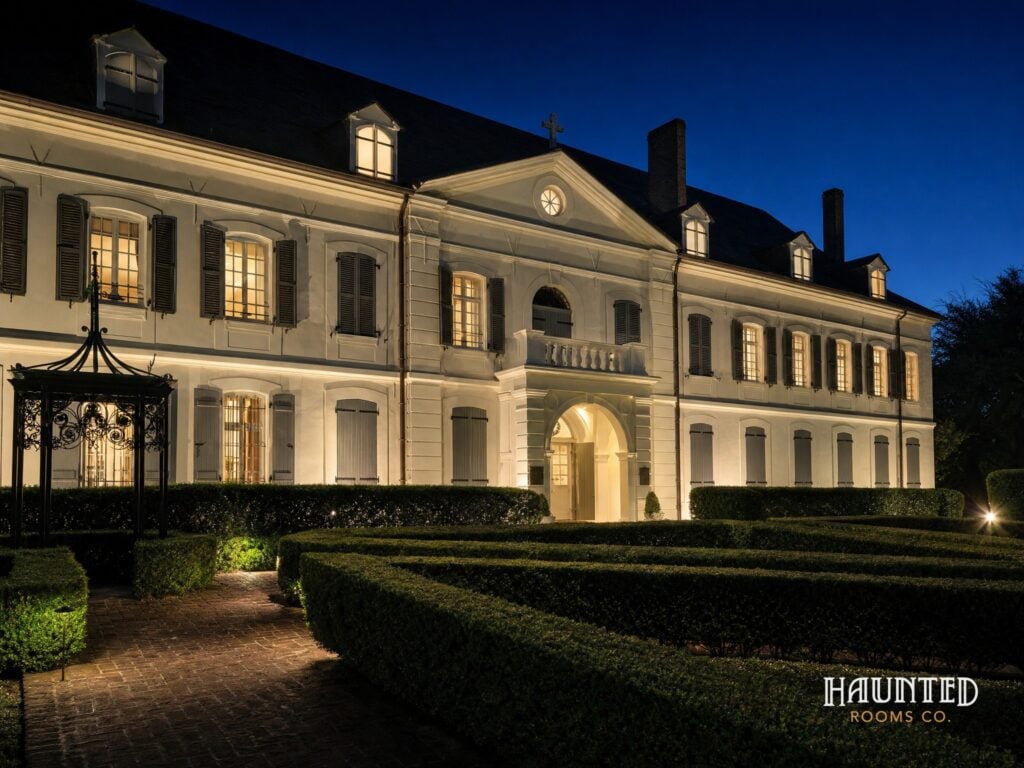
The Ursuline nuns arrived from France in 1727. Their first convent went up in 1734, and the building you see replaced it around 1752, which makes it, by many accounts, the oldest building in the Mississippi Valley. It survived the Great Fire of 1788 because it stood well away from where the fire began. Today it is a museum, set behind a formal boxwood garden on Chartres Street.
Its legend is the Casket Girls, the young French women who came to the colony around 1728 and lodged with the nuns until they married. Their coffin-shaped chests, the story goes, were stored on the third floor and later found empty, so the nuns sealed the floor and nailed the shutters with blessed nails to keep vampires in. The archdiocese’s archivist says the third floor holds archives and storage, the chests were ordinary trunks, and the vampire twist is modern.
Haunted Rooms tip: Look up at the shuttered third-floor windows from Chartres Street after dark; the shutters are modern hurricane shutters, not seals.
Address Jackson Square, Chartres St between St. Peter and St. Ann, New Orleans, LA 70116
Where to look The altar and balconies, and the alley beside the cathedral at dawn
Reported ghosts Pere Antoine, Pere Dagobert
Visiting A working cathedral; visitors welcome outside services
Tours A stop on French Quarter ghost walks
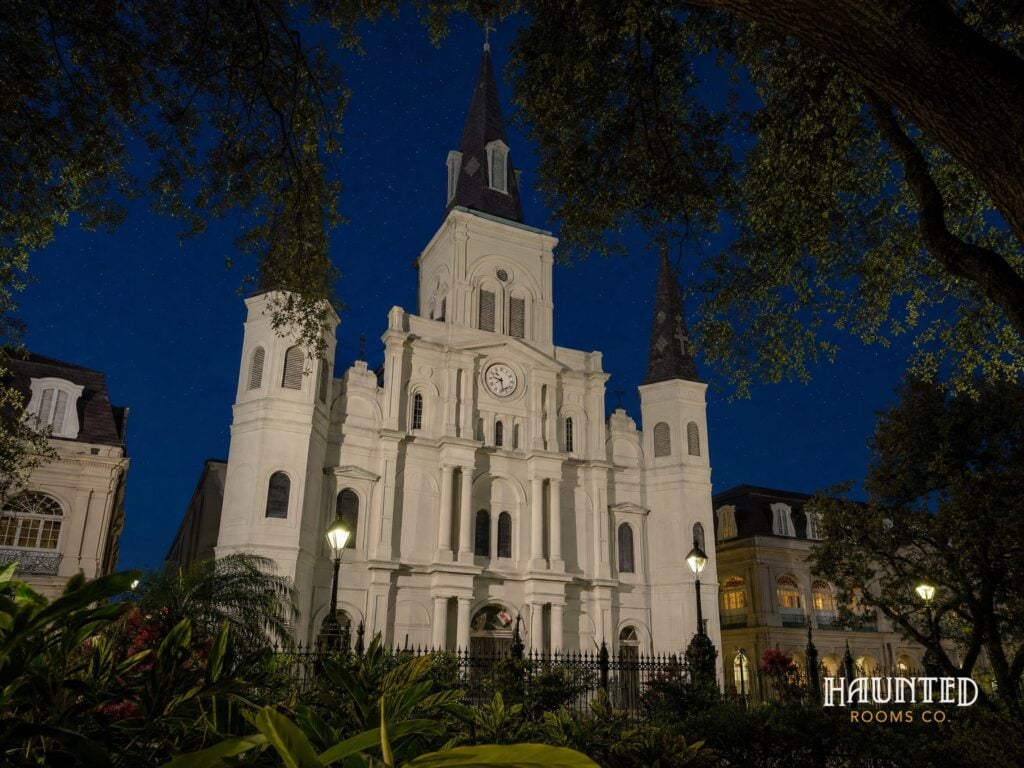
A church has faced the old parade ground, now Jackson Square, since 1718. The Cathedral-Basilica of St. Louis, King of France, is the fourth church on the site: its predecessor was lost in the Great Fire of 1788, the replacement went up from 1789 to 1794, and that church was largely rebuilt in the 1850s into the three-spired cathedral on every postcard. Prominent early residents were buried beneath it.
Its ghosts are clergy. Pere Antoine, a Capuchin friar who arrived in 1774 and was loved for his charity, died in 1829, and people report a robed figure near the altar, on the balconies and in the narrow alley beside the cathedral that bears his name, especially early in the morning. Pere Dagobert, pastor from 1745, is said to walk the aisles on quiet evenings with his head bowed. It is a working church, so visit respectfully.
Haunted Rooms tip: Walk Pere Antoine’s Alley early in the morning, before the square fills, when he is said to appear.
Reported ghosts Jean Lafitte, Andrew Jackson, a woman in a long white dress, a child on the third floor
Visiting A working bar and restaurant, open to the public
Tours A regular stop on French Quarter ghost walks
Two Catalan merchants, Pedro Front and Francisco Juncadella, finished this building at Bourbon and Bienville in 1806 and opened it as a grocery. A bar was running on the ground floor by the 1830s, and by 1869 it was advertising itself as the Absinthe House, where bartender Cayetano Ferrer is credited with the Absinthe Frappé. The absinthe ban of 1912 and Prohibition hit hard: the original bar fixtures left for another club on Bourbon Street and only came home in 2004.
Legend has Andrew Jackson and Jean Lafitte planning the defense of New Orleans here in 1814, and both are named among its ghosts, along with Marie Laveau. Staff and drinkers describe chairs and bottles moving by themselves, doors that swing open, laughter with no one there, a woman in a long white dress and a child running on the third floor. The famous meeting has no record behind it, and neither do the tunnels said to run to Lafitte’s Blacksmith Shop.
Haunted Rooms tip: Order an absinthe frappé at the bar and ask the bartender for the newest story.
Where to look The Seance Lounges upstairs and the Courtyard Bar
Reported ghosts Pierre Antoine Lepardi Jourdan, a glass-throwing spirit in the bar
Visiting A working restaurant and bar
Tours A stop on French Quarter ghost walks
Hours and season Dinner nightly from 5 p.m.; bar from 3 p.m.; weekend brunch
After the Great Fire of 1788, Pierre Antoine Lepardi Jourdan built his home on this corner of Jackson Square. The restaurant’s own history says he loved it, gambled it away in a poker game in 1814, and took his own life on the second floor, in the rooms now called the Seance Lounges, before he had to move out. Muriel’s opened here in 2001 and serves Creole dinners and weekend jazz brunch.
Muriel’s tells the ghost story itself. Jourdan is said to show himself as a sparkle of light upstairs, knocks are heard on the brick walls, and a table is kept set with bread and wine for him. Downstairs, a livelier spirit in the Courtyard Bar is blamed for glasses that fly across the room and shatter, which the restaurant says has happened three times since March 2001.
What investigators report
Staff reserve a table each night in the second-floor seance room for the ghost of former owner Pierre Antoine Lepardi Jourdan, set with an offering of bread and wine. Patrons and employees there have described glasses shattering, objects moving and unexplained voices upstairs.
Where to look The old shop floor and the courtyard
Reported ghosts Dr. James Dupas, moving displays, children in the courtyard
Visiting Museum open to the public
Tours A stop on French Quarter ghost walks
Hours and season Self-guided Tuesday to Saturday, 11 a.m. to 4 p.m.; guided tours at 10 a.m. Thursday to Sunday (seasonal)
Tickets Adults $10 self-guided, $20 guided
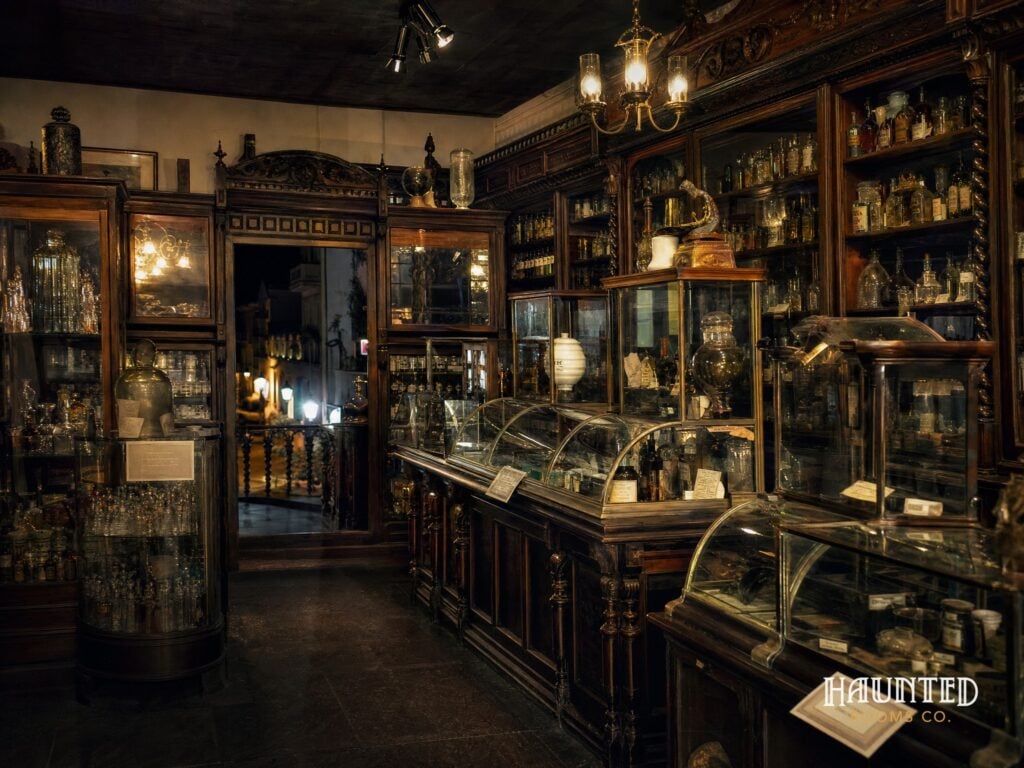
Louis J. Dufilho Jr., often called America’s first licensed pharmacist, qualified in 1816 and ran his apothecary in this Chartres Street building, finished in 1823, until 1855. It has been a museum since 1950, with hand-blown medicine bottles, leech jars, hypodermic needles and bloodletting tools in carved wooden cases.
Ghost stories center on Dr. James Dupas, who later ran the business, and the tale that he experimented on enslaved people, including pregnant women. Historians note there is little or no proof of that, though census records show he enslaved two people. Ghost tour guides still talk of books and displays moving on their own, alarms going off at night, and children seen in the courtyard.
Haunted Rooms tip: Join the 10 a.m. guided tour for the stories behind the strangest objects.
Where to look Upper-floor guest rooms, the seventh floor, the hallways at night
Reported ghosts A helpful ghostly maid, a Confederate soldier, unexplained moans
Visiting A working hotel; book a room to stay the night
The Omni Royal Orleans fills a block of St. Louis Street, a short walk from Jackson Square. It opened in 1960 as the Royal Orleans on the site of the St. Louis Hotel, which the 1915 hurricane wrecked. Before that, the City Exchange on this spot was used for slave auctions until the 1830s, a history the city has never forgotten and many visitors find hard to sit with.
Its best-known ghost is gentle. Historic Hotels of America, which the hotel belongs to, says many accounts describe a maid who walks the halls at night, and one guest woke to find her trying to change the sheets around them. Other guests talk of tucked-in blankets, taps and lights turning on, moans in empty corridors and a uniformed soldier on the seventh floor.
Haunted Rooms tip: Ask for an upper floor and leave the light on if you would rather not be tucked in.
Where to look The upper galleries, the staircase and the courtyard
Reported ghosts A man in robes, harem women at the windows, screams on the stairs
Visiting Private condominiums; view from the street only
Tours A stop on many French Quarter ghost walks (outside only)
This tall corner townhouse at Dauphine and Orleans was built in 1836 for Philadelphia-born dentist Joseph Coulon Gardette and sold in 1839 to planter and banker Jean Baptiste Le Prête, who added its lacy cast-iron galleries. When Le Prête’s fortune collapsed after the Civil War, the bank took the house. It later held apartments and an art academy, and since 1966 it has been private condominiums.
It is better known as the Sultan’s Palace. The story says the brother of a Turkish sultan rented the house with a harem, and that everyone inside was murdered one stormy night, the sultan buried alive in the courtyard. No newspaper or police record of any massacre has been found, and the tale seems to grow from older legends retold in a 1922 book. Residents have still reported a robed man beside their beds, footsteps, flute music and screams on the stairs.
Haunted Rooms tip: This is a private home. Admire the ironwork from across the street and keep your voice down.
Where to look The lobby and elevators, Room 221, Room 930 on the ninth floor and Rooms 301 and 302
Reported ghosts Ada (also called Eva or Ava), a 1920s couple, a third-floor prankster
Visiting A working hotel; book a room to stay the night
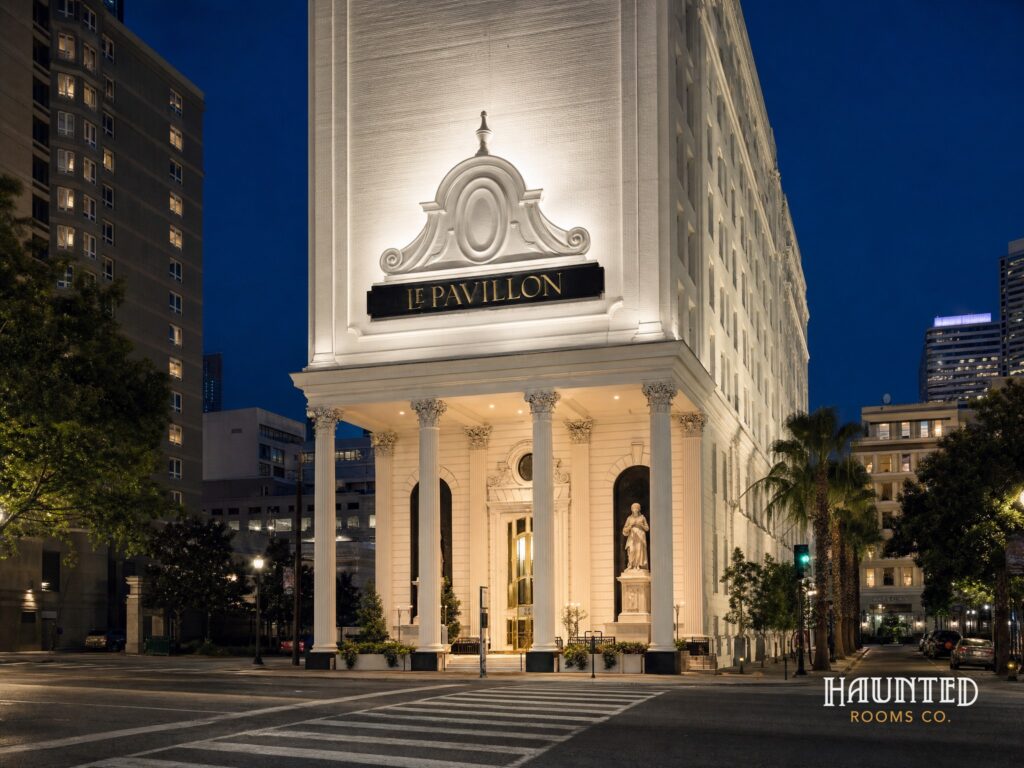
Le Pavillon opened in January 1907 as the New Hotel Denechaud, became the DeSoto Hotel a few years later and took its current name after a 1970s revival. Its columned Poydras Street portico, crystal chandeliers and late-night peanut butter and jelly sandwiches make it one of the city’s best-loved grand hotels. A $19 million renovation has since brought it into Marriott’s Tribute Portfolio.
It is also one of the most reported haunted hotels outside the French Quarter. The best-known ghost is a young woman called Ada, Eva or Ava, said to have been struck by a carriage on Poydras Street and seen near Room 930. Guests also describe a smartly dressed 1920s couple who stroll into the elevators and vanish, and a prankster on the third floor who pulls sheets off beds.
Haunted Rooms tip: Come down to the lobby in the evening for the free peanut butter and jelly sandwiches, then keep an eye on the elevators.
Where to look Room 208, the second floor, the courtyard and Rooms 107 and 109
Reported ghosts Five boys from a 1790s boarding school, a boy called Armand, a housekeeper, Andrew Jackson
Visiting A working hotel; book a room to stay the night
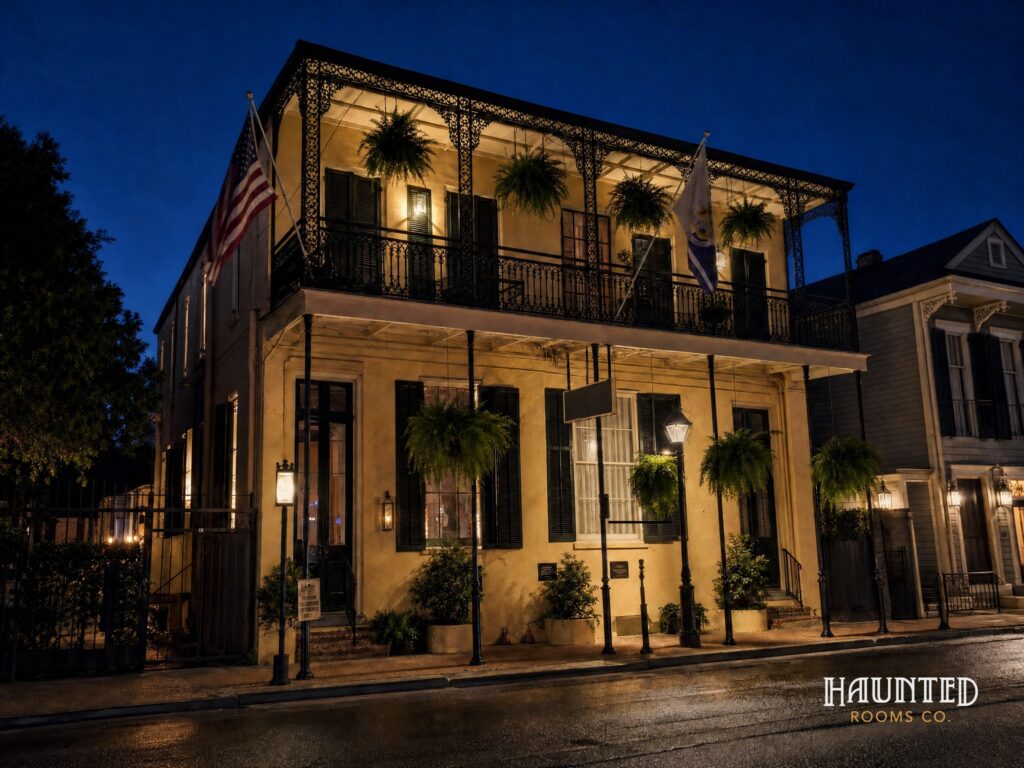
This small Royal Street hotel stands on the lot of the old federal courthouse where General Andrew Jackson was fined $1,000 for contempt of court in 1815, weeks after the Battle of New Orleans. The courthouse came down in the late 1880s and the present two-story brick building, with its iron gallery and Creole courtyard, replaced it. Local legend says a boys’ boarding school stood here earlier and burned in the great fire of 1794.
Those boys are the hotel’s best-known ghosts. Guests report children laughing in the courtyard at night, a boy sitting in front of a TV that switched itself on, and covers tugged off beds. Room 208 is the room people ask for, linked to a boy remembered as Armand. A tidy-minded housekeeper and, some say, Old Hickory himself complete the cast.
Haunted Rooms tip: Ask for Room 208, or a second-floor room off the courtyard, when you book, and take a coffee out to the courtyard after dark.
Where to look The 500 Building, its second-floor elevator landing, guest-room beds
Reported ghosts Wounded soldiers and army surgeons, a young woman who nursed the sick
Visiting A working hotel; book a room to stay the night
The family-run Hotel Provincial is a cluster of restored Creole townhouses and courtyards on Chartres Street, a few steps from the Old Ursuline Convent. Its buildings are on the National Register of Historic Places, and the land was once part of the French colony’s Royal Hospital grounds and herb garden. The hotel itself says one building stands where a military hospital once stood.
That is Building 500, the heart of its ghost stories. Guests describe walking in to see wounded soldiers moaning on the beds, who vanish when the lights go on, and bloodstains that appear on sheets and fade away. One famous story says the elevator opened on the second floor onto a full hospital ward.
Haunted Rooms tip: Ask for a room in the 500 Building when you book.
Where to look Room 21, the mirror outside Room 21, the second-floor hallway
Reported ghosts Marie, a young daughter of the Gleises family, and her grieving mother
Visiting A working hotel; book a room to stay the night
Built in 1849 as the family home of Paul Gleises, the Lafitte Guest House is a three-story Creole mansion with lacy cast-iron galleries at the quiet, residential end of Bourbon Street. It has just 14 rooms, filled with antiques, and some booking sites now list it as Lafitte Hotel & Bar.
Its ghost story centers on Room 21. Local legend says a young daughter named Marie died in the house, possibly of yellow fever, and that her mother never recovered and died in the same room. Guests report crying and sobbing in Room 21, and a little girl seen in the mirror outside it.
Haunted Rooms tip: Room 21 is the one to ask for. Call the hotel directly to request it.
Where to look May Baily's Place bar, the courtyards, the Hermann House rooms
Reported ghosts Millie the phantom bride, a Confederate officer, bar pranksters
Visiting A working hotel; book a room to stay the night
The Dauphine Orleans is a cluster of Creole buildings one block from Bourbon Street, and the hotel tells its ghost stories itself. Its bar, May Baily’s Place, takes its name from one of the city’s early licensed bordellos, which the hotel says ran here in the mid to late 1800s. Hotel tradition also says John James Audubon worked on Birds of America in what is now the breakfast room.
The famous ghost is Millie, said to be May Baily’s sister, whose Confederate fiance was shot in a gambling brawl on their wedding day. Guests say they see her in a lace gown near the bar. Others report a uniformed officer pacing the courtyard, glasses sliding off the bar, a barstool lifting off the floor and televisions flicking on by themselves.
What investigators report
A ghost hunting group investigating Suite 110 reported a temperature drop on their probe near a corner closet, and another team picked up electromagnetic activity in the same spot.
Where to look The memorial plaque in the sidewalk and the Jimani bar below
Reported ghosts Victims of the 1973 fire
Visiting The Jimani Lounge is a working bar; the upper floors are closed
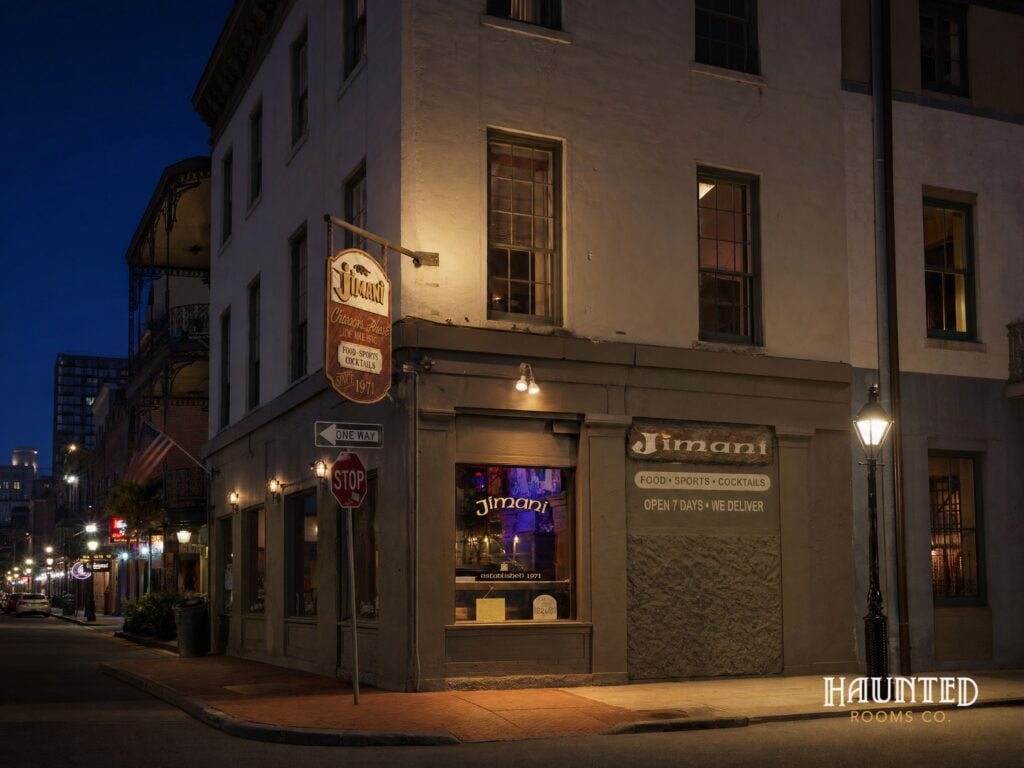
On the evening of June 24, 1973, an arson fire swept through the UpStairs Lounge, a gay bar on the second floor of this building at Chartres and Iberville. Thirty-two people died, making it the deadliest fire in New Orleans history. No one was ever convicted, and for years the city barely acknowledged the loss. The Jimani Lounge, which has run on the ground floor since 1971, is still open; the floors above are used for offices and storage or stand empty.
A memorial plaque set into the sidewalk in 2003 was stolen in April 2024 and replaced in June 2025, on the eve of the 52nd anniversary. Patrons of the Jimani have long said they feel a presence here, and the TV series Ghost Hunters filmed at the bar looking for the victims. If you come, come to remember the 32. This is a memorial first.
Haunted Rooms tip: Pause at the memorial plaque in the sidewalk before you go in.
Where to look The balcony, the courtyard windows and backstage
Reported ghosts The Captain on the balcony, a young woman in white often called Caroline, a man in a dark suit
Visiting A working theater; see it on show nights
Tours A stop on French Quarter ghost walks
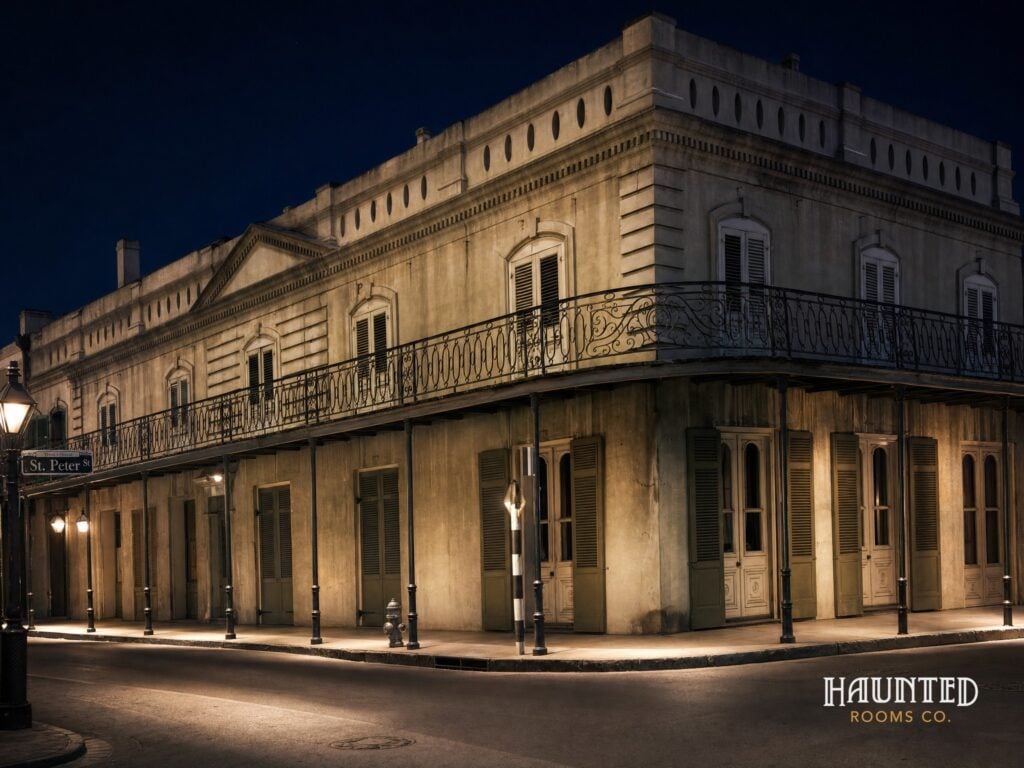
Le Petit Theatre, on St. Peter Street beside Jackson Square, has staged plays here since 1922 and is often called the oldest community theater in continuous use in the country. The 324-seat house still runs a full season of plays and musicals, and parts of the building are much older than the company.
Its ghosts are company lore. Technical director John Grimsley told The Advocate in 2025 that he saw a man in a captain’s hat watching builders from the balcony, and then no one; longtime staff said he was a former patron. Theater legend also tells of a young woman in a white gown, often called Caroline, seen behind the courtyard windows, said to have fallen to her death during a wedding reception, and of a man in a dark suit in the wings.
Haunted Rooms tip: See a show, and arrive early enough to look up at the balcony before the lights go down.
Where to look The Peyroux House rooms, the carriage house, the main entrance
Reported ghosts An 18th-century carriage master, heavy footsteps, a Confederate soldier
Visiting A working hotel; book a room to stay the night
Hotel St. Pierre is a budget-friendly group of Creole cottages and courtyards at Burgundy and Dumaine, with two small pools. Its oldest building, the Gabriel Peyroux House, dates to about 1780 and is one of the few survivors of the city’s early French colonial building style. The jazz museum that opened next door at 1017 Dumaine in 1961 was described as the first in the world.
Ghost City Tours says the Peyroux House is where guests feel icy hands and a weight at the foot of the bed. Staff say footsteps are the most common report, including heavy steps above a carriage house room when no one was staying overhead. A man in a blue shirt and black boots, said to be the family’s old carriage master, is seen near the entrance.
Haunted Rooms tip: Ask for a room in the Peyroux House when you book; it is a request, not a guarantee.
Address Washington Ave, across from Commander's Palace, Garden District, New Orleans, LA 70130
Where to look The central aisles and the old society tombs
Reported ghosts Yellow fever victims, Civil War soldiers
Visiting Guided tours only since reopening in October 2026
Tours Tours of 75 to 90 minutes, booked through the Preservation Resource Center (prcno.org)
Ghost hunting No ghost hunting; history tours only
Laid out in 1833 for the old City of Lafayette, now the Garden District, this walled city block holds about 1,100 family tombs and some 7,000 burials, and it filled fast during the yellow fever years. Its tombs have appeared in Interview with the Vampire, Double Jeopardy and The Originals. The city closed it in 2019 over vandalism, crowding and repairs, and it reopened on October 1, 2026 for small guided tours only.
Ghost tour writers say yellow fever victims and Civil War soldiers walk here, and visitors describe a feeling of being watched among the tombs. Anne Rice fans come looking for her fictional Mayfair witches. The new tours, run with the Preservation Resource Center, stick to history and take no more than 16 guests, so come for the stories in the stone rather than a ghost hunt.
Haunted Rooms tip: Book a Preservation Resource Center tour well ahead: there are no walk-ups and groups are capped at 16.
Where to look The hallways of the main house, the courtyard, guest rooms in the side buildings
Reported ghosts A woman in red, children heard laughing, a mother searching for them
Visiting A working hotel; book a room to stay the night
The Lamothe House is a circa 1839 Creole double townhouse on oak-lined Esplanade Avenue, at the quiet downriver edge of the French Quarter. It is listed on the National Register of Historic Places, and its five Grand Antique Suites keep the original high ceilings, cypress floors and antiques, around a flagstone courtyard and pool.
Its ghost stories are quieter than the big Quarter hotels, but persistent. Guests describe a woman in a red dress who steps out of a room and vanishes, children laughing late at night, and a woman walking the halls as if looking for them. Online guest reports also mention lights switching on by themselves and toys rattling.
Haunted Rooms tip: Ask for one of the Grand Antique Suites in the 1839 main house, where the house’s story began.
Where to look Courtyard rooms, upper hallways, empty rooms
Reported ghosts A girl looking for her grandmother, a bearded man in colonial dress
Visiting A working hotel; book a room to stay the night
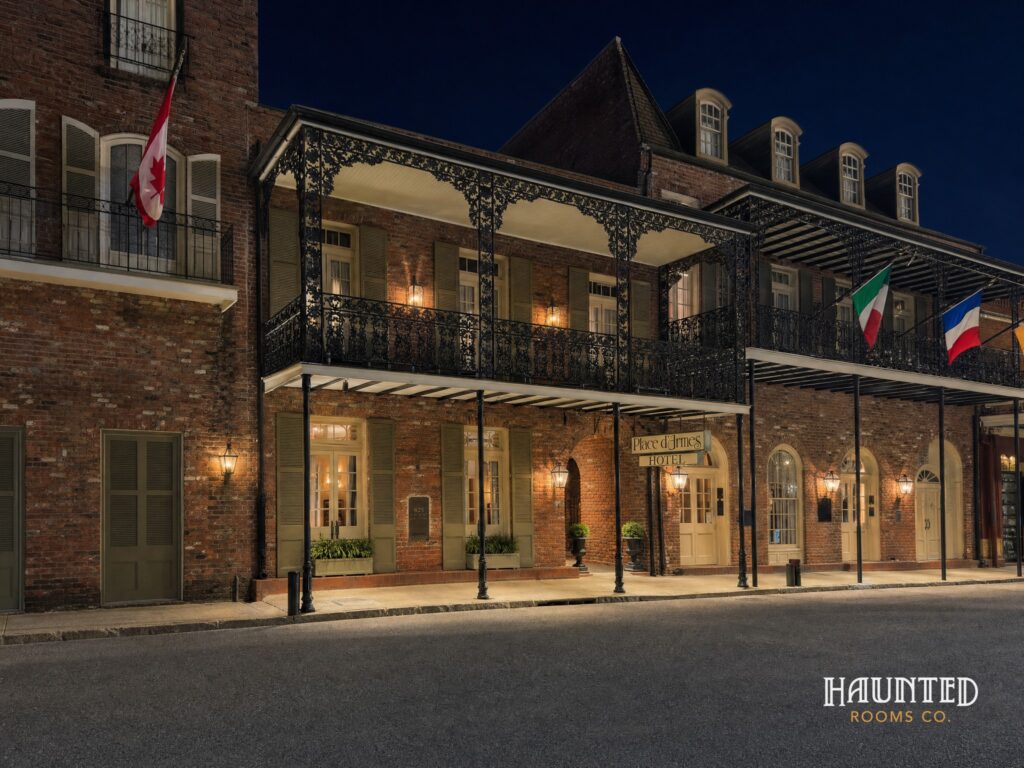
The Place d’Armes Hotel sits just off Jackson Square, a block from Cafe du Monde, in restored 18th and 19th century buildings around shady courtyards and a pool. The name comes from the old parade ground in front of St. Louis Cathedral, the colonial Place d’Armes. It is one of the best-placed hotels in the Quarter for a first visit.
Ghost bloggers and French Quarter tour guides say a school once stood here and burned in the Great Fire of 1788, killing the headmaster and several pupils. Guests report footsteps, voices and laughter from empty rooms, furniture moved overnight, a little girl in old-fashioned clothes who asks where her grandmother is, and an old bearded man in 18th-century dress who nods politely and fades away.
Haunted Rooms tip: Book a courtyard room and take a late walk around Jackson Square, a one-minute stroll away.
Address 3811 St. Charles Ave, New Orleans, LA 70115
Where to look Room 10, the third floor near Room 21, the ballroom, the grand staircase
Reported ghosts A courteous ghostly host, a sick little girl, a woman in white
Visiting A working hotel; book a room to stay the night
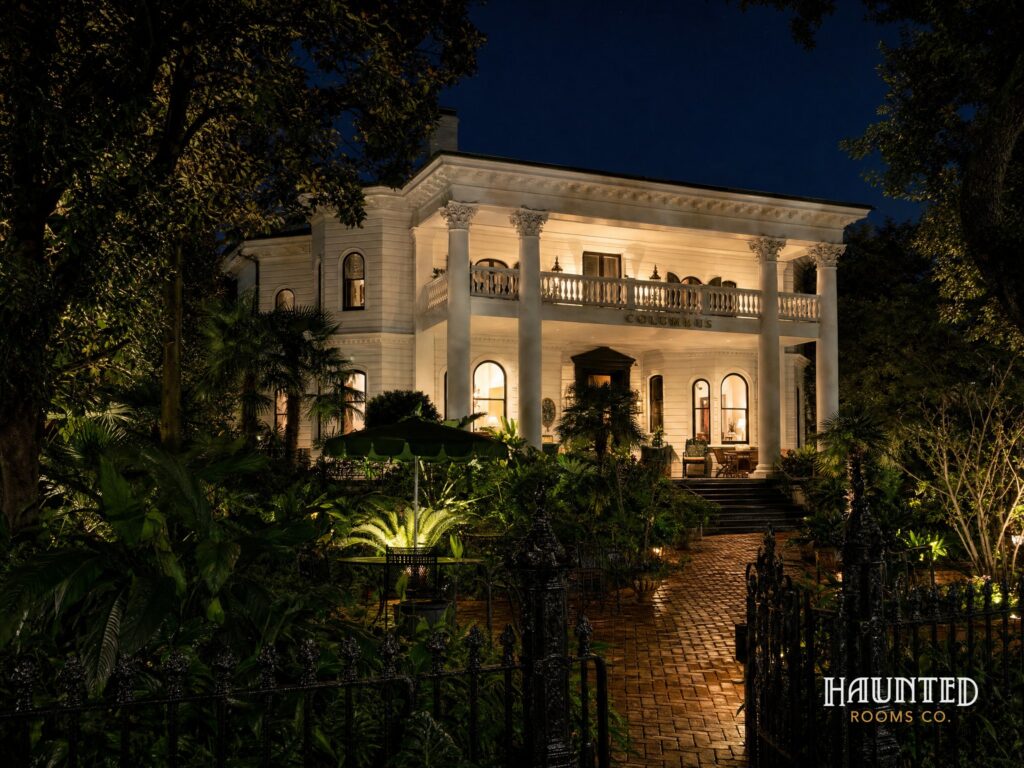
Out on St. Charles Avenue, on the streetcar line, The Columns is an 1883 Italianate mansion designed by Thomas Sully for tobacco merchant Simon Hernsheim. It became a boarding house around World War I and a hotel in 1953, played a bordello in the 1978 film Pretty Baby, and is on the National Register of Historic Places. Its porch bar is a local favorite.
Ghost City Tours collects the stories: a well-dressed gentleman who appears at guest room doors offering help, then vanishes; a little girl who looks ill on the third floor near Room 21; and a woman in a long white dress drifting across the old ballroom. Room 10 is the one people ask for, with a woman seen sitting on the bed, cold spots and a toilet that flushes by itself.
Haunted Rooms tip: Ask for Room 10 when you book, then have a drink on the front porch as the streetcars pass.
Where to look The courtyard, the small bar, bedroom mirrors
Reported ghosts Spanish soldiers in uniform, a dark gray figure, small handprints
Visiting A working hotel; book a room to stay the night
Le Richelieu is a small, 88-room hotel in the quiet residential end of the French Quarter, a few blocks from the Old Ursuline Convent. It is made up of two buildings around a courtyard with a saltwater pool, and it is one of the few Quarter hotels with its own parking. SmarterTravel notes that Paul McCartney once lived here for a few months.
Its ghost story is a local legend: a band of Spanish soldiers is said to have been executed on this ground, and guests describe men in full uniform marching through the courtyard or standing in the bar. Culture Trip adds child-sized handprints that appear on mirrors and a dark gray figure seen in bedrooms. We know of no record of executions here, so treat it as a story.
Haunted Rooms tip: Sit out in the courtyard late in the evening, where the soldiers are said to march.
Where to look The courtyard, especially its far corner, and the guest rooms off the galleries
Reported ghosts Stories of the Axeman of New Orleans and of past murders on the property, told by the hotel itself
Visiting Hotel guests only; book through Booking.com or the hotel
The Haunted Hotel is a small guesthouse at 623 Ursulines Avenue in the French Quarter, a few blocks from Jackson Square, with rooms off two levels of galleries around a brick courtyard. It sells itself on its ghosts: the hotel says the building dates from 1829 and has seen a string of murders, and guests come here specifically hoping for a sighting.
Treat the stories with care. The hotel’s own telling links the property to the Axeman, the unknown killer who attacked people across New Orleans in 1918 and 1919, and says the courtyard corner is where activity is strongest. The local ghost researcher behind Southern Spirit Guide notes that a famous ghost tale has been attached to this address for nearly a century but may be mostly fictional. The building was also listed for sale in March 2026, so check that it is still taking guests before you plan around it.
Haunted Rooms tip: Book a room that opens onto the courtyard and spend some time out there late at night, which is where the hotel says guests notice the most.
These places appear in older lists of haunted spots. We keep them here so you know the facts before you go, but you cannot (or should not) visit them.
Charity Hospital, New Orleans
The huge 1939 Art Deco hospital on Tulane Avenue flooded in Hurricane Katrina in August 2005 and never reopened. Historians who worked with the makers of the film Renfield told them the building had a long haunted reputation, and urban explorers have been drawn to it for years. Do not try to get in: it is owned by LSU and is part of a long-delayed redevelopment into apartments and space for Tulane University, with completion expected in 2027.
Six Flags New Orleans (Jazzland)
Opened as Jazzland in 2000 and closed for good after Hurricane Katrina left it under several feet of water in 2005, the park became a famous abandoned site, and police arrested trespassers for years. It is gone now: demolition began in late 2024 and the park structures were cleared by March 2026 for the Bayou Phoenix redevelopment. There is nothing left to see, and the site is still off-limits.
Changed from our older guide: the LaLaurie Mansion was rebuilt after the 1834 fire and is a private home, and the most extreme torture tales trace to a 1946 book, not to records. The Sultan’s Palace massacre has no record behind it. The Jimani is the bar below the site of the 1973 UpStairs Lounge fire, not the same bar. Muriel’s story is the restaurant’s own; it says Jourdan lost the house in 1814. We dropped claims we could not trace, including Andrew Jackson’s ghost being seen at the Old Absinthe House as fact and Dr. Dupas experimenting on enslaved people. New in this update: the Old Ursuline Convent, St. Louis Cathedral, Lafayette Cemetery No. 1, Le Petit Theatre and twelve more haunted hotels.
Visited one of these places? Tell us what happened
We collect first-hand accounts from visitors and add the best ones to our guides, with your first name and the date of your visit. We read every story before it’s published.
Frequently asked questions
What is the most haunted place in New Orleans?
The LaLaurie Mansion at 1140 Royal Street is the name most people give, because its story is rooted in a real 1834 fire that exposed the torture of enslaved people. St. Louis Cemetery No. 1, with Marie Laveau’s tomb, and the Hotel Monteleone are close behind.
Can you go inside the LaLaurie Mansion?
No. It is a private home, and no tours or paranormal groups are allowed inside. You can see it from the sidewalk at Royal and Governor Nicholls streets, and nearly every French Quarter ghost walk stops outside. See our full LaLaurie Mansion guide.
Can you visit Marie Laveau's tomb?
Yes, but only on a guided tour. Since March 2015 the Archdiocese has allowed the public into St. Louis Cemetery No. 1 only with official licensed guides, after years of vandalism. Tours of about 45 minutes leave from the Basin St. Station visitor center, and you must not mark the tomb or leave offerings.
Is Lafayette Cemetery No. 1 open?
Yes, again. The Garden District cemetery closed to visitors in 2019 and reopened on October 1, 2026 for small guided tours run with the Preservation Resource Center, with no more than 16 people and no walk-ups.
Which New Orleans hotels are haunted?
The Hotel Monteleone, Bourbon Orleans, Le Pavillon, Andrew Jackson Hotel, Hotel Provincial and Lafitte Guest House are the best known, and all are open to book. See our guide to haunted hotels in New Orleans for the rooms to ask for.
Are New Orleans ghost tours worth it?
They are the easiest way to hear the stories at places you cannot go inside, such as the LaLaurie Mansion and the Sultan’s Palace. Expect legend mixed with history; this guide tells you which parts are on record.
Sources and how we research
Every place in this guide is checked against its official website, historic register listings and news coverage, and we confirm whether it is open, closed, private or gone before we list it. Ghost stories are reported as staff, visitors and local historians tell them; we say so where records contradict a story. Each place shows how many independent sources we checked it against; our own Haunted Rooms pages are not counted.
New guides, haunted places to visit and ghost hunt dates near you. No spam, unsubscribe any time.
About the authors
The Haunted Rooms Team runs public ghost hunts and overnight investigations at historic venues across the United States. We research every place in our guides using official sites, historic registers, local archives and news coverage, and we report ghost stories as the stories they are. We review each guide regularly so you are not sent to a place that has closed, changed hands or banned visitors. Spotted something out of date? Let us know.